


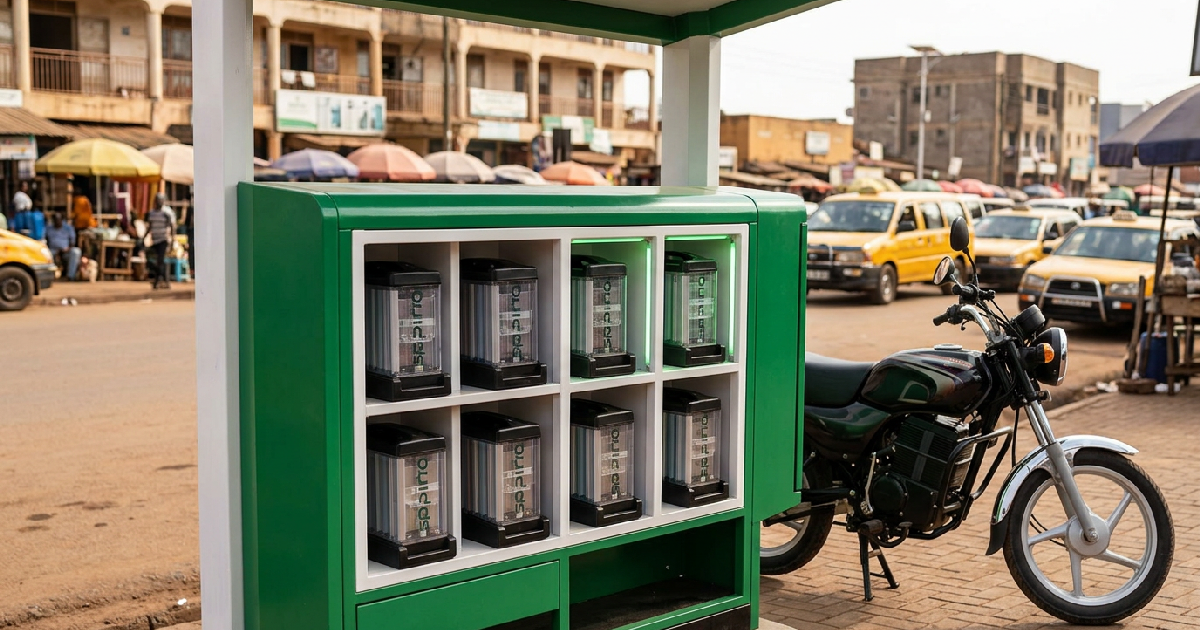
Spiro co-founder and chairman Gagan Gupta announced a $215 million funding round on June 1, 2026, marking a shift for the electric mobility company as it redirects capital toward large-scale battery-swapping infrastructure. The equity raise, led by Impact Fund Denmark and Equitane, brings the startup’s total debt and equity financing to more than $500 million.
This capital injection is earmarked to expand battery capacity and roll out additional swap stations across the seven African countries where the Dubai-headquartered firm currently operates.
The move clarifies the priorities of what is currently the most-funded electric vehicle (EV) startup in Africa. While the company led by CEO Kaushik Burman continues to generate the majority of its revenue from vehicle sales, the leadership team is increasingly focused on the recurring, high-margin potential of energy services.
By building a dense network of stations, the firm aims to address “rider anxiety,” a critical barrier for commercial motorcycle operators who cannot afford downtime during their work shifts.
This industrial-scale approach to energy infrastructure responds to a tightening investment environment where backers demand evidence of sustainable revenue. In markets like Kenya or Uganda, boda boda operators typically earn between $10 and $15 per day, with fuel consuming 40% to 60% of that income.
The ability to offer a reliable, cheaper alternative is the primary driver of adoption, potentially saving riders up to $2 daily. The latest funding will allow the firm to deepen its presence in existing markets rather than chasing growth in new territories.
Engineering a distributed energy utility network
The company is no longer positioning itself solely as a motorcycle manufacturer but as a distributed clean-energy utility. This strategy relies on the compounding nature of energy demand. Every motorcycle sold represents a permanent customer for the battery-swapping network, creating a predictable revenue stream that mirrors traditional utility models.
Gupta noted that as fleet density increases, the business economics shift from one-off sales to continuous service provision.
To support this transition, the firm has heavily invested in its technical capabilities, employing over 150 engineers and securing more than 30 proprietary patents. These technical resources managed the acquisition of Coexlion, a UK-based engineering and design firm, in May 2026 to enhance the company’s internal research and development. This focus on com/african-iot-sector-growth-industrial-impact/”>African IoT sector growth through industrial connectivity allows the firm to monitor battery health and station performance in real-time across its 2,500 deployed swap stations.
Beyond motorcycles, the company is preparing to open its infrastructure to third-party partners. This move would allow other manufacturers or industrial users to utilise the established battery network, further diversifying the revenue mix. By modularising its energy delivery system, the startup is essentially building the backbone of electric mobility for the continent.
This shift mirrors how other manufacturers pivot to Manufacturing Execution Systems to gain better control over distributed assets and regional production hubs.
Localising the supply chain and manufacturing
A significant portion of the $215 million funding is allocated to supporting the localisation of manufacturing. The company already operates vehicle assembly facilities in Kenya, Rwanda, and Uganda, alongside a battery recycling plant in Nigeria. Localising these operations is a strategic hedge against supply chain disruptions and aligns with government priorities for industrial growth.
These facilities are critical for maintaining the rollout of the Ekon electric bike, currently priced at approximately $1,500.
Local assembly reduces the freight costs and high import duties often associated with completely built units. By moving toward semi-knocked-down or completely knocked-down kits, the company can better integrate local labour and materials. This depth of engineering is becoming a standard for firms operating at scale in the region.
For those interested in the fundamentals of mechanical builds, the process of assembling such hardware is as rigorous as the work of experts like Patrick Faulkner and Ed Hodges when building robots for competitive environments.
The scale of the company’s operations as of June 2026 is substantial, with over 100,000 electric vehicles deployed and more than 30 million battery swaps completed to date. These operations have translated to more than one billion kilometres of CO2-free travel.
The environmental benefit is matched by an economic one; riders can reduce daily mobility costs by up to 40% by switching from petrol-powered bikes to the electric alternative.
Secured energy infrastructure as a competitive moat
In the competitive e-mobility landscape, the ability to build and maintain the physical infrastructure of swapping stations acts as a formidable moat.
Competitors like Ampersand and Roam have raised $43 million and $32 million respectively, yet the volume of Spiro’s half-billion-dollar financing allows it to build infrastructure at an order of magnitude higher than its peers. This capital advantage is crucial for overcoming the “chicken-and-egg” problem where riders require stations before committing to a vehicle.
The company’s focus on the battery-swapping model addresses the specific technical constraints of the African power grid. Instead of relying on slow, home-based charging that could strain local transformers, the centralised swap stations can manage load more effectively. Many of these stations are now integrating solar power and battery energy storage systems to ensure reliability in areas with unstable grid connections.
Looking ahead, the company plans to move into the Democratic Republic of Congo and Ethiopia, markets with high motorcycle density and urgent needs for transport modernisation. This expansion aligns with a broader trend of African nations looking to reduce their reliance on expensive fuel imports.
By establishing local manufacturing and recycling facilities, the company is embedding itself into the industrial policy of its host nations. The success of this infrastructure-first approach will likely determine the benchmark for mobility startups across the continent.
