


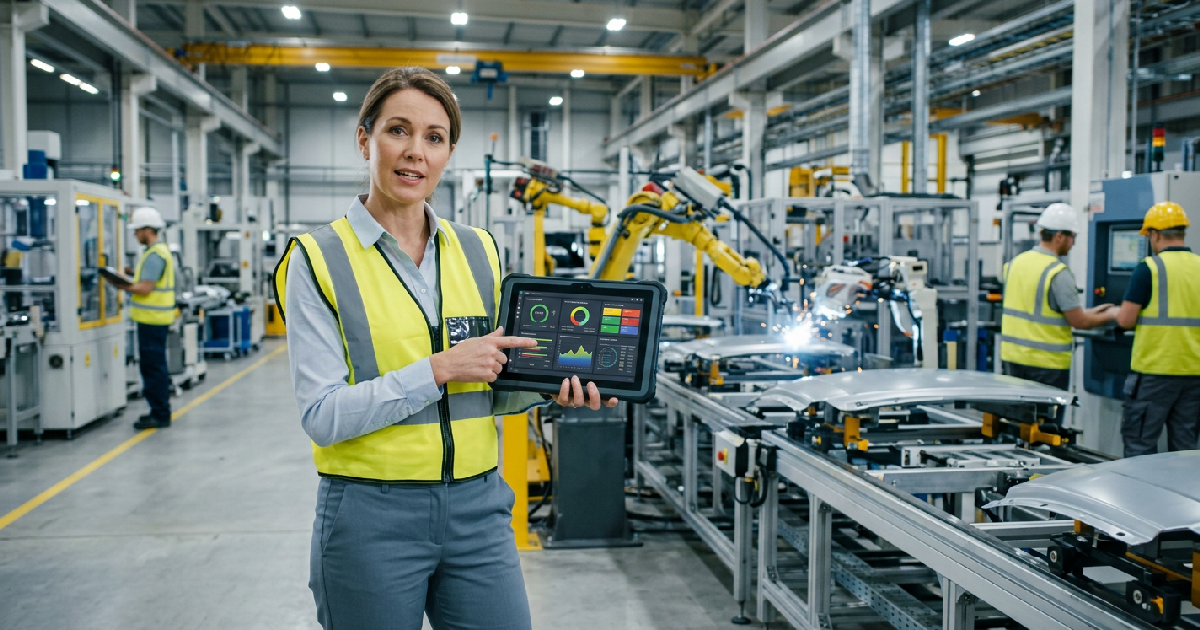
Manufacturers are repositioning the Manufacturing Execution System (MES) as a strategic lever to combat labour shortages and rising quality demands, moving away from high-cost installations that historically lacked flexibility. Industrial leaders are now prioritising these systems over traditional Enterprise Resource Planning (ERP) and analytics to provide a foundation for adaptable production lines. According to recent findings from ABI Research, MES and Manufacturing Operations Management (MOM) software now rank at the top of technology priorities for global manufacturers.
The refocus on execution-layer technology comes as plants struggle with a persistent lack of skilled personnel. While a software system cannot replace a human operator, a modern MES simplifies complex everyday processes, making it easier for new hires to reach full productivity while preserving the institutional knowledge of experienced staff. This shift is particularly evident in sectors like aerospace, automotive, and medical devices, where failures have increased the pressure to build quality into every manufacturing step.
Isabel Lopes, Business Developer Manager at Critical Manufacturing, stated that “Digital transformation doesn’t start with algorithms— it starts with architecture.” This perspective highlights a change in how engineers view the shop floor: as a hub for intelligent action rather than just a place where parts are made. By integrating machine signals and operator input, companies adopting these systems are seeing operational efficiency improvements ranging from 15% to 20%.
Strategic lever for industrial productivity and quality
Modern manufacturing demands a level of agility that older, “heavy” systems simply cannot provide. Past MES projects often burned through budgets and took years to deploy, resulting in static software that hindered rather than helped when market demands shifted. Today, the focus has moved toward modular platforms that allow engineers to start with specific needs, such as industrial connectivity or traceability, and expand as those requirements grow.
The introduction of low-code and no-code tools has significantly changed the power dynamic on the factory floor. Instead of waiting for central IT departments to update a workflow, operations teams can now tweak dashboards and applications themselves. This autonomy reduces IT backlogs and ensures that the software evolves at the same speed as the production hardware it monitors.
Beyond simple efficiency, the strategic value of an MES lies in its ability to ready a facility for Artificial Intelligence. AI models require structured, reliable data to be effective, and the execution layer provides exactly that foundation. Without this, the vast amounts of data generated by machines remain siloed and useless for predictive maintenance or root-cause analysis.
Cloud versus on-premise deployment strategies
One of the most immediate decisions for operations managers is whether to host their MES in the cloud or keep it on-site. Cloud-based MES solutions are gaining traction among companies that want to offload the burden of server maintenance and software updates to the provider. This approach supports faster scaling across multiple sites and reduces the strain on internal technical teams.
However, many industrial facilities still prefer the absolute control of on-premise systems for critical local processes. The emerging standard is a hybrid model where certain sensitive or high-speed operations remain local, while data analytics and multi-site management shift to the cloud. This flexibility prevents manufacturers from being locked into a single infrastructure strategy as they grow.
Reliable infrastructure remains the backbone of these digital efforts, especially in developing industrial markets. Ensuring that data can flow without interruption is as vital as the software itself, a challenge often seen when infrastructure reliability impacts broader digital systems and industrial output.
Measurable gains in compliance and traceability
The impact of a well-deployed strategic lever is most visible in compliance and waste reduction. Data from PwC indicates that compliance rates can increase by 20% following an MES implementation. For global brands, the results are even more specific; Nestlé reported a 30% improvement in traceability metrics after refining its execution systems to better monitor shop floor events.
Traceability is no longer just a regulatory box-ticking exercise. It has become “decision-driven traceability,” where real-time records allow managers to find the root cause of a defect moments after it occurs. This immediate feedback loop prevents the production of entire batches of scrapped parts, directly affecting the bottom line in high-volume environments.
Engineers are also finding that the process of preparing for an MES implementation often brings its own rewards. The rigorous “process cleanup” required to map workflows into a digital system frequently reveals hidden inefficiencies. Isabel Lopes noted that some customers began seeing a return on investment even before the software was installed due to this preparatory cleanup.
Building resilience through adaptable engineering
As global manufacturing becomes more data-intensive, the principles of execution and strategic planning are being applied to various sectors. Large-scale construction and manufacturing initiatives, such as those seen when agromeqa engineering aims to boost export capacity, rely on the same fundamentals of process control and structured data.
For industrial operations in Africa and other emerging markets, the shift toward flexible, modular MES platforms provides a pathway to leapfrog the “heavy” legacy systems that hampered Western plants for decades. By adopting the “strategic lever” mindset, these facilities can build the resilience needed to manage supply chain shocks and volatile market conditions from day one.
Execution remains the lifeblood of strategy. As manufacturers navigate 2026, the ability to mesh shop floor reality with high-level goals will determine which firms maintain a competitive advantage. Transforming the MES from a records system into a hub for intelligent action is now the primary objective for engineering leaders globally.
