


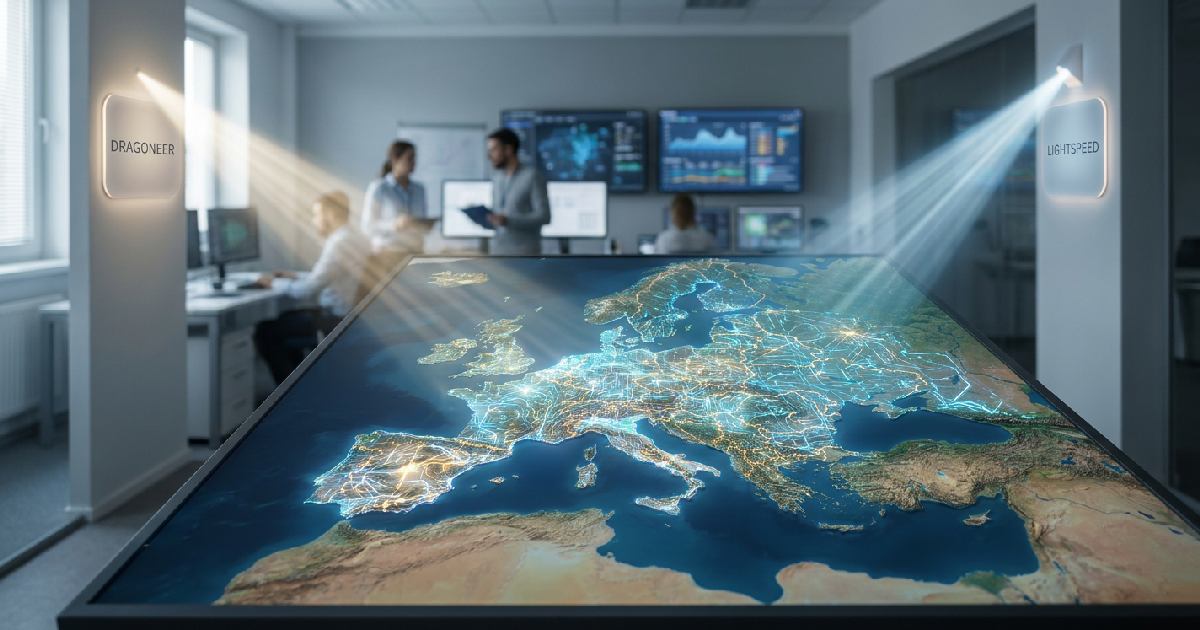
Munich-based Helsing secured $1.8 billion in Series E funding for its European defence AI platforms, reaching an $18 billion valuation. 8 billion in a Series E funding round for its European defence AI platforms, propelling its valuation to $18 billion.
The funding round, led by Dragoneer Investment Group with Lightspeed Venture Partners co-leading, represents the largest-ever capital injection for a European defence technology startup. It underscores a growing urgency among European governments to bolster sovereign defence capabilities, particularly in the wake of shifting geopolitical landscapes.
Record investment fuels European defence AI advancement
Helsing’s latest Series E funding round saw significant participation from a mix of new and existing investors. New entrants included Disruptive, ICONIQ, Goldman Sachs Alternatives, JPMorgan Chase, CPP Investments, General Catalyst, Plural, and StepStone.
They joined existing supporters like Prima Materia, Accel, and Greenoaks, signaling strong investor confidence in the company’s vision. This funding follows a substantial €600 million Series D round in June 2025, demonstrating sustained interest in defence AI products.
A rapidly expanding market for military technology
Investor demand for the Series E round “significantly exceeded” the available allocation, Helsing reported. This highlights the intense market appetite for AI-driven and software-defined defence technology, a sector experiencing rapid growth.
The global increase in military budgets, especially across Europe, is making defence technology one of the fastest-growing areas for venture capital. Governments are accelerating investment in defence following Russia’s invasion of Ukraine, which starkly revealed the need for real-time targeting and battlefield awareness.
Helsing’s strategic goals and product roadmap
The newly acquired capital will be deployed to accelerate Helsing’s mission to develop and integrate entirely new AI platforms into the defence capabilities of its growing number of partner nations. This includes further research and development into advanced hardware solutions.
The company also plans to fulfil existing and future contracts with customers across Europe and beyond. Helsing’s core approach, dubbed “software-defined defence,” integrates artificial intelligence with advanced hardware and the latest innovations from the defence domain.
Engineering next-generation autonomous defence systems
Helsing’s product portfolio includes the Altra battlefield decision-support platform, the HX-2 Strike Drone, and the CA-1 Europa autonomous aircraft platform. These systems are designed to give military forces better battlefield intelligence and facilitate quicker operational decisions.
The German firm is also engaged in designing sophisticated underwater surveillance capabilities and AI systems. These can sense and detect threats, providing crucial assistance to military personnel operating in challenging conditions.
HX-2 Strike Drone: Precision and resilience in combat
The HX-2 Strike Drone is an electric-powered, AI-defined munition. First revealed in late 2024, it features an X-wing design and boasts a range of up to 100km. This drone is engineered to operate effectively in GPS-denied environments, engaging targets using its onboard AI capabilities.
Critically, the HX-2 is jam-resistant and immune to electronic warfare when paired with Altra. It can also operate in swarm formations, significantly enhancing its tactical utility. Helsing has a Memorandum of Understanding with European energetic materials manufacturer EURENCO to supply warheads for the HX-2.
CA-1 Europa: Aerial autonomy in contested airspace
The CA-1 Europa platform represents Helsing’s push into autonomous aircraft. This includes the CA-1EA (Electronic Attack) model, an autonomous aircraft designed for electronic warfare. It was showcased on June 10, 2026, at an international air show.
The CA-1EA is intended to provide electronic jamming of hostile radar systems from the air, with Initial Operational Capability (IOC) planned for 2031. Building on the same platform, the CA-1KA (Kinetic Attack) is an autonomous combat aircraft version currently under development, with first test flights scheduled for early 2027 and IOC targeted for 2029.
Altra: The AI-powered command and control backbone
At the heart of Helsing’s integrated systems is Altra, an AI-powered Command and Control (C2) backbone. This platform integrates with various military assets, including artillery, Intelligence, Surveillance, and Reconnaissance (ISR) drones, and strike systems.
Altra generates a live target map from battlefield data, providing commanders with crucial real-time insights. This capability is vital for enabling rapid, informed decision-making in complex operational environments, helping forces understand and react to dynamic threats.
Geopolitical shifts drive demand for sovereign AI defence
The substantial investment in Helsing reflects a broader strategic realignment across Europe. European governments are increasingly prioritising the development of indigenous defence technology, reducing reliance on imported solutions from non-European partners.
This push for technological sovereignty is a direct response to current geopolitical realities, ensuring that European nations maintain control over critical defence capabilities. Helsing, founded in 2021 by Dr. Gundbert Scherf, Torsten Reil, and Niklas Köhler, embodies this ambition.
Strategic independence through domestic innovation
Helsing currently employs approximately 900 people across its operations in Germany, France, Estonia, and the United Kingdom. Despite attracting global investors, the company has maintained its predominantly European ownership, reported to be around 80%.
This commitment to European roots, combined with rapid expansion, aligns with increased European defence spending and a growing demand for sovereign technology solutions. Helsing’s software is already integrated into several military programmes, notably including systems supplied to Ukraine.
Competition in the evolving defence tech landscape
While Helsing has established itself as one of Europe’s largest AI-focused defence companies, it operates within a competitive global market. It faces rivals such as Anduril in the United States and emerging European contenders like Quantum Systems and Tekever.
The scale of this funding round, however, demonstrates Helsing’s strong market position and investor confidence in its long-term growth. The company anticipates software becoming the critical intelligence layer connecting military assets across air, land, sea, and electronic warfare.
This vision underscores a paradigm shift in modern defence strategy, moving towards highly integrated and intelligent systems. The new funding provides Helsing with ample resources to expand research, strengthen partnerships, and deliver AI-powered defence capabilities at an even greater scale.
Industrial implications and African opportunities in defence tech
The momentum behind companies like Helsing signals a significant shift in industrial priorities. Engineering firms across various sectors will need to adapt to the increasing demand for high-tech components, resilient supply chains, and specialized manufacturing processes required for advanced defence systems.
This trend impacts not only traditional defence manufacturers but also smaller engineering firms that can contribute specialized parts, sensors, or software solutions. It highlights the growing convergence of digital and physical engineering in critical national infrastructure.
Bridging the gap: African industry and global defence trends
While Helsing’s primary focus remains European, the principles of building sovereign technological capabilities and developing advanced autonomous systems hold strong relevance for African nations. As security concerns evolve, African countries are also looking to enhance their defence industries and reduce reliance on external suppliers.
This presents an opportunity for local engineering and manufacturing sectors to innovate and build capacity, potentially drawing inspiration from European models. Investments in industrial connectivity and robust AI infrastructure, as seen in Helsing’s strategy, are crucial for such development. African IoT sector expands through industrial connectivity, laying groundwork for sophisticated applications like defence AI.
The future of defence engineering and industrial growth
The move towards software-defined defence means a greater emphasis on advanced materials, precision engineering, and complex systems integration. African industrial players, particularly those in industrial and engineering stocks, can find long-term growth opportunities by focusing on these areas.
Developing expertise in secure AI infrastructure and ethical deployment of autonomous systems is also paramount. Companies like Helsing demonstrate that success increasingly hinges on the ability to develop and integrate sophisticated software with cutting-edge hardware, pushing the boundaries of what’s possible in military engineering.
