


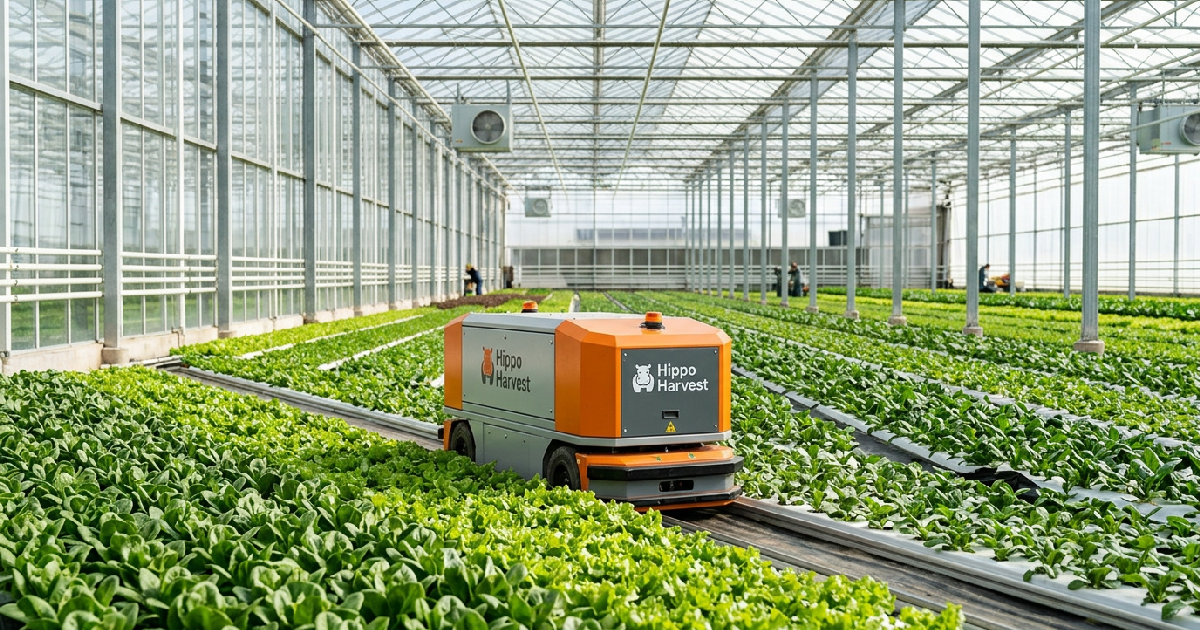
Hippo Harvest secured $30 million in Series C funding to expand its fleet of autonomous mobile robots and scale its controlled environment agriculture operations.
The funding round brings the company’s total capital raised to $93 million since its founding in 2019. Alongside Cox Farms, the round saw participation from Congruent Ventures, Hawthorne Food Ventures, Collaborative Fund, and the Fresh Investment Club.
Robotic integration in controlled environment agriculture
This strategic backing arrives as Hippo Harvest readies the commercial rollout of its indoor-grown spinach, which joins a product line already featuring organic butter lettuce launched earlier this year. For senior plant managers, the focus remains on the manufacturing execution system that allows these facilities to compete with traditional field agriculture on price and reliability.
The Hollister expansion is currently in the permitting phase and represents a 30-fold increase in the company’s current production footprint. Success at this scale would validate Hippo Harvest’s thesis that robotics can solve the labour and resource limitations of traditional farming while providing retailers with a year-round, climate-resilient supply.
The company already distributes produce through regional retailers including Sprouts, Haggen, and Gus’s Community Markets, and plans to use the Series C funds to broaden its West Coast and national retail presence.
Hippo Harvest’s production model is built around proprietary Autonomous Mobile Robots (AMRs) that function as “indoor tractors.” These machines handle the entire growth cycle by monitoring, tending, and harvesting plants with a level of precision difficult to achieve with manual labour.
The robots physically respace growing modules as the plants mature, ensuring optimal light distribution and airflow. This dynamic use of space allows for a 94% reduction in land usage compared to traditional open-field methods.
These sensor-rich robotic platforms collect daily imagery and microclimate data for every module. This granular monitoring enables the company to identify and resolve localized plant Health issues before they impact the broader crop.
While the broader cobot market focuses on physical machines working alongside humans, Hippo Harvest utilises a truly autonomous fleet to manage the biological variables of the greenhouse. The result is a system that can produce high-quality organic produce with 92% less water and 55% less fertilizer.
Automated pest management and nutrient delivery
To maintain its USDA-certified organic status without relying on manual chemical application, Hippo Harvest employs specialised UVC robots for pest management. These units navigate the facility at night, using ultraviolet light to control common greenhouse pathogens and pests such as spider mites and aphids.
This engineering-led approach to biological control eliminates the need for traditional pesticides and reduces the human labour typically required for organic crop scouting.
The irrigation infrastructure uses a closed-loop, direct-to-root nutrient delivery system. By delivering water and fertiliser directly to the root zone, the system keeps the edible portions of the leafy greens dry. This precision not only conserves resources but also reduces the risk of foodborne illnesses often associated with contaminated runoff in field farming.
By isolating the root zone, the company ensures a cleaner product with a potentially longer shelf life for the consumer.
Scaling to the 30-acre Hollister facility
The primary purpose of the $30 million Series C is to unlock the capacity of the Hollister site. Moving from a one-acre research facility to 30 acres of greenhouse glass is an immense jump in mechanical and civil engineering complexity.
The site must integrate a massive array of climate control systems, robotic charging stations, and automated packing lines to maintain the efficiency found in the pilot project. This facility serves as the technical blueprint for Hippo Harvest’s intended national expansion.
By localising production in Hollister, the company significantly reduces “food miles” and logistics costs. Most US leafy green production is concentrated in specific regions of California and Arizona, requiring transcontinental transport to reach consumers.
Hippo Harvest’s model allows for high-yield production facilities closer to major population centres on the West Coast, creating a more predictable supply chain. This move reflects a wider trend where industrial connectivity and localized manufacturing are becoming the priorities for resilient supply chains.
Strategic implications of Cox Farms leadership
Cox Farms’ role as the lead investor signals a shift in horticultural technology investment. Rather than relying solely on tech-focused venture capital, Hippo Harvest has secured backing from an established market leader in North American greenhouse operations.
This provides the company with deep operational expertise in large-scale glasshouse management, which is critical as they navigate the thin margins of the retail grocery sector. CEO Eitan Marder-Eppstein noted that years of investment in robotics have finally created an operation capable of producing consistent organic greens at an economically competitive price point.
The company’s commitment to sustainability extends to the Climate Pledge, with Hippo Harvest targeting net-zero carbon emissions by 2040. The precision of the robotic system is the key to this goal, as it minimizes the waste of inputs and land.
If the Hollister facility successfully scales these technical efficiencies, it could redefine the baseline for commercial organic farming globally. For engineers and industrialists, the project proves that food production is increasingly becoming a matter of high-end robotics and precise process control.
