


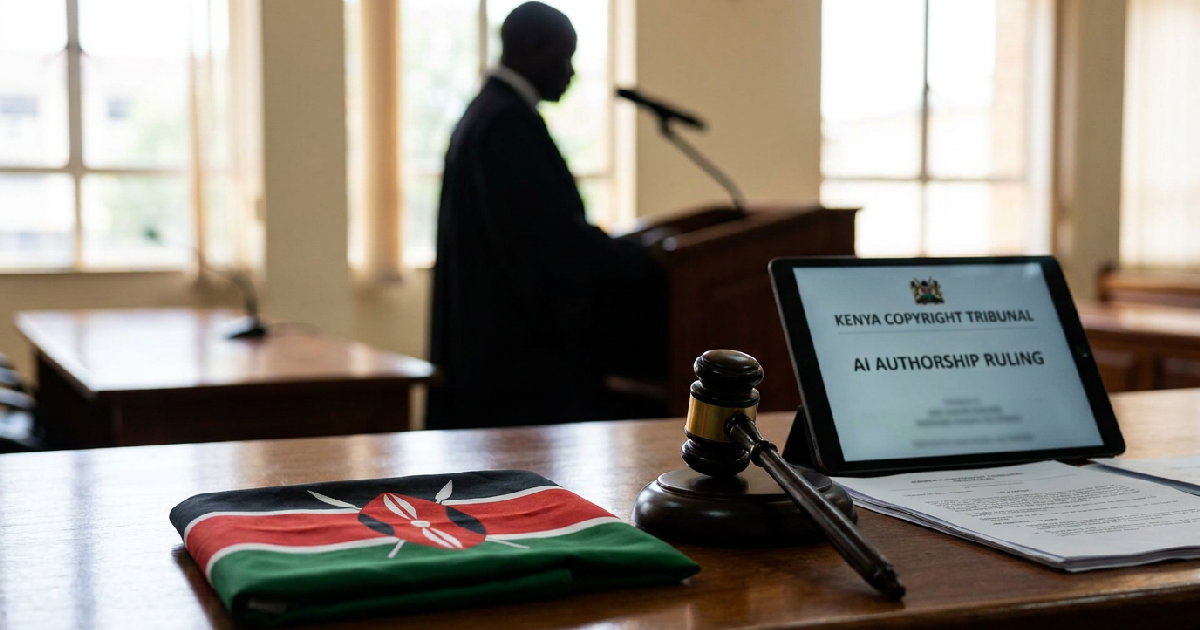
Kenya’s Copyright Tribunal has made it clear: works created exclusively by artificial intelligence cannot be copyrighted under Kenyan law. This landmark ruling, issued on July 9, 2026, firmly establishes that legal recognition as an author remains an exclusively human prerogative, a decision with wide-ranging implications for Africa’s growing tech and creative sectors.
The tribunal’s stance underscores a global trend where jurisdictions grapple with the intellectual property challenges posed by generative AI. It signals that while AI can assist, the ultimate creative spark and intellectual effort must originate from a human for copyright protection to apply.
Kenya AI copyright decision clarifies legal boundaries
The Kenya Copyright Tribunal’s decision highlights a fundamental principle of intellectual property law. It states that machines, including advanced AI systems, lack the legal personality required to qualify as an author.
This interpretation aligns with Kenya’s Copyright Act, which defines an “author” as the person who first creates a literary, musical, dramatic, or artistic work. This definition inherently presumes human involvement and original thought.
Defining human contribution in AI-assisted works
Creators are still free to use AI platforms, such as large language models or image generators, in their creative processes. However, the ruling necessitates a demonstrable and substantial human contribution for any resulting work to secure copyright protection.
This means simply providing a prompt to an AI system won’t automatically make the output eligible. Individuals and companies hoping to monetise AI-assisted content must now keep meticulous records of their specific intellectual input.
Tracing the dispute: Akoth v Aryeh Movement
The tribunal’s definitive ruling stemmed from a dispute involving Cynthia Beldina Akoth and the Aryeh Movement. Akoth, an author, had been contracted by Aryeh Movement to produce a collection of “Bible Scripture Stories,” for which she utilised AI tools to generate some content.
When the working relationship broke down, Akoth discovered that Aryeh had registered the literary works with the Kenya Copyright Board (KECOBO) under its own name. She subsequently filed a complaint with KECOBO, seeking the revocation of Aryeh’s certificate, arguing that she had not consented to the registration nor transferred ownership.
KECOBO’s role and the tribunal’s clarification
Initially, KECOBO agreed with Akoth and revoked Aryeh’s certificate. But the Aryeh Movement escalated the matter to the Copyright Tribunal.
The Tribunal determined that KECOBO had exceeded its mandate by revoking the certificate to resolve an ownership dispute. KECOBO’s primary role, it clarified, is to maintain the copyright register, while ownership disagreements fall under the purview of judicial bodies.
Broader implications for African tech law and creators
This Kenya AI copyright ruling carries significant weight for the country’s creative economy, valued at KSh 1 trillion in 2025. It also provides a crucial precedent for other African nations navigating similar regulatory waters.
The decision impacts software developers, content creators, and publishers who increasingly integrate generative AI into their workflows. It highlights the need for clear guidelines on what constitutes “sufficient effort” and human originality in a digitally evolving landscape.
Protecting livelihoods in the creative industry
Dan Aceda, a Musician and Board Member at the Kenya Copyright Board, has voiced concerns about the existential threat AI poses to artists. He noted the issue of AI platforms training models on copyrighted material without compensation, directly impacting creators’ livelihoods.
This ruling provides a framework to protect human creators and their original output, ensuring they retain rights to their work even when using AI as a tool. It promotes an environment where human ingenuity remains at the core of creative and AI systems development.
Legislative landscape and future regulation of generative AI
The Copyright Tribunal’s decision comes amid a period of intense legislative review in Kenya. The country is actively debating broader AI regulation and reviewing its copyright laws.
Several proposed bills aim to clarify legal ambiguities surrounding AI-generated works. They also address issues like AI training data, ownership of AI-assisted content, and liability for infringement.
Key bills shaping Kenya’s intellectual property future
The Draft Copyright and Related Rights Bill 2026, published by KECOBO earlier this year for public consultation, proposes to repeal and replace the Copyright Act of 2001. This draft bill introduces specific obligations for AI-generated works and addresses image and personality rights.
The Artificial Intelligence Bill 2026, filed in Parliament, includes provisions on non-consensual image use and transparency for AI developers. Additionally, the Kenya Intellectual Property Authority Bill, 2026, tabled by Majority Leader Kimani Ichung’wah, seeks to consolidate various IP bodies and laws into a single authority.
Global alignment on human authorship
Kenya’s ruling aligns with international trends on AI intellectual property. Jurisdictions like the United States have consistently maintained that copyright protection requires human authorship, rejecting registrations for works created entirely by machines.
The European Union also adheres to an “author’s own intellectual creation” standard, which presupposes human intellectual input. This excludes purely machine-generated outputs from copyright eligibility.
What this means for industrial innovation
For industrial sectors, this ruling provides clarity on the ownership of designs, software code, or technical documents where AI tools might be used. Companies will need to ensure human oversight and demonstrable creative input in any AI-assisted intellectual property they wish to protect.
This clarity could spur investment in AI tools that enhance human creativity, rather than those designed to operate autonomously without human intervention. It ensures that the value created by human engineers and innovators remains attributable and protected.
