


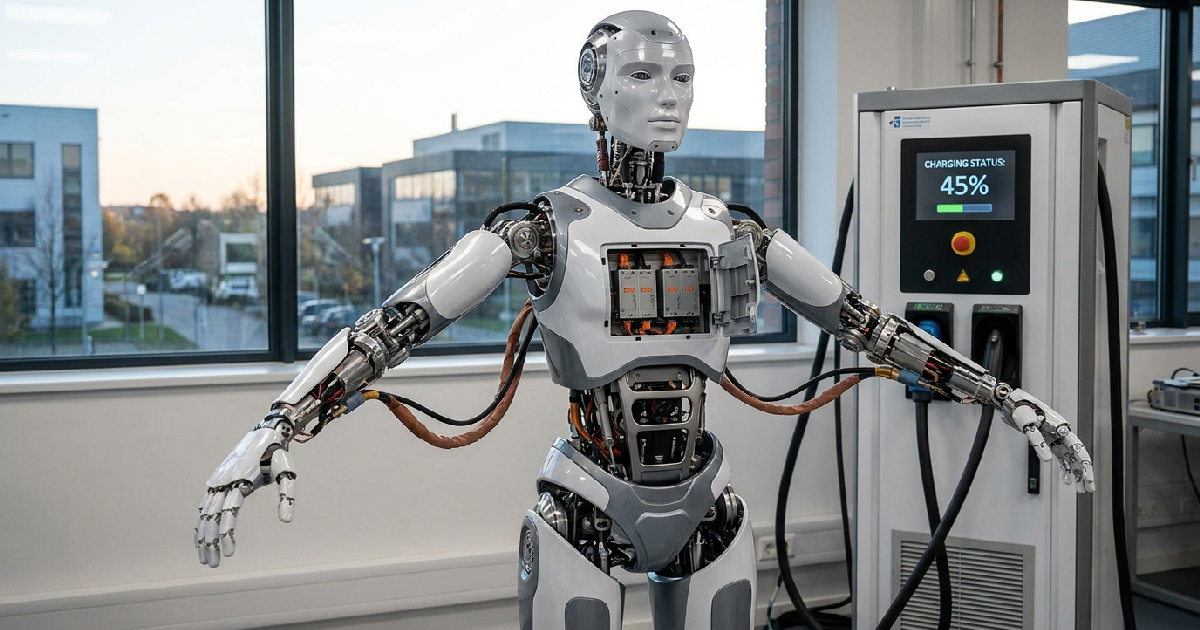
Humanoid robots are rapidly moving from research labs to industrial settings, but their widespread deployment hinges on solving a fundamental bottleneck: efficient power management.
This challenge is far more intricate for bipedal machines than for simpler robotic systems or electric vehicles. It requires a delicate balance between high-power motors, sophisticated onboard computing, and the physical limitations of battery technology and system weight.
The enduring power challenge for humanoids
Humanoid robots demand significant, continuous power for their dynamic locomotion, intricate manipulation tasks, and advanced onboard computing. These systems handle AI and Vision-Language Models, alongside an array of sensing systems, often pulling several kilowatts during peak operations.
Unlike electric vehicles, which can dedicate a third of their mass to batteries, humanoids typically face a hard limit of just one-eighth of their total weight for energy storage. Adding more battery capacity, while seemingly beneficial, paradoxically increases the robot’s overall mass.
This added weight then demands greater joint torque, which in turn leads to higher power consumption, creating a difficult “weight-penalty spiral.” Energy storage, power conversion, and motion systems can also account for about 30% of a humanoid robot’s total cost.
Advancing humanoid battery life and capacity
Current lithium-ion batteries are the go-to for humanoid robots, offering a balance of energy density and respectable power. Typical designs achieve 280-300 Wh/kg, but these restrict robots to 1-4 hours of active use.
High-mobility tasks drain batteries faster, with most packs currently offering only 2-4 hours of operation before needing a recharge. This frequent downtime poses a significant barrier to industrial integration.
For example, Agility Robotics’ Digit can operate for 90 minutes, followed by a 9-minute fast charge, or in 30-minute intervals in Amazon warehouses. Figure 03 runs for 3-4 hours on its 2.3 kWh battery pack.
No commercially available humanoid robot can currently complete a full 8-hour manufacturing shift on a single charge. This reliability issue is considered the number one barrier, even more so than AI, with most robots operating for 30-90 minutes before intervention.
Overcoming thermal and capacity hurdles
High temperatures present a major challenge, risking component damage and even battery fires, which necessitates robust cooling systems. Advanced Battery Management Systems (BMS) are therefore crucial for monitoring health, preventing overheating, and ensuring safe operation.
Semi-solid-state batteries show promise, projected to boost cell energy density to 350-400 Wh/kg. This could potentially extend continuous operation to 6-8 hours, a significant improvement over current capabilities.
Grepow already offers advanced semi-solid NMC batteries with an energy density up to 350 Wh/kg. Solid-state batteries, expected commercially between 2027 and 2029, offer even higher density and improved safety.
These emerging technologies, alongside high-silicon anode technology from companies like Amprius Technologies, are vital for enabling sustained autonomy. Ionel Stefan, CTO of Amprius, sees this as crucial for efficiency.
Driving efficiency through advanced actuation systems
Actuators are the precision components that enable anthropomorphic movements, integrating transmission mechanisms, drivers, motors, brakes, encoders, and torque sensors. These core execution units directly influence a robot’s agility and power consumption.
Humanoid robots feature numerous actuators, with advanced designs incorporating 16-60 degrees of freedom. Rotary actuators are ideal for continuous rotation in joints like hips and shoulders, often using Brushless DC (BLDC) motors and gear reducers.
Harmonic drives are common in high-end robotics, providing gear reduction ratios of 50:1 to 160:1 in compact packages. Linear actuators, by contrast, excel at absorbing heavy impact loads and delivering high force in joints like the knee.
Innovations in motor and gear technology
High efficiency in actuators is paramount, as it reduces waste heat generation and extends operational time. Thermal management within actuators also controls temperature rise, preventing performance degradation or damage.
Higher torque density allows for lighter robots, which optimises the centre of gravity and enhances dynamic response. This also contributes directly to extending battery life.
Techrobots MJBX Series rotary actuators, for example, achieve a torque density of 57.8 N·m/kg. Lin Engineering motors provide up to 20% higher power density and reduce current draw by as much as 15%.
WaveDrives has developed and patented Sarcomere Inspired Linear Actuation (SILA), operating at low voltages for high power density and efficiency. Coreless motors are also gaining traction for dexterous hands due to their small size and quick response.
Integrated power management and thermal regulation
A humanoid robot power architecture typically starts from a 48V, 52V, or 72V battery bus, supplying various high-current loads. These include joint actuators, AI computing boards, cameras, LiDAR, cooling fans, and safety controllers.
The power system must adeptly manage voltage, current, heat, safety, and communication, often under rapidly changing loads. Separating high-current loads from low-noise control circuits is crucial for stability.
Thermal regulation is not just for batteries; actuators also generate considerable heat that needs to be managed to maintain performance. Transitioning to higher voltage platforms, such as 400V, can reduce current and improve drivetrain efficiency.
Smart solutions for sustained operation
Gallium Nitride (GaN) power electronics are transforming this space, switching faster than silicon MOSFETs. This enables higher operating frequencies, reduced losses, and improved system efficiency, crucial for compact motor drives.
Marco Palma, Director of Motor Drives Systems and Applications at Efficient Power Conversion (EPC), emphasises GaN’s role in solving power electronics challenges for humanoids. Regenerative energy recovery can also improve usable runtime by 5-12%.
Innovative strategies also include advanced BMS, wireless charging, and fast-charge modules. Swappable battery packs offer a practical pathway to sustained uptime, allowing robots to work continuously while depleted batteries charge elsewhere.
Strategic placement of charging stations, within 15 metres of the work zone, can mitigate the impact of limited battery runtime. This approach minimises downtime and maximises operational hours in industrial environments.
The market’s high stakes for robust power systems
The global humanoid robot market is projected to reach $38 billion by 2035, according to Goldman Sachs Research from January 2025. This significant growth underscores the intense demand for reliable, long-lasting power solutions.
Morgan Stanley forecasts an astonishing 1 billion humanoids by 2050, which would create multi-terawatt-hour demand for high-performance battery systems. These projections highlight the urgent need for breakthroughs in power technology.
As industrial automation grows, the ability of these robots to perform reliably over extended shifts will dictate their commercial success. Humanoid deployment reached approximately 2,000 units globally in 2024, demonstrating nascent but strong market uptake.
For manufacturers in Africa, advancements in humanoid robot power management could unlock new efficiencies and productivity gains. Just as industrial connectivity is expanding across the continent, so too could the deployment of advanced robotics, provided these power hurdles are overcome.
These developments signify a future where robotics plays an even more central role in global industry. The core engineering challenges in power management, once solved, will accelerate this transformation across diverse sectors.
