


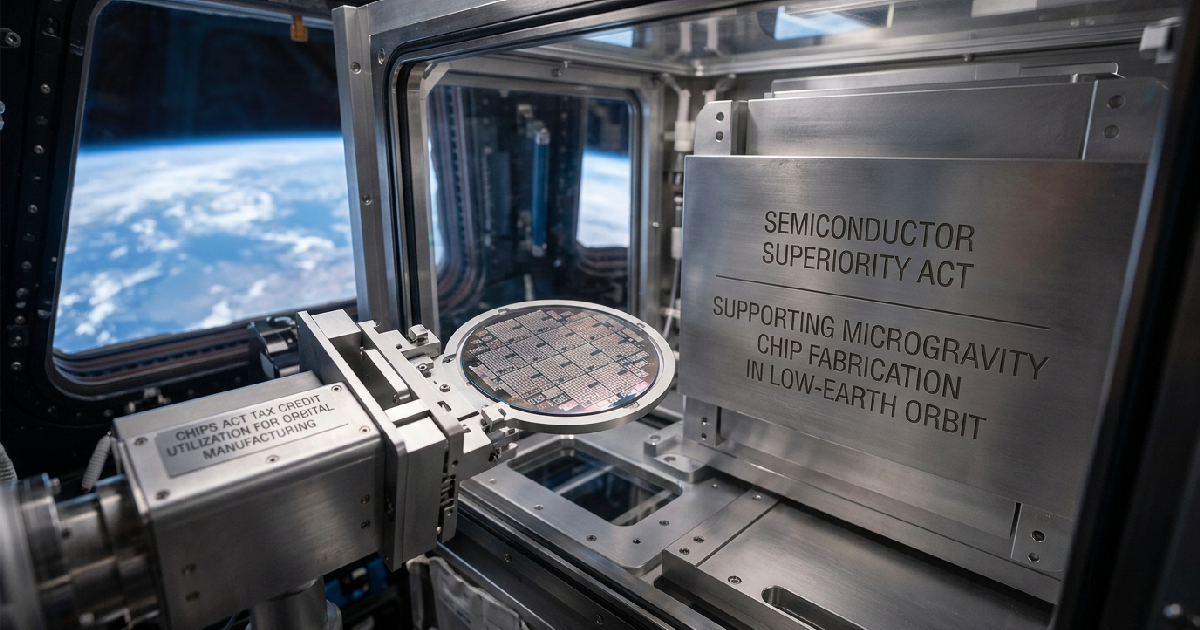
U.S. Senator Ted Budd and Senator Michael Bennet introduced the Semiconductor Superiority Act on June 11, 2026, to allow space-based semiconductor manufacturing to qualify for federal tax credits.
The bipartisan legislation seeks to amend the CHIPS and Science Act of 2022 by explicitly including facilities located in low-Earth orbit (LEO) as eligible for the 25% Advanced Manufacturing Investment Credit.
If passed, the bill would incentivise American firms to produce silicon chips in microgravity, a frontier where the absence of gravity leads to fewer material defects and superior crystal growth.
The Senate push follows companion legislation introduced in the House last month by Representative Suzan DelBene, Representative Vern Buchanan, and Representative Terri Sewell. Lawmakers argue that providing regulatory certainty is vital to maintaining a competitive edge against China, which has already established chipmaking capabilities aboard its Tiangong Space Station.
While current law does not explicitly bar space-based projects, the lack of specific mention in Section 48D of the Internal Revenue Code has created a “grey area” that discourages long-term capital expenditure by risk-averse semiconductor firms.
Microgravity environments offer a fundamental physical advantage for high-end electronics manufacturing. On Earth, gravity causes convection and sedimentation, which can introduce irregularities in the crystal lattices of semiconductor wafers. In the near-vacuum and weightlessness of LEO, manufacturers can achieve more uniform material deposition.
This technical leap is increasingly relevant as terrestrial fabrication approaches the physical limits of Moore’s Law, forcing engineers to look toward exotic materials and environments to boost processing power.
Closing the gap with Chinese space fabrication
The urgency behind the Semiconductor Superiority Act stems from evidence of an accelerating space-based industrial race. Senator Ted Budd noted that China has already integrated orbital fabrication into its national supply chain, building on a history that dates back to 1996 when it first produced integrated circuits using space-grown crystals. To counter this, U.S.
lawmakers want to ensure that domestic firms have the financial “green light” to move beyond terrestrial factories. This shift highlights a broader trend where manufacturers pivot to Manufacturing Execution Systems to handle increasingly complex, multi-environment supply chains.
Several private players are already preparing for this transition. Aegis Aerospace and United Semiconductors have established a partnership to develop an in-space manufacturing platform, while companies like Space Forge have demonstrated gas-phase crystal growth on autonomous orbital platforms.
The proposed legislation would provide these pioneers with the same 25% tax credit currently enjoyed by onshore facilities in states like Texas and Arizona, technically extending the “onshore” manufacturing perimeter into orbit.
Senator Michael Bennet emphasised that high-tech hubs like Colorado are primed for this shift due to an existing concentration of aerospace research institutions. By aligning semiconductor policy with orbital infrastructure, the bill aims to support high-paying jobs in regions that already manage complex satellite and launch operations.
These aerospace firms often face high capital costs, similar to the rocket motor supply chain costs seen in high-growth defence and industrial sectors.
Clarifying tax eligibility for orbital infrastructure
A specific provision of the Semiconductor Superiority Act clarifies that “property” and “infrastructure” for manufacturing in LEO qualify for the Advanced Manufacturing Investment Credit. This includes the specialised automated labs and furnaces required for crystal growth.
However, the legislation maintains a strict boundary: the rockets and launch vehicles used to transport these payloads into orbit remain excluded from the tax credit. This distinction ensures the funding remains targeted at industrial production rather than general transportation.
The potential for space-made chips extends beyond basic electronics to high-power AI applications. Elon Musk’s SpaceX has already discussed plans to deploy AI data centres in space using chips processed at its upcoming Terafab facility. Proponents of the bill argue that as AI platforms scale through funding and increased computational demand, the efficiency of the underlying hardware will become the ultimate bottleneck for global competition.
Representative Terri Sewell stated that the act is an investment in American ingenuity intended to safeguard advanced supply chains from external shocks. Since the International Space Station (ISS) is scheduled for decommissioning in 2030, the private sector is racing to build successor commercial platforms.
Explicitly including these future nodes in the CHIPS Act framework gives developers the long-term tax visibility required to secure project financing for 2027 and beyond.
Maintaining momentum in the global semiconductor race
The introduction of the Senate bill on June 11 marks a key milestone in legislative efforts to formalise space as a manufacturing beat. By removing the ambiguity of Section 48D, the U.S. aims to prevent a “brain drain” of aerospace engineering talent to overseas jurisdictions that might offer more aggressive subsidies for orbital industry.
For the professional operations manager or engineer, this represents a significant expansion of the industrial floor, where the vacuum of space becomes a manageable process variable rather than a scientific novelty.
As the legislation moves through committee, the focus will likely shift to how the Internal Revenue Service (IRS) and the Department of Commerce define “space-based property” in practice. If passed, the Semiconductor Superiority Act would represent the first time the U.S.
tax code has been updated to treat low-Earth orbit as a functional industrial zone. This move signals a permanent shift in how the world’s leading economies view the relationship between sovereign territory and industrial productivity.
