


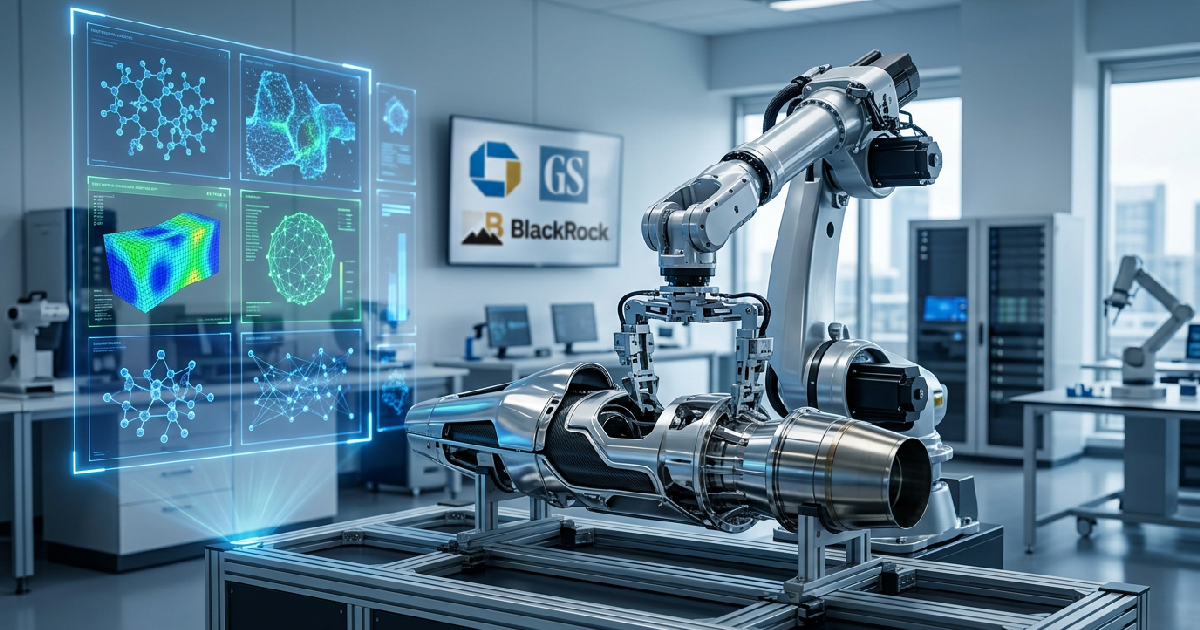
Jeff Bezos and Vikram Bajaj have raised $12 billion for their physical AI company, Prometheus, valuing the venture at $41 billion as of 11 June 2026. The Series B funding round includes capital from Bezos himself, alongside JPMorgan Chase, Goldman Sachs, and BlackRock.
This capital injection will fund the development of an “artificial general engineer” (AGE) designed to automate the design and manufacturing of complex physical systems such as aerospace components and drug compounds.
The latest funding follows an initial $6.2 billion raised when the company launched in November 2025, bringing total investment to over $18 billion. Unlike standard AI models trained on text, Prometheus uses “physical AI” trained on real-world experimental data, robotics interactions, and engineering workflows.
Co-CEO Jeff Bezos confirmed that a large portion of the $12 billion will cover the company’s massive compute needs required for these intensive simulations.
Prometheus currently employs approximately 150 people across offices in San Francisco, London, and Zurich. Bezos, who remains Executive Chairman of Amazon, has taken an active operational role as Co-CEO, marking his first such position in a technology company since stepping down as Amazon CEO in 2021.
He became a founding investor in late 2024 and joined the operational team after becoming impressed by the technology’s potential to compress industrial cycles.
Building an artificial general engineer for complex systems
The mission of Prometheus centres on the “artificial general engineer,” a set of tools intended to help smaller teams of engineers accomplish more in less time. The goal is to understand the laws of physics rather than identifying patterns in data. This software aims to facilitate the entire process from initial design to end-stage manufacturing for industries including computing, automotive, and drug discovery.
Co-CEO Vikram Bajaj, a Stanford medical school professor and former co-founder of Alphabet’s Verily, noted that the pace of physical creation currently fails to match human imagination. By transforming design challenges into end-to-end AI problems, the company hopes to make the “dream-build loop” significantly more efficient. This focus on the physical world mirrors trends where manufacturers pivot to Manufacturing Execution Systems to improve plant agility.
The company is not building hardware or robots but the software intelligence that drives physical tasks. Investors, including DST Global and Arch Venture Partners, view this “physical AI” sector as more defensible than pure software because the physical world creates moats that code alone cannot. Because the work is “very compute intensive,” the company must simulate real-world physics accurately before any manufacturing begins.
Addressing labor scarcity and productivity gains
Bezos has introduced a concept he calls “labor scarcity” to describe how AI will affect the global workforce. He argues that the productivity gains from an artificial general engineer will raise standards of living to the point where demand for human workers actually outpaces supply. He suggests this shift could allow two-earner households to become one-earner households as work becomes more efficient.
This vision of a more productive economy coincides with a period where collaborative automation goes mainstream, yet it stands in contrast to recent layoffs across the tech sector. Bezos maintains that AI will create more opportunities than it eliminates.
“The cycle from dream, to manufacturing at rate, to having it out in the world can be very long,” Bezos told CNBC. He believes the new tools can make that cycle 10 times faster or even more.
Regulation at the application level
Regarding the oversight of these powerful new engineering tools, Bezos has advocated for healthy government regulation to improve product safety. However, he cautioned that regulation should happen at the “application level” rather than the foundational technology. He used the analogy that a knife should not be outlawed simply because it could be used in a harmful way.
Prometheus continues to keep the specifics of its current progress under wraps while operating from its San Francisco headquarters and European offices. Although an early version of the software is expected soon, the company has not yet determined a final product launch timeline. This cautious approach comes as other sectors, such as robotaxi services, face technical hurdles that have slowed their public deployment.
Global industrial implications for manufacturing
The ability to compress the engineering cycle has broad implications for manufacturing hubs in the United Kingdom, India, and Africa. If the dream-build loop becomes 10 times faster, it could lower the barrier to entry for complex industrial designs in regions with developing infrastructure.
This technology would allow teams to iterate on designs for machinery or medical compounds without the decades of institutional knowledge typically required.
In the African context, these tools could support the development of local industrial capacity by augmenting the work of existing engineers. Much like how the African IoT sector expands through industrial connectivity, physics-aware AI could help local firms jump directly into high-tech manufacturing.
By using AI to handle the “heavy lifting” of engineering simulation, Prometheus may enable a new era of global production where the speed of manufacturing finally catches up to the speed of imagination.
