


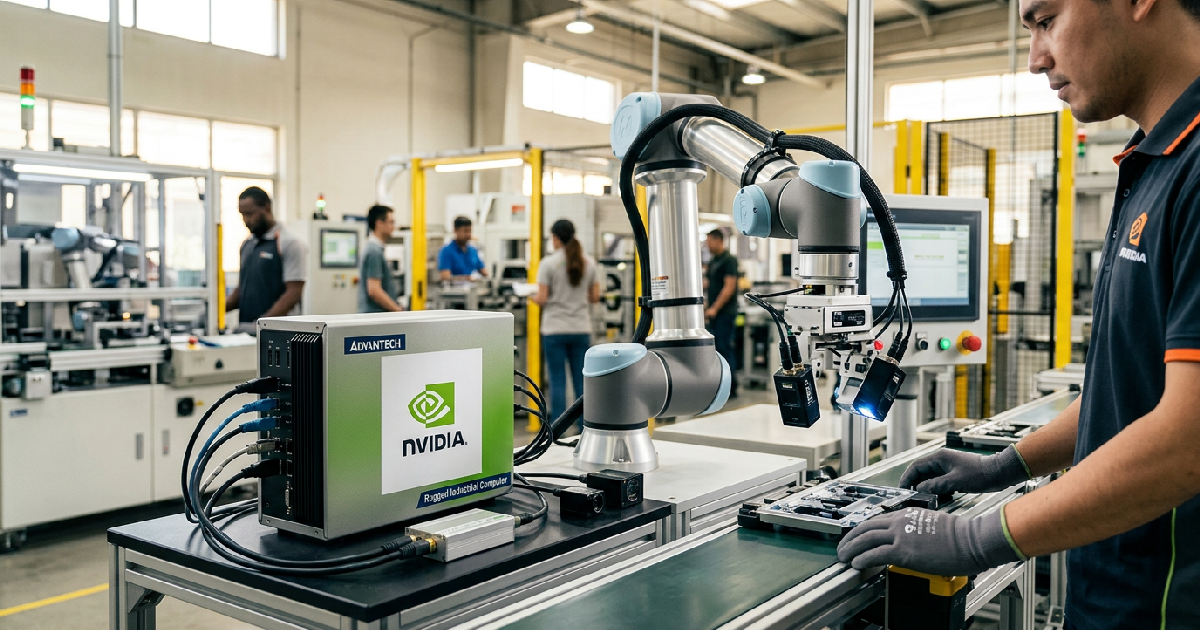
Advantech Co. Ltd and NVIDIA Corporation have expanded their long-standing partnership to accelerate the deployment of industrial artificial intelligence within manufacturing environments. The collaboration integrates NVIDIA’s edge computing hardware and software platforms with Advantech’s industrial computing solutions to create a unified framework for “factory AI.”
By embedding advanced computing power directly into the production line, the two companies aim to solve persistent bottlenecks in automated inspection, predictive maintenance, and autonomous logistics for global manufacturers.
This expansion comes as the industrial sector moves away from centralised cloud processing toward edge-based architectures. Advantech is now incorporating NVIDIA’s latest Jetson and IGX platforms into its hardware lineup, allowing for real-time data processing without the latency issues inherent in remote servers.
For floor managers and operations directors, this means hardware can now run complex vision algorithms and digital twin simulations locally, ensuring that critical machine decisions happen in milliseconds rather than seconds.
The timing of this growth aligns with a broader industry trend where manufacturers pivot to Manufacturing Execution System as strategic lever for plant agility. As these systems become more data-intensive, the need for specialised AI hardware becomes a requirement rather than a luxury.
Advantech’s new systems are specifically designed to survive the harsh vibrational and thermal conditions of a factory floor while providing the teraflops of performance required by modern neural networks.
Scaling industrial AI through edge computing hardware
At the heart of the partnership is the integration of NVIDIA Omniverse and the Metropolis framework into Advantech’s ruggedized industrial PCs. This setup allows engineers to build and test factory layouts in a virtual environment before a single piece of equipment is moved on the physical floor.
These digital twins are fed by real-time sensor data, permitting a level of simulation accuracy that was previously impossible. It enables a “software-defined” factory approach where updates to production logic are pushed to machines like a smartphone OS update.
Advantech is also focusing on the growing footprint of African IoT sector growth through industrial connectivity. By providing standardized AI modules, the company lowers the entry barrier for emerging markets to adopt high-end automation. Instead of building bespoke AI infrastructure from scratch, firms can deploy pre-validated Advantech systems that are already optimized for NVIDIA’s software stack, significantly reducing the time-to-market for smart factory initiatives.
Improving automated optical inspection and plant safety
One primary application for the expanded partnership is Automated Optical Inspection (AOI). Traditional AOI systems often struggle with lighting variations or complex product geometries, leading to high false-rejection rates. By using NVIDIA’s AI inference capabilities, Advantech’s systems can distinguish between a superficial scratch and a structural defect with human-like nuance.
This precision reduces waste and ensures that production lines maintain a higher “first-pass” yield during 24-hour operations.
Safety is the other major beneficiary. The system uses vision AI to monitor “no-go” zones around heavy machinery, instantly slowing or halting equipment if a worker enters a dangerous area. Unlike legacy light curtains or physical barriers, these AI-driven safety systems can differentiate between a person, a forklift, and a static object.
This prevents unnecessary downtime while maintaining a rigorous safety standard that protects the workforce without sacrificing total plant output.
Future-proofing the smart factory infrastructure
The move by Advantech to deepen its NVIDIA ties signals a shift toward modularity in industrial design. Engineers no longer want locked-in, proprietary systems; they need hardware that can evolve as AI models improve. Since the cobot market expected to reach USD 2.
18 billion by 2026, the demand for processors capable of handling collaborative robotics and AI simultaneously has surged. Advantech is positioning itself as the primary hardware layer for this new wave of collaborative industrial tech.
Looking ahead, the partnership will likely focus on “Physical AI”—the concept where the AI has a deep understanding of the laws of physics. This is crucial for robotic arms and autonomous mobile robots (AMRs) that must navigate unpredictable factory environments.
By combining Advantech’s industrial-grade reliability with NVIDIA’s breakthroughs in spatial computing, the companies are providing the foundational kit needed for the next decade of automated manufacturing. Success will depend on how quickly brownfield sites can integrate these high-performance modules into existing, older production lines.
