


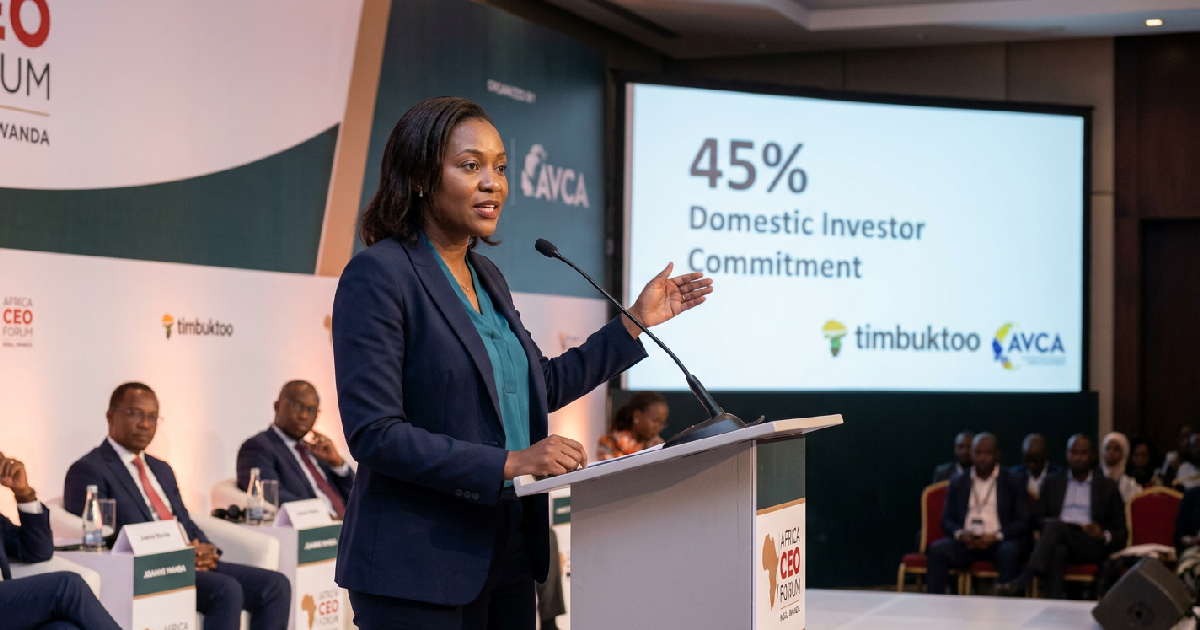
Domestic investors now contribute 45% of total venture fund commitments in Africa, marking a major departure from the continent’s historic reliance on foreign capital. Joanne Manda, Global Lead for timbuktoo, confirmed the figure on 15 May 2026, during the Africa CEO Forum in Kigali, Rwanda. This participation rate is the highest ever recorded for the continent, up from an average of 23% between 2022 and 2024, according to data from the African Private Capital Association (AVCA).
The shift comes as African high-net-worth individuals and institutional investors move away from offshore parking of capital in favour of local economies. Joanne Manda leads timbuktoo, a United Nations Development Programme (UNDP)-backed platform designed to de-risk African startups through a $1 billion public-private finance model. By using $350 million in risk-tolerant capital, the initiative seeks to draw an additional $650 million from private investors over the next decade.
Addressing the “talent gap” remains a primary objective for the initiative’s leadership. Investors frequently cite a lack of technical expertise as a barrier to scaling the businesses they fund. To bridge this, timbuktoo has established 16 University Innovation Pods (UniPods) with 12 more in development. These pods aim to turn academic institutions into active hubs for R&D, much like how manufacturers pivot to Manufacturing Execution Systems to drive operational agility.
Establishing thematic hubs for industrial engineering and fintech
The timbuktoo initiative operates through an infrastructure of 10 sector-specific thematic hubs across the continent. These facilities provide the technical “rails” for startups in critical industrial segments. The Fintech Hub in Lagos, Nigeria, was the first to launch in 2024, followed by others focusing on healthtech in Kigali and MineTech in Zambia. Applications for the Zambia MineTech Accelerator Programme closed in February 2025, specifically targeting engineering solutions for the mining sector.
These hubs serve as essential testing grounds for regional innovation. For instance, the Cleantech Hub in Nairobi and the Agritech Hub in Accra focus on decentralised infrastructure and agricultural output. By housing these operations in specific economic capitals, the initiative allows for a direct exchange between engineers and the industries they serve. This collaborative model is a vital part of the effort to support 10,000 startups and scale over 1,000 high-impact enterprises within a decade.
The demand for such industrialised support is high, as African IoT sector growth continues to increase the need for hardware-ready talent. According to a Q1 2026 report, timbuktoo has already trained 3,480 innovators. The goal is to create $10 billion in value on the African continent by providing the physical and financial pathways required for indigenous technology to scale beyond the informal sector.
Unlocking institutional billions for African digital infrastructure
A significant hurdle for African engineering projects is the $3 trillion currently held by African pension funds and insurance firms, much of which remains outside the continent. Joanne Manda argues that perception of risk, rather than reality, often drives the regulations that mandate these funds be held offshore. Reforming these structures would provide the patient capital necessary for large-scale digital and physical infrastructure.
Domestic retail investors have already demonstrated an appetite for these local assets. Rwanda’s 2024 sustainability-linked bond was oversubscribed by local retail participants, proving that capital exists within the continent. The challenge lies in creating the “pipes” to direct this money into productive sectors. By deepening local capital markets, young Africans can invest in the technical future of their own countries.
This domestic shift is timely, as venture capital inflows have been volatile. African startups raised $3.5 billion in 2023, a 46% decline from the previous year. High concentration of capital in just four countries—Nigeria, Kenya, South Africa, and Egypt—leaves much of the continent underserved. Increasing the domestic share of investment ensures that essential long-term projects, such as the Nigeria-Niger gas pipeline, can proceed with more stable regional backing.
Building a decade of industrialised startup growth
The long-term vision for timbuktoo includes impacting 100 million livelihoods and creating 10 million dignified new jobs. This requires a fundamental shift in how education systems train innovators from an early age. The initiative’s University Innovation Pods are designed to address this by ensuring the pipeline of talent is technically capable of driving the fourth industrial revolution.
Success will depend on African governments moving from capacity building to genuine investment. While progress has been made, the lack of digital infrastructure remains a persistent constraint. Joanne Manda believes that once these foundational hurdles are cleared, Africa’s technological transformation will be rapid. As the continent moves toward self-funded innovation, the focus remains on building real products and scaling them across Africa’s 54 distinct markets.
