


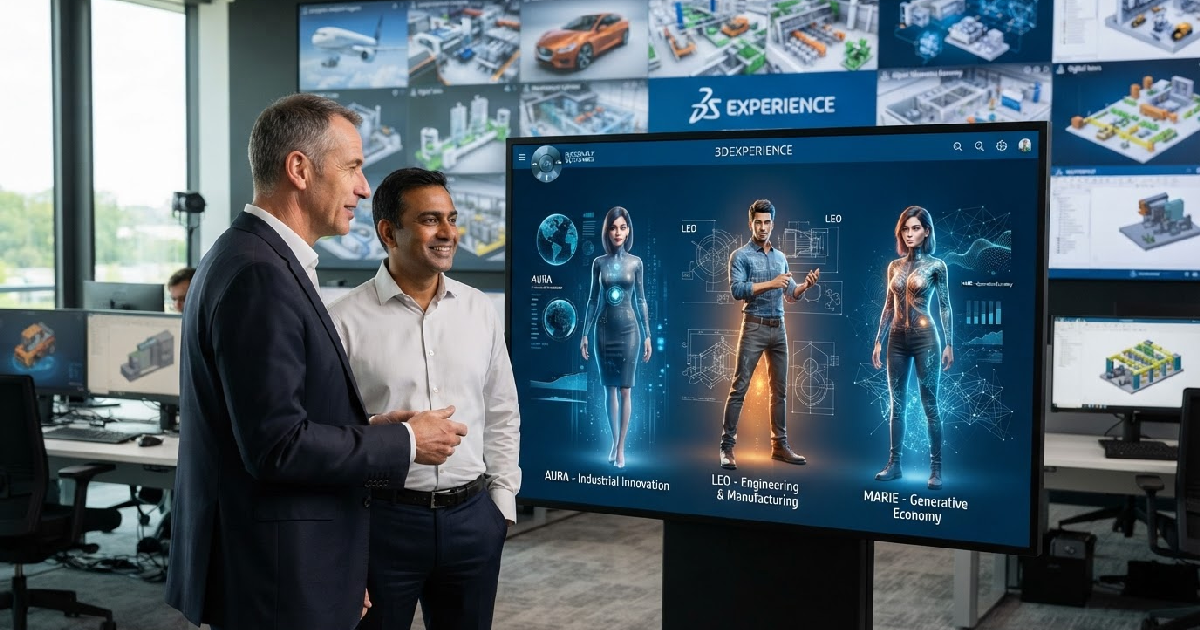
Dassault Systèmes has expanded its 3DEXPERIENCE platform with the addition of three AI-powered virtual companions: AURA, LEO, and MARIE.
This move enables industries to tackle complex challenges with enhanced precision and speed, aligning with the company’s vision for a “Generative Economy”. This is where scientific knowledge and industrial know-how drive the creation of tangible products and systems. Pascal Daloz, CEO and Chairman of Dassault Systèmes, oversees this strategic direction, with SOLIDWORKS CEO Manish Kumar having previously demonstrated the AI assistants.
How Dassault virtual companions transform industrial workflows
These virtual companions are far more than mere chatbots; they are AI-powered digital partners equipped with 19 distinct competencies. They interpret user intent within specific industrial contexts, make informed decisions, and generate outcomes grounded in scientific principles and industry-accurate reality. This deep contextual understanding sets them apart from more general large language models (LLMs).
They operate directly on real project data, including CAD models, requirements, and simulations, providing a contextual grasp that generic AI solutions simply can’t match. These companions guide users, uncover unseen insights, explore new possibilities, and execute relevant tasks across various industrial workflows.
Their secure operation relies on AI factories from OUTSCALE, Dassault Systèmes’ global cloud and AI operator, strategically deployed across three continents to protect sensitive data and intellectual property.
AURA orchestrates programme management
AURA, serving as the business expert, concentrates on programme management and orchestration. It manages knowledge and context across requirements, projects, and changes in complex industrial undertakings. This ensures teams maintain alignment and consistency throughout large-scale initiatives.
The system empowers users by drawing upon existing enterprise knowledge and know-how, streamlining project oversight. It reduces potential bottlenecks in multi-faceted operations and keeps projects on track through clear, context-aware guidance.
LEO streamlines engineering and manufacturing
LEO, the engineering specialist, supports intricate engineering tasks from initial design through to production. It helps engineers analyse technical problems, explore alternatives, and make critical technical decisions with speed and confidence. LEO can generate Manufacturing Bills of Materials (MBOM) proposals directly from product structures.
This capability dramatically cuts MBOM creation and update efforts by 90% to 95%, while boosting manufacturing engineering efficiency by up to 50%. LEO also reduces industrialisation lead time by a quarter. It does this by assisting with work instruction translation for shop-floor clarity and automating bulk updates, tool strategy, and path improvements in NC machine programming.
MARIE advances scientific research
MARIE, the scientist in this trio, offers deep scientific expertise across diverse disciplines such as materials science, chemistry, formulations, and therapies. Its primary function involves investigating complex phenomena and applying this knowledge to real-world industrial problems.
MARIE also aids in formulating new hypotheses and exploring potential technological breakthroughs. This accelerates research and development within industrial settings, enabling faster prototyping of scientific ideas and a quicker path to discovery.
Dassault Systèmes’ legacy in 3D design and PLM
Dassault Systèmes has a long history of industrial innovation, originating as a spin-off from Dassault Aviation in 1981. Charles Edelstenne and Francis Bernard founded the company, launching its first product, CATIA (Computer-Aided Three-dimensional Interactive Application), the same year. CATIA quickly became central to 3D design in aeronautics and later the automotive industry.
By 1984, Boeing adopted CATIA for its aircraft design, notably for the Boeing 777 by 1998. The company expanded its market presence further by acquiring SolidWorks in 1997, targeting the expanding 3D modelling sector.
Bernard Charlès, who joined in 1983, played a key role in developing the digital mock-up (DMU) concept in 1989 and extending it to Product Lifecycle Management (PLM) by 2000, shaping the company’s trajectory toward holistic digital environments.
The 3DEXPERIENCE platform, introduced in 2012, integrated these diverse applications into a unified ecosystem. This platform offers a holistic view of business activities, allowing companies to create and visualise “virtual twins” of products, processes, and operations. This foundational work paved the way for the AI-native agentic capabilities now delivered by these Dassault virtual companions.
The “Generative Economy” and data sovereignty
The introduction of these Dassault virtual companions represents a strategic step towards what Dassault Systèmes calls the “Generative Economy.” This concept, building on the “3D UNIV+RSES” vision unveiled a year prior, focuses on leveraging AI-transformed knowledge and know-how to generate physical objects and complex systems. It marks a significant shift from merely designing to actively and intelligently generating solutions across the entire product lifecycle.
The virtual companions operate within a sovereign infrastructure provided by OUTSCALE, Dassault Systèmes’ cloud and AI operator. This setup ensures that customers access industrial-grade AI at scale while their proprietary data and intellectual property remain fully protected. This addresses a critical concern for industrial enterprises adopting advanced AI, allowing secure innovation and development across three continents.
The broader impact on industrial innovation
The deployment of such advanced industrial AI assistants is set to accelerate innovation cycles, reduce time to market, and lower product development costs. By enabling humans and AI to collaborate seamlessly on complex challenges, these tools ensure greater accuracy, traceability, and reliability. This is achieved through extensive simulation and validation, occurring long before any physical production begins.
The integration of these capabilities into the 3DEXPERIENCE platform offers a vision for the future of manufacturing and engineering. It allows industries to move closer to creating comprehensive virtual representations of products and processes. This fosters a highly interconnected and intelligent industrial landscape, where design, simulation, and manufacturing are intrinsically linked.
