


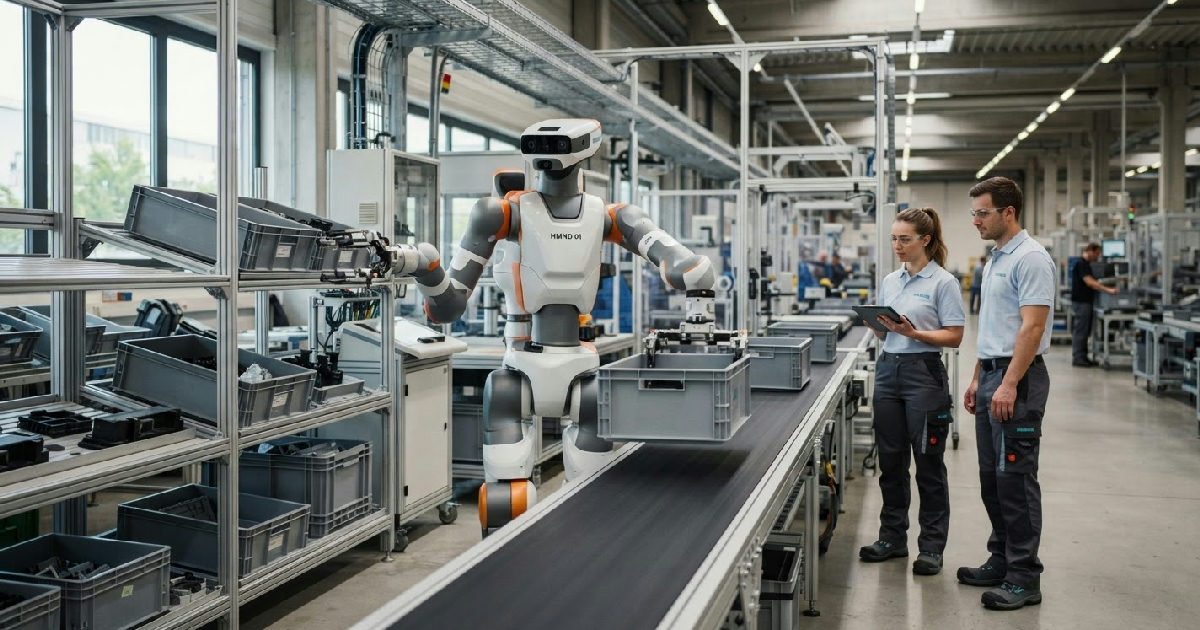
Humanoid Siemens complete logistics at Erlangen factory
Siemens’ Erlangen factory is now using robots from UK-based AI and robotics firm Humanoid to automate logistics.
The project specifically addressed the automation of repetitive material handling. The POC focused on a critical tote-to-conveyor destacking task, where the HMND 01 robot autonomously picked totes from storage, transported them, and placed them onto a conveyor for human operators. This demonstration validated the robot’s capability to execute continuous, repetitive tasks, addressing long-standing needs for enhanced efficiency and labour support in demanding industrial environments.
Validating Performance and Reliability in Industrial Settings
The successful proof of concept was structured in two distinct phases, designed to rigorously test the HMND 01 robot under varying conditions. The initial phase involved extensive in-house development and demonstration, where Humanoid engineers built a physical twin. This digital replica supported rapid iteration and optimisation of the robot’s functionalities before its critical on-site deployment.
The second phase saw a two-week on-site deployment at the Siemens Electronics Factory. Here, partners measured the robot’s performance and reliability during autonomous operation, meeting all target metrics.
The HMND 01 achieved a throughput of 60 tote moves per hour, handled two different tote sizes, and performed continuous autonomous task execution for more than 30 minutes. Its operational uptime also exceeded eight hours, a crucial benchmark for industrial readiness.
Both the overall pick and place success rate and the autonomous pick and place success rate surpassed 90%, demonstrating the robot’s precision and consistency. These figures are vital for industrial adoption, indicating that the robot can reliably perform its assigned tasks without frequent human intervention.
This rigorous testing in a live production environment provides compelling data for the practical deployment of humanoid robots in tasks that traditionally require human labour, offering a tangible solution to operational bottlenecks.
A Broader Partnership for Physical AI in Factories
This initial proof of concept represents the first step in what Humanoid and Siemens intend as a long-term strategic collaboration. The companies anticipate expanding the scope of their partnership, exploring additional use cases, and potentially initiating a broader rollout of humanoid robots across various Siemens facilities.
This expansion would leverage the specific skill sets developed by the HMND 01 and future iterations, integrating them further into complex manufacturing workflows.
Artem Sokolov, founder and CEO of Humanoid, articulated his company’s commercial focus, stating, “At Humanoid, we are a commercially driven company. Our focus is on creating robots that deliver measurable value in real-world settings.” He emphasised the importance of validating systems against real operational requirements, moving beyond lab environments.
Stephan Schlauss, Global Head of Manufacturing Motion Control at Siemens AG, highlighted the Electronics Factory Erlangen’s role as a “customer zero” for Siemens, where new automation technologies are rigorously tested internally before broader implementation across its network.
This partnership also benefits from the deep collaboration between Siemens and NVIDIA, which aims to build AI-driven, adaptive factories. The HMND 01 robot itself relies on the NVIDIA physical AI stack, incorporating the Jetson Thor edge computer and Isaac Sim for its operational intelligence.
This integration is vital for advancing physical AI applications in manufacturing, combining NVIDIA’s AI infrastructure with Siemens’ industrial expertise.
Deepu Talla, Vice President of Robotics and Edge AI at NVIDIA, noted that this deployment “paves the way for humanoid robots meeting real production targets on a live factory floor,” underscoring the practical readiness of these advanced systems.
The Global Drive Towards Humanoid Industrial Robots
The successful deployment of Humanoid’s HMND 01 robot within a Siemens facility underscores a broader global trend: the accelerating integration of humanoid robots into industrial settings. The global humanoid robot market, valued at $4.89 billion in 2025, is projected to reach $165.13 billion by 2034, reflecting a compound annual growth rate of over 50%.
This rapid expansion is driven by persistent labour shortages across manufacturing and logistics sectors, coupled with an increasing demand for automating physically demanding and repetitive work.
Humanoid robots offer a distinct advantage as their human-like form allows them to operate in environments already designed for people, potentially reducing the need for extensive infrastructure modifications. This adaptability is critical for factories seeking to upgrade automation without complete overhauls.
Major players like Tesla with its Optimus, Boston Dynamics with its electric Atlas, and Figure AI with its Figure 02 and 03 models are also making significant strides, deploying their robots in automotive production and logistics centres.
The investment landscape mirrors this enthusiasm, with venture capital funding for humanoid robotics startups reaching $11.0 billion in 2026, more than double the $4.8 billion seen in 2025. This capital infusion is fuelling rapid development and deployment, moving these advanced machines from research labs into operational environments.
Companies like Humanoid are at the forefront of this shift, demonstrating that commercially driven innovation can deliver measurable value in real-world settings.
Siemens’ Strategic Commitment to AI-Driven Production
For Siemens, this collaboration with Humanoid is more than a single pilot project; it represents a key pillar in its strategic vision for the factory of the future. Siemens is actively integrating generative AI, industrial copilots, and digital twin technology to address talent shortages and boost productivity across its global operations.
The company aims to increase factory automation levels to between 70% and 80%, a significant jump from the current 30% to 40% in many facilities.
The Siemens Electronics Factory in Erlangen, where the HMND 01 was tested, serves as a “lighthouse” factory for digital transformation and Industry 4.0. This award-winning site manufactures industrial controls and drives, employing approximately 1,000 people. It has already implemented over 100 AI algorithms in various functions, from production and logistics to quality inspection and maintenance.
Siemens plans to invest €500 million to expand this plant by 2030, transforming it into a demonstration site for AI-powered manufacturing and further solidifying its role as an internal testing ground for advanced technologies.
This internal validation strategy, led by figures like Stephan Schlauss, Global Head of Manufacturing Motion Control, ensures that technologies are robust before being offered to customers. Siemens believes that advanced automation and AI can help preserve manufacturing jobs in high-wage countries by enhancing productivity and allowing human workers to focus on more complex, value-added tasks.
This approach showcases a future where human ingenuity and advanced robotics collaborate to drive industrial output.
Future Implications for Industrial Automation
The successful proof of concept between Humanoid and Siemens signals a tangible shift in the readiness of humanoid robots for widespread industrial deployment. Beyond initial logistics tasks, these robots are expected to take on more complex roles in assembly, maintenance, and service, particularly in environments requiring flexibility and autonomous decision-making.
Potential applications extend to machine tending, packaging, parts feeding, and visual inspection, moving between workstations in general industrial production.
Analysts predict a significant reduction in the average bill-of-materials cost per humanoid robot, potentially decreasing to $13,000–$17,000 by the early 2030s. This cost reduction, coupled with proven performance metrics, will accelerate adoption across various industries. As these machines become more capable and cost-effective, they will play a crucial role in mitigating labour shortages and enhancing operational resilience.
The collaboration between technology developers and industrial end-users, exemplified by Humanoid and Siemens, is essential for translating laboratory advancements into practical factory floor solutions. This partnership, alongside others leveraging AI security manufacturing best practices, is not just about replacing human labour but augmenting it, creating more efficient, adaptable, and productive manufacturing ecosystems globally.
The era of humanoid robots in factories is not a distant vision but a rapidly unfolding reality.
