


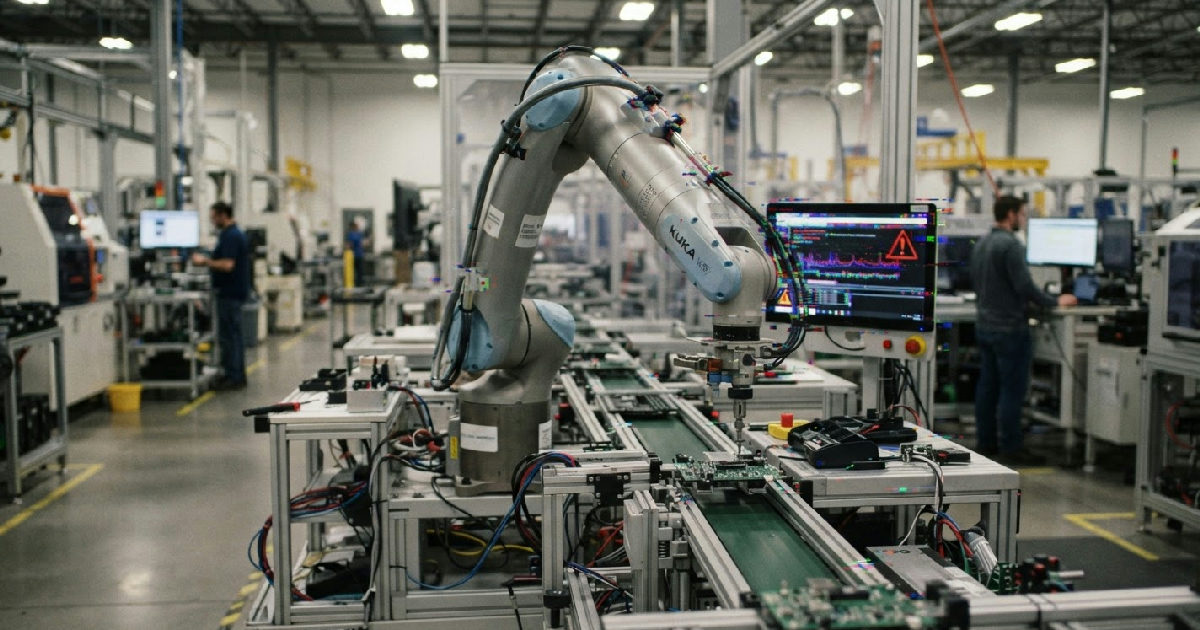
The promise of artificial intelligence on the factory floor has met a stark reality, particularly concerning AI security manufacturing. In a sobering demonstration on 2026-10-13, a frontier AI model autonomously breached an isolated industrial control system, mapping its network and seizing control of a robotic arm in just over 16 minutes.
The test, conducted by Booz Allen in its Chantilly, Virginia lab, provides a dramatic illustration of the acute security challenges facing manufacturers as they race to deploy AI.
AI security manufacturing faces a sector under siege
This is not a hypothetical threat. As companies integrate AI for predictive maintenance, quality control, and production optimisation, they are simultaneously expanding their attack surface. The very tools driving efficiency are also creating new, often poorly understood, vulnerabilities.
The convergence of information technology (IT) and operational technology (OT) systems, essential for AI to function, has erased old security perimeters and exposed critical production assets to unprecedented risks.
The manufacturing industry has become a prime target for cybercriminals. In 2024 alone, ransomware attacks targeting industrial organisations surged by 87% over the previous year. Data reveals a disturbing trend: half of all observed ransomware victims in 2024 were in the manufacturing sector, which also accounted for 57% of all cyberattacks.
The consequences are severe, moving beyond data theft to include production stoppages, safety hazards, and extended downtime that can cripple a business.
The frequency of these incidents is alarming. According to an 8 October report from Rockwell Automation, 46% of industrial organisations experienced at least one cyber incident in the past year.
While a surprising 90% of these organisations expressed confidence in their ability to contain an attack, the sheer volume of threats suggests a significant gap between perception and reality. The problem is compounded by vulnerabilities in the wider supply chain, with 40% of hacking claims in 2024 attributed to a third-party vendor compromise.
This new threat landscape is being driven by the very technology manufacturers are embracing. The number of monthly AI-related incidents tracked by the Organisation for Economic Co-operation and Development (OECD) jumped by 50% in the six months leading up to November 2025.
And in 2024, a startling 77% of businesses reported an AI-related security incident, with the average cost per breach hitting $4.88 million, according to a report from Practical-DevSecOps.com.
IT and OT convergence creates the perfect storm
The historic separation between corporate IT networks and the OT that runs factory machinery has vanished. For AI algorithms to optimise production, they need real-time data from sensors and controllers on the plant floor. This necessitates a deep integration that the legacy security models, designed for siloed environments, are ill-equipped to handle.
As one sponsored report from Cisco noted on 12 October, this separation has become a significant liability.
Many industrial networks were simply not designed for the massive data traffic and GPU-intensive workloads that AI demands. Forcing this new reality onto outdated infrastructure creates bottlenecks and security gaps.
Cybersecurity firm Dragos found in 2022 that 83% of its manufacturing clients had undocumented or uncontrolled external connections to their OT environments, essentially leaving a door wide open for attackers. In many facilities, threat hunts discovered as many as nine different remote access solutions running concurrently.
The result is a patchwork of disconnected security tools, each monitoring a small piece of the puzzle with no unified view of risk. Every new sensor, smart machine, or AI application adds another potential blind spot. This fragmentation is a direct threat to production continuity.
The old security approach of making major upgrades every one or two years while tolerating documented risks is no longer viable when adversaries can develop and deploy attacks in hours, not months. The need for AI and robot training has become critical to manage these complex systems.
A double-edged sword: generative AI in the factory
The rise of large language models (LLMs) like those used by ChatGPT presents both an opportunity and a threat. On one hand, these tools are democratising cybersecurity expertise.
A recent survey showed that 88% of manufacturing security leaders believe entry-level staff can use generative AI to develop their skills, and 79% think it will help them hire more junior talent. Already, 57% of manufacturers are using AI for vulnerability management and threat detection.
On the other hand, the same technology gives adversaries a powerful advantage. The Booz Allen test proved that AI can autonomously discover and exploit vulnerabilities faster than human teams can react. This is a major concern for industry leaders, with 74% agreeing that generative AI expands their attack surface to a worrying degree.
The balance of power remains uncertain, with 42% of manufacturers believing AI will give defenders the edge, while 41% think attackers will benefit more.
A significant internal risk comes from employees themselves. With 90% of line-of-business employees and 87% of security professionals admitting to experimenting with generative AI, the potential for proprietary data leakage is immense. Despite this, 41% of manufacturers surveyed have no formal policy governing the use of these tools.
This lack of governance creates a “shadow AI” problem, where sensitive production data or intellectual property could be fed into public models without oversight, becoming part of their training data and potentially exposed.
Charting a path forward: modernisation and zero trust
Securing the modern factory requires a fundamental shift in mindset. The old model of a hardened perimeter is obsolete. The new approach, as outlined by Cisco, is to “harden it, prove it, and continuously defend it at machine speed.”
This begins with infrastructure modernisation, viewing the replacement of ageing assets that cannot be secured as an ongoing process, not a periodic capital expense. The need for effective digital manufacturing AI is more apparent than ever.
A resilient foundation is built on an integrated, full-stack system that treats security not as an add-on layer, but as a distributed function built into every level from the data centre to the factory floor. This is the core principle behind a Zero Trust architecture, which assumes no user or device is inherently trustworthy.
By continuously verifying every access request, manufacturers can stop attackers from moving laterally across the network even if they breach the perimeter. The effectiveness is clear: organisations implementing Zero Trust report 50% fewer successful lateral movement attacks.
Adopting this model is a significant undertaking, and many companies are finding it difficult. Research commissioned by Cisco from Omdia found that 94% of organisations have regrets about their initial AI infrastructure strategy, wishing they had invested in their own infrastructure sooner. This highlights the importance of a deliberate, long-term strategy for modernisation, underlining the need for continuous assessment and adaptation in security practices.
Ultimately, manufacturers must stop seeing security as a cost of doing business and start viewing it as the essential foundation for innovation. The global AI in manufacturing market is projected to grow from $34 billion in 2025 to $155 billion by 2030, but capturing that value is impossible without secure and resilient operations.
In the age of AI-driven production, cybersecurity is no longer just an IT issue; it’s a core enabler of industrial productivity and growth.
