


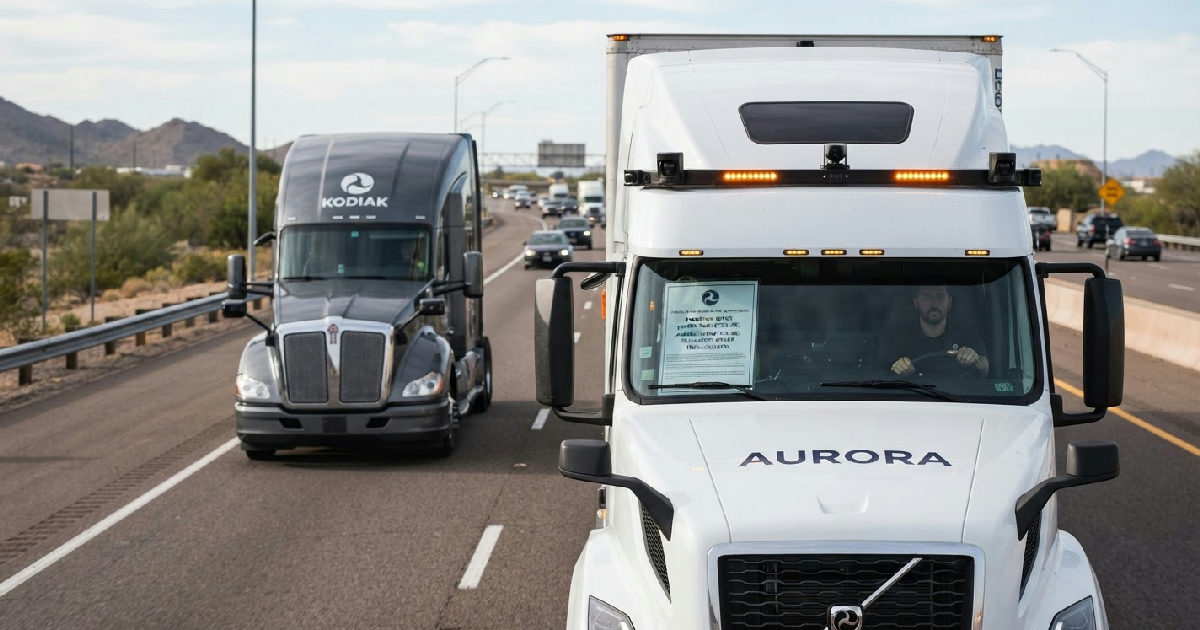
A federal exemption, effective October 7, 2026, has removed a regulatory barrier for self-driving trucks in the United States, granting a five-year waiver to autonomous trucking firms Aurora Innovation and Kodiak AI.
This federal intervention streamlines a contentious safety requirement, accelerating the commercial viability of driverless heavy-duty vehicles. For years, the federal rule mandated that a human driver place reflective warning triangles on the road within 10 minutes if a traditional big rig encountered trouble. But without a human operator, this task became an intractable problem for autonomous trucks.
Regulatory Roadblock Lifted for Federal Exemption Self-Driving Trucks
The core of the issue lay in a safety protocol designed for human-operated vehicles. When a conventional truck broke down or needed to pull over, its driver was legally obliged to exit the cab and place physical warning triangles to alert other road users. This made inherent sense for traditional logistics, ensuring visible safety measures around stationary vehicles.
However, this requirement created an obvious paradox for self-driving trucks. An autonomous vehicle, by definition, operates without a human at the controls, making the manual deployment of warning devices impossible. This regulatory gap became a major hurdle, preventing the widespread adoption and commercialisation of this advanced technology.
Aurora Innovation had previously taken federal safety regulators to court over this mandate, arguing its impracticality for autonomous systems. After an initial denial, the company escalated its legal challenge to the District of Columbia Court of Appeals, highlighting the industry’s determination to overcome such prescriptive rules. While legal proceedings continued, some companies operated under temporary waivers, underscoring the urgency of a permanent solution.
The new five-year exemption, running through 2031-10-07, allows companies to replace these traditional roadside warning devices with cab-mounted warning beacons. This alternative solution provides immediate, high-visibility alerts to other motorists without ever requiring a person to step out of the truck, thereby enhancing safety for all road users, particularly in potentially hazardous roadside environments.
Industry Acclaim for Enhanced Safety and Efficiency
The industry has welcomed the FMCSA’s decision as a significant step forward. Daniel Goff, Vice President of External Affairs at Kodiak AI, emphasised the transformative potential of the ruling, stating it will help “usher in an autonomous era of freight movement on U.S.
roads, one that can save lives and improve the efficiency of goods delivery.” This reflects a broader industry belief that autonomous vehicles can reduce human error, a leading cause of accidents.
Gerardo Interiano, Aurora’s Head of Government Relations and Public Affairs, echoed this positive sentiment, affirming that the decision “underscores the government’s recognition of the economic and community benefits of autonomous trucking.”
He highlighted the cab-mounted warning beacons as a “critical, 21st-century solution that enhances roadside safety by immediately alerting other road users without ever needing to put a person in harm’s way.” The technology offers a safer, more immediate response than manual triangle placement.
The move also suggests a growing alignment between regulatory bodies and technological innovators, moving past prescriptive rules towards performance-based safety outcomes. This regulatory flexibility is crucial for fostering innovation in sectors like autonomous driving, where new solutions often challenge existing frameworks. Such changes are vital for the continued progress of modern logistics.
California Opens its Roads to Heavy-Duty Autonomous Vehicles
While the federal exemption addresses a critical operational detail, the broader regulatory landscape for autonomous trucking continues to evolve, particularly in key states. California, a pivotal market for transportation and technology, has demonstrated a significant shift in its approach to heavy-duty autonomous vehicles. This move signals a willingness to integrate advanced logistics solutions into its extensive freight network.
Just last year, in September 2023, California lawmakers passed Assembly Bill 316 (AB 316), which aimed to ban autonomous semi-trailer trucks and required a trained human safety operator in any truck weighing 10,001 pounds or more on public roads.
This bill passed the state Senate with a substantial vote of 36-2, reflecting considerable concern over job displacement and safety from labour groups, notably the International Brotherhood of Teamsters.
However, Governor Gavin Newsom ultimately vetoed AB 316 on September 23, 2023. In his veto letter, Newsom argued that the bill was “unnecessary for the regulation and oversight of heavy-duty autonomous vehicle technology in California, as existing law provides sufficient authority to create the appropriate regulatory framework.” His decision prioritised the state’s ability to develop its own nuanced regulatory approach over a blanket ban.
Following this, the California Department of Motor Vehicles (DMV) adopted new autonomous vehicle (AV) regulations on April 28, 2026. These regulations marked a turning point, removing the previous prohibition on operating AVs with a Gross Vehicle Weight Rating (GVWR) of 10,001 pounds or more.
This effectively opened California’s roads to heavy-duty autonomous vehicle technology for both testing and deployment, aligning the state more closely with federal pushes for autonomous vehicle integration.
Manufacturers seeking driverless testing permits under the new California rules must complete extensive testing. The requirements include 500,000 miles of testing for heavy-duty vehicles at each phase, with at least 100,000 of those miles specifically completed on California roads. Additionally, companies must prepare a structured safety case, demonstrating a rigorous approach to autonomous operations.
Despite these advancements, the California Teamsters union filed a lawsuit in August 2026, challenging the DMV’s new rules on procedural grounds, indicating continued scrutiny from labour interests.
Expanding Commercial Routes and Operational Readiness
With regulatory hurdles slowly clearing, autonomous trucking companies are rapidly expanding their commercial operations. Aurora Innovation, for instance, launched its commercial driverless service between Dallas and Houston in May 2025. This initial route proved the operational viability of their autonomous system in a real-world commercial setting, handling significant freight volumes.
Since that launch, Aurora has steadily expanded its network. Its self-driving trucks now operate on additional routes, including Fort Worth to El Paso, El Paso to Phoenix, Fort Worth to Phoenix, and Laredo to Dallas. These routes cover substantial distances across major logistics corridors, demonstrating the growing reliability and scalability of Aurora’s autonomous technology in long-haul freight.
Kodiak AI is also making considerable strides in operational deployment. The company recently established a new 435-mile autonomous route between Dallas and Laredo, Texas, in partnership with carrier Charger USA. Along this route, Kodiak AI’s self-driving trucks are transporting both refrigerated and dry freight for consumer packaged goods and food and beverage customers.
This showcases the versatility of autonomous platforms to handle diverse cargo types. Expanding fleet operations like these are crucial for broader adoption.
Kodiak AI currently operates 35 driverless trucks commercially in Texas, a state that has been more receptive to autonomous vehicle testing and deployment. The company also reports reaching 93% on its readiness index as it prepares for fully driverless long-haul routes. This metric highlights the systematic approach autonomous developers take to ensure safety and performance before widespread deployment, signifying a meticulous path toward full automation.
The Broader Impact on Logistics and Industrial Productivity
The FMCSA’s exemption, coupled with shifting state-level regulations, represents more than just a minor technical adjustment; it signifies a maturing regulatory environment for autonomous vehicles. This move sets a crucial precedent, suggesting that regulators are willing to adapt existing frameworks to accommodate new technologies, provided robust safety alternatives are in place. This flexible approach is essential for industrial progress.
Such regulatory clarity is vital for attracting continued investment and accelerating the development of autonomous trucking. Companies can now plan long-term deployment strategies with greater certainty, which will likely lead to increased efficiency in supply chains. Less time spent navigating ambiguous rules means more resources dedicated to refining the technology and expanding its reach. Advancements in AI robot training are also propelling related industrial automation.
This development could also spur innovation in related fields. As autonomous trucks become more prevalent, demand for infrastructure adaptations, new telematics systems, and advanced maintenance protocols will grow.
It poses a pertinent question: could these cab-mounted warning beacons, designed for autonomous trucks, eventually become standard equipment across the entire trucking industry, enhancing safety for human-driven vehicles too? This could create a unified safety standard on highways.
Looking Ahead: The Future of Freight Movement
The journey towards fully autonomous freight movement on U.S. roads remains complex, with technological, social, and economic factors still to navigate. However, this recent federal exemption marks a tangible and positive step. It directly addresses a practical operational challenge, demonstrating that regulatory bodies are capable of adapting to the rapid pace of innovation in the technology sector.
The economic benefits of autonomous trucking are substantial, promising reductions in operating costs, improved fuel efficiency, and a potential easing of the driver shortage crisis impacting logistics globally. The ability to operate 24/7 with fewer stops for human rest could dramatically reshape supply chains, making them more resilient and responsive to demand fluctuations.
For regions like Africa, where infrastructure development and logistics efficiency are critical for industrial growth, lessons from the U.S. regulatory evolution in autonomous trucking could prove invaluable. As African nations look to modernise their transport networks and boost manufacturing capacity, the adoption of clear, forward-thinking policies around autonomous technologies will be crucial.
This technology holds potential to dramatically improve the movement of goods, driving further advancements in transport across the continent.
While challenges remain, including ongoing debates around job displacement and public acceptance, the FMCSA’s decision represents a pivotal moment. It’s a clear signal that the U.S. is committed to integrating autonomous technology into its national freight system, paving the way for a more efficient, and potentially safer, future for road transport.
