


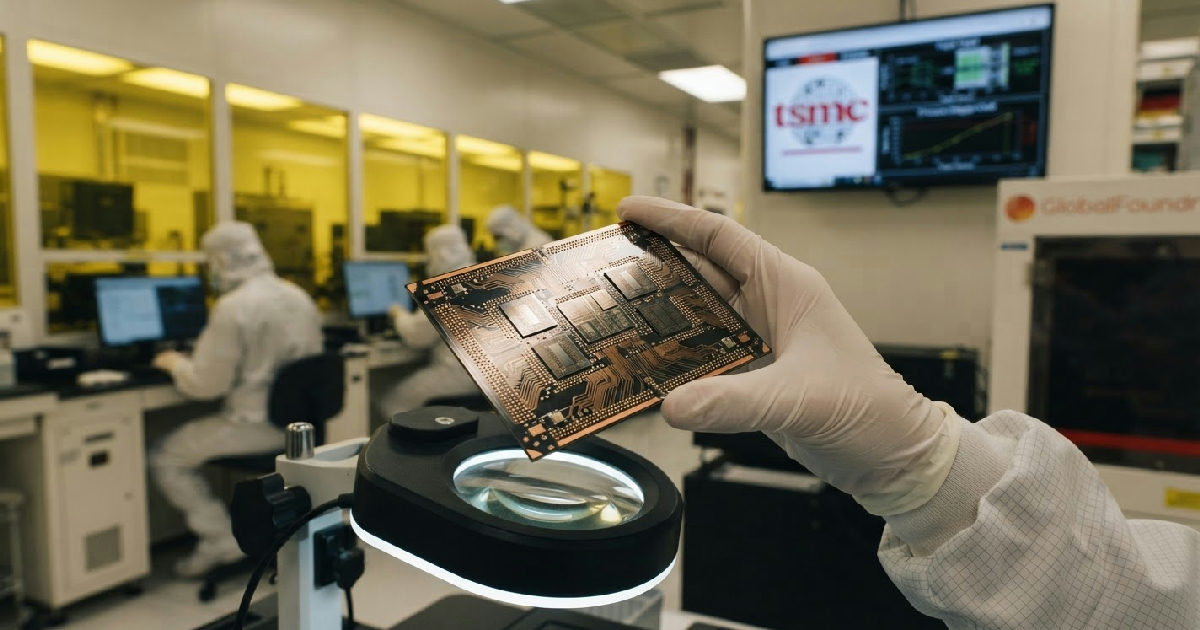
Taiwan Semiconductor Manufacturing Company (TSMC) will source US-made silicon interposers, a key component in advanced chip packaging, from GlobalFoundries (GF) under a $2 billion agreement.
Under the agreement, GlobalFoundries will expand its fabrication facility in Malta, New York, to produce custom silicon interposers for TSMC. The project is intended to address demand for advanced packaging and diversify the US semiconductor supply chain. Production is expected to ramp up in the first half of 2028.
The role of CoWoS and silicon interposers
The agreement relates to TSMC’s Chip-on-Wafer-on-Substrate (CoWoS) advanced packaging technology. The process integrates multiple silicon dies, including logic dies and high-bandwidth memory (HBM) stacks, into a single package. It is used in advanced processors for AI computing.
This integration can improve performance and energy efficiency by enabling high-bandwidth connections between components. A silicon interposer is a thin silicon layer that provides dense electrical connections between dies within a package. Limited interposer capacity can constrain production of some AI accelerators.
The expanded Malta facility is also expected to support embedded deep-trench capacitor (DTC) components. The project forms part of broader developments in semiconductor manufacturing and advanced packaging.
Implications for AI chip production
Demand for AI training and inference has increased pressure on the semiconductor supply chain. Companies such as Nvidia and AMD use advanced packaging technologies to integrate processors and high-bandwidth memory. Limited advanced-packaging capacity has been one of the constraints on supplying AI chips.
The agreement is intended to ease this constraint by establishing a US-based source of silicon interposers for TSMC. It would diversify the company’s supply of the component and reduce its reliance on production locations in Asia. The arrangement also complements TSMC’s broader manufacturing investments in the United States.
Building a domestic US advanced packaging ecosystem
The agreement forms part of wider efforts to expand semiconductor manufacturing and advanced packaging in the United States. It complements other major projects intended to establish more domestic capacity across the semiconductor supply chain.
Under a potential domestic supply-chain model, logic dies manufactured at TSMC’s Arizona facilities could be combined with silicon interposers produced at GlobalFoundries’ New York facility. The components would then be sent to a packaging facility for integration with memory and final assembly. This would complement wider investment in semiconductor manufacturing and design.
Potential links between New York and Arizona
Advanced semiconductor packaging has been concentrated in Asia, including Taiwan. The GlobalFoundries–TSMC agreement adds a US-based source of silicon interposers, potentially supporting closer links between manufacturing operations in New York and Arizona.
TSMC is also pursuing advanced packaging capabilities in Arizona. Separately, Amkor Technology is developing an approximately $2 billion advanced packaging and test facility in Peoria, Arizona.
Amkor’s project has been awarded up to $407 million in direct funding under the US CHIPS Act, with production expected to begin in early 2028. This schedule broadly overlaps with GlobalFoundries’ planned production ramp-up in the first half of that year.
Together, these projects could support a more extensive US-based semiconductor supply chain. In a potential arrangement, logic dies manufactured in Arizona could be combined with interposers produced in New York before being sent to a facility for final packaging and testing.
What the agreement means for GlobalFoundries and TSMC
For GlobalFoundries, the agreement provides a five-year manufacturing arrangement valued at $2 billion and expands the role of its Malta facility in the advanced-packaging supply chain. The company’s shares rose approximately 4% in premarket trading after the announcement.
Under the agreement, GF will provide manufacturing services to TSMC for silicon interposers used in its advanced-packaging ecosystem. The company says the additional capacity will support future expansion as demand grows. ‘By providing manufacturing service using GF’s trusted U.S. manufacturing footprint, we are creating a secure, scalable source of essential advanced-packaging elements,’ said Ed Kaste, senior vice-president of CMOS Business at GlobalFoundries.
For TSMC, the agreement adds a US-based source of silicon interposers, diversifying supply for a component used in its CoWoS packaging ecosystem. It may reduce reliance on production in Asia and complement the company’s wider US manufacturing investments.
The road ahead to 2028
The agreement marks the start of an expansion programme at GlobalFoundries’ Malta facility. The company will need to install the required equipment and scale up manufacturing processes to meet its target of beginning the production ramp-up in the first half of 2028.
Semiconductor fabrication requires tight process control, clean manufacturing environments and inspection systems to maintain component quality and reliability.
Although the agreement will establish interposer production in the United States, the location and timing of final packaging will depend on the development of additional advanced-packaging capacity. TSMC’s and Amkor’s Arizona projects could contribute to that capacity, subject to their respective schedules.
Depending on where final packaging takes place during the initial production phase, some US-made interposers may need to be shipped to Asia for integration into finished chip packages. Establishing a more extensive US-based supply chain will depend on the availability of domestic packaging and testing capacity.
