


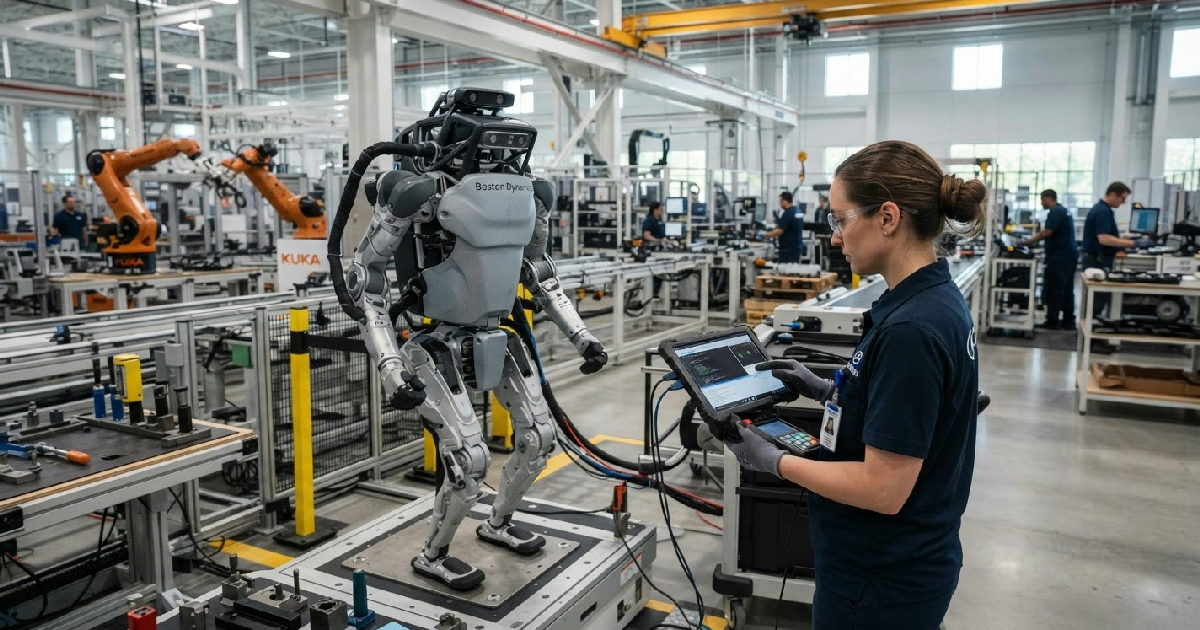
Hyundai Motor Group and Boston Dynamics are expanding their work on AI-enabled robotics for manufacturing following the opening of a dedicated applications centre in Georgia. The Robotics Metaplant Application Center (RMAC) is being used to train and validate Boston Dynamics’ Atlas humanoid robot for manufacturing tasks.
Hyundai Motor Group unveiled its AI Robotics Strategy at CES 2026 in January, outlining plans to expand robotics across manufacturing and other applications. The strategy includes collaboration with Boston Dynamics and the use of Hyundai Motor Group’s manufacturing network to train and validate robots. The companies plan to use Atlas initially for manufacturing tasks such as parts sequencing and material handling, with broader applications planned over time.
Establishing the AI Robot Training Manufacturing Application Center
The Robotics Metaplant Application Center (RMAC) opened at Hyundai Motor Group Metaplant America (HMGMA) in Georgia on 21 September 2026. The facility serves as a testbed and training centre for integrating Atlas into Hyundai Motor Group’s manufacturing operations.
RMAC is located within HMGMA in Bryan County, Georgia, near Savannah. Hyundai says pilot operations began in June 2026. Its initial role is to train and validate Atlas for manufacturing tasks before planned deployment at HMGMA.
The initial phase of RMAC is now operational. Hyundai plans to move RMAC into a facility approximately ten times larger in 2027. This expansion underscores the scale of Hyundai’s ambition in automated manufacturing.
Training Atlas through physical AI
Training robots to operate reliably in changing physical environments remains an important challenge for wider deployment. Atlas uses AI-based learning alongside robotics hardware to develop capabilities for tasks in physical environments.
This training methodology combines several advanced approaches. Human operators can teleoperate Atlas during training, generating physical-world data that can be used to develop and refine the robot’s AI models. Motion-capture data can also be used to demonstrate movements that can subsequently inform robot training.
Simulation can supplement physical-world training by allowing robot behaviours to be tested across different scenarios. This includes navigating uneven floors or operating with limited mobility, allowing the AI to identify and refine stable movement strategies.
Skills developed and validated through simulation and physical testing can be incorporated into the robot’s software and subsequently deployed across compatible units.
Hyundai’s Long-Term Robotics Investment
Hyundai Motor Group acquired an 80% stake in Boston Dynamics in 2021. In 2026, Hyundai pursued the acquisition of SoftBank’s remaining 9.65% stake for $325 million, which would make Boston Dynamics a wholly owned subsidiary.
The proposed acquisition would give Hyundai full ownership of Boston Dynamics and further integrate the robotics company into Hyundai Motor Group’s robotics strategy.
Marc Raibert, Executive Director of Boston Dynamics AI Institute, emphasised this, stating their mission to create future generations of advanced robots that are “smarter, more agile, perceptive and safer than anything that exists today.”
Hyundai Motor Group also plans to invest approximately 9 trillion won (about $6.3 billion) in the Saemangeum area of South Korea from 2026. The project includes an AI data centre, a robotics manufacturing and components cluster, hydrogen infrastructure and solar-power facilities. The robotics cluster is expected to be completed in 2029.
Deployment Goals and Expanding Applications
Hyundai has outlined a phased deployment plan for Atlas. Hyundai Motor Group plans to deploy 25,000 Atlas units across Hyundai Motor and Kia’s global plants over the coming years. Full-scale deployment at HMGMA is planned from 2028, initially for parts-sequencing work.
Hyundai plans to expand Atlas into component-assembly processes from 2030. Over time, Hyundai plans to apply Atlas to repetitive and physically demanding tasks, including heavy-load handling. This mirrors the broader trend towards smart manufacturing across industries.
Boston Dynamics also plans to explore Atlas applications beyond automotive manufacturing. Next year, the company will investigate use cases in other industrial sectors, including aerospace, semiconductors, logistics, food and beverage, and life sciences. The planned applications would extend Atlas beyond automotive manufacturing into several other industrial sectors.
To support this large-scale deployment, Hyundai Motor Group will establish a new production facility in the U.S. capable of manufacturing 30,000 robots annually. The facility is intended to support Hyundai’s planned expansion of Atlas production.
Implications for industrial automation
The RMAC programme provides a test case for the use of humanoid robots in industrial environments. The training programme focuses on testing how Atlas can operate in real-world manufacturing environments and adapt to different tasks.
Zack Jackowski, Chief Product & Technology Officer at Boston Dynamics, captured this vision, stating that “Together with Hyundai Motor Group, we are pioneering physical AI at enterprise scale.” He added that RMAC reinforces their “shared ambition to create a future where robots amplify human potential by making work safer and more productive.”
If deployed at scale, humanoid robots could change how manufacturing tasks are allocated between automated systems and human workers.
Goldman Sachs Research has projected that the global humanoid-robot market could reach $38 billion by 2035. The research also identifies remaining challenges around robot manipulation, software and production capacity. If Atlas reaches commercial-scale deployment, Hyundai expects the technology to support improvements in safety, quality and productivity across selected manufacturing processes.
As humanoid robotics develops, similar systems could eventually be considered by smaller manufacturers, although adoption will depend on factors including cost, reliability, safety and the suitability of individual tasks. RMAC’s training and validation programme will provide further evidence on the technical and operational requirements for deploying humanoid robots in manufacturing.
