


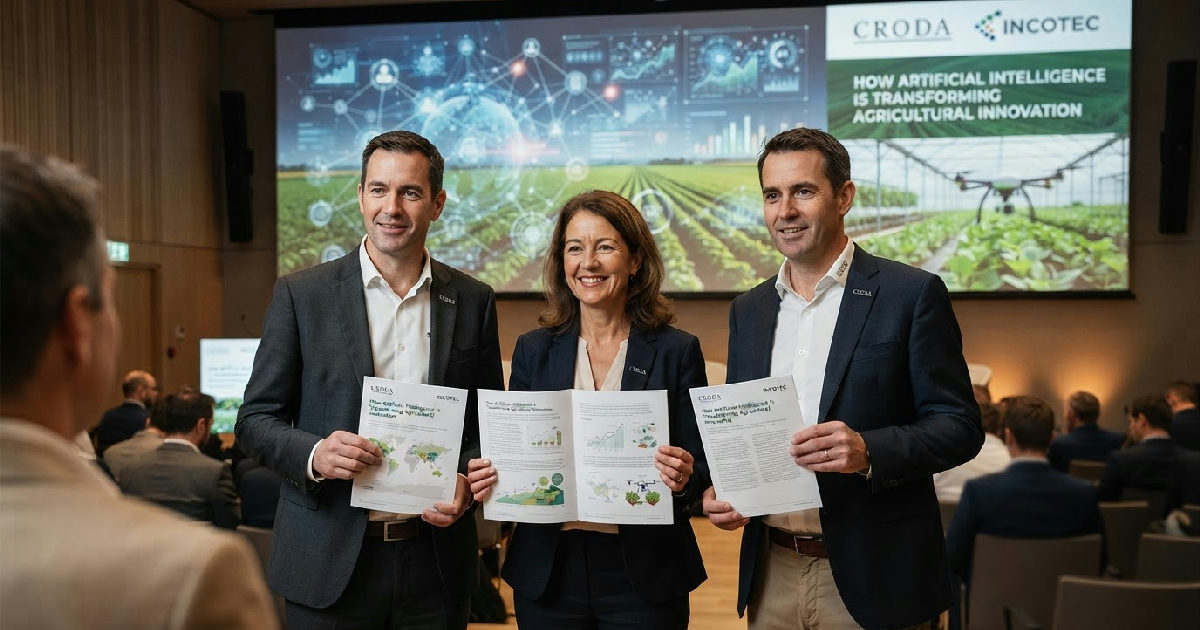
A white paper from Croda Agriculture and its seed enhancement business, Incotec, examines how artificial intelligence (AI) could be used in agricultural research and development.
The paper examines practical applications of AI across agricultural research and development. It describes potential applications ranging from historical data analysis to AI-assisted seed quality assessment. The report discusses how AI could support the development of agricultural products and methods intended to improve productivity, resilience and sustainability.
White paper examines AI in agricultural R&D
Artificial intelligence is being explored as a tool for changing how agricultural R&D is conducted. The white paper, titled ‘How Artificial Intelligence is Transforming Agricultural Innovation’, describes how AI can help researchers identify potential research opportunities more quickly. It can also help researchers identify patterns in historical datasets.
For agricultural manufacturers and suppliers, AI offers additional ways to analyse complex scientific data. It could shorten the time required to move some research findings towards commercial application. AI models can help researchers screen potential ingredients or formulations through in silico experiments before conducting physical trials.
Generative AI can also propose candidate formulations for researchers to evaluate. AI can also be used to analyse phenotypic observations alongside genetic data. This analysis may help researchers predict which plant varieties are more likely to exhibit desired traits.
AI and imaging support seed quality assessment
One application discussed in the report concerns Incotec, Croda’s seed enhancement business. The example involves using AI to analyse X-ray images as part of tomato seed quality assessment. The method combines X-ray images with historical germination data.
Researchers can use the analysis to identify patterns associated with seed performance. The findings may help researchers make decisions about seed treatment and seed selection. Such assessments may help inform decisions intended to improve seed performance and crop establishment.
The example illustrates how AI-assisted image analysis can be applied to seed quality assessment.
Data quality and collaboration in agricultural AI
Developing AI applications for agriculture involves more than selecting the technology. Croda emphasises the importance of data quality, organisational capability and collaboration. Thomas Riermeier, president of life sciences at Croda, highlighted these considerations.
“The question is no longer whether artificial intelligence will influence agricultural innovation. It is already transforming the way our industry discovers, develops and delivers solutions to some of agriculture’s biggest challenges,” Riermeier stated. He also noted that “Success depends on bringing together scientific expertise, trusted data and strong partnerships across the agricultural ecosystem.”
The report draws on contributions from organisations across the agricultural value chain. Contributors include BASF, Rijk Zwaan, Dotmatics and the University of Amsterdam Business School. Their contributions address the relationship between scientific expertise, data and technology. The report presents collaboration across these fields as one way to support the development of solutions for growers.
Organisational Readiness for AI Integration
Introducing AI into agricultural manufacturing and R&D teams can create organisational challenges. The white paper highlights the importance of establishing reliable data foundations. Companies must ensure their data is clean, accessible, and structured for AI analysis.
Workforce preparation is another consideration. Researchers need the skills to interpret AI-generated outputs and assess them alongside established scientific knowledge. Dr Finn Bauer, vice-president of R&D for life sciences at Croda, highlighted the importance of scientific expertise in AI adoption.
“AI is already helping researchers uncover insights from complex scientific data and identify promising opportunities more quickly,” Bauer said. He added that “The greatest impact will come when we combine these emerging capabilities with deep scientific expertise and closer collaboration across the agricultural value chain.”
The report’s discussion of AI adoption also raises questions about the skills and resources companies need to implement these technologies.
Potential applications of AI in sustainable agriculture
Croda’s report examines how AI could contribute to agricultural practices intended to improve sustainability. AI may help farmers optimise resource use, assess crop conditions and inform decisions about agricultural inputs. Predictive models may help farmers identify emerging risks and respond before some problems worsen.
James Hunt, Global Strategy Director for Croda Agriculture, noted in June 2025 that “Farming is becoming smarter through the use of AI. Where predictive agriculture is replacing reactive responses, with AI, droughts, pests, and crop health issues can be anticipated, enabling action before problems arise.” Such applications could contribute to food security by helping farmers identify and respond to agricultural risks.
One market forecast estimates that the global AI-in-agriculture market could grow from US$4.21 billion in 2025 to US$23.93 billion by 2035, representing a projected compound annual growth rate (CAGR) of 18.8%. This growth reflects the industry’s recognition of AI’s potential.
AI-enabled precision agriculture can help tailor the application of water, seeds, fertilisers and pesticides to local crop and field conditions. Some studies report potential improvements in crop yields and input efficiency from precision agriculture, although results vary by crop, location, technology and implementation. The potential environmental benefits depend on how the technology is implemented and whether it reduces unnecessary inputs without creating other environmental costs.
The EU’s Common Agricultural Policy for 2023–2027 includes measures that can support the modernisation and digitalisation of agriculture. The EU AI Act entered into force in August 2024 and establishes rules for AI systems according to their risk classification. Whether a particular agricultural application is subject to high-risk requirements depends on its intended use and the Act’s applicable provisions.
Croda’s report emphasises collaboration among researchers, suppliers, manufacturers, technology companies and growers. Sharing expertise and relevant data may support the development of agricultural technologies and products. These applications could help address some of the challenges facing growers, including the need to produce food for a growing global population.
Cross-sector collaboration and investment in data infrastructure may support further development of AI applications in agriculture.
