


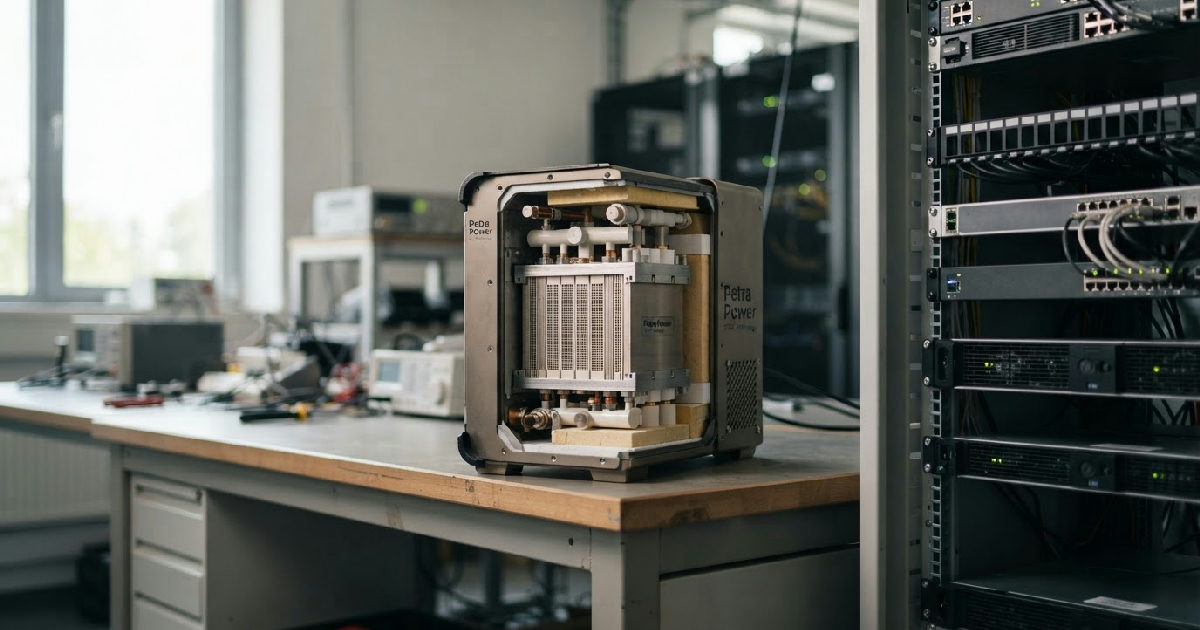
Petra Power is spearheading efforts to modernise power generation for two energy-intensive sectors: data centres and military vehicles, with its cutting-edge solid oxide fuel cells.
Their approach revolves around ceramic devices that convert various fuels directly into electricity without combustion, promising substantial gains in efficiency and reduced environmental impact. This shift represents a significant departure from traditional power generation, offering a compact and lightweight alternative for critical infrastructure and mobile military assets.
Petra Power targets dual markets with solid oxide fuel cells
Petra Power’s innovative solid oxide fuel cell technology is designed to address pressing energy challenges across distinct yet equally demanding industries. The company is actively developing solutions for data centres, which are increasingly burdened by the power requirements of AI workloads, and for the defence sector, seeking more efficient auxiliary power for ground vehicles.
Aaron Goodman, the company’s founder, explained that their SOFCs significantly reduce fuel costs and emissions compared to conventional power sources. He also highlighted their smaller physical footprint, making them a more compact and lightweight option. This dual-market strategy underpins Petra Power’s ambition to deliver what it calls the “next 100GW of power” for these crucial segments.
SOFC Advantages and Efficiency Gains
The core of Petra Power’s offering lies in its fuel cell efficiency. Traditional power generation, as Goodman described, involves multiple steps: “Combustion takes fuel and creates explosions. Those explosions create heat. That heat creates motion.” These numerous conversions lead to substantial energy loss within the system, making it inherently inefficient.
In contrast, Petra Power’s solid oxide fuel cells streamline this process dramatically. They strip electrons directly from the fuel, generating electricity in a single step with minimal loss. This electrochemical conversion is theoretically much more efficient, delivering up to three times the fuel savings of conventional generators and turbines.
The SOFC technology offers significant fuel flexibility, capable of running on natural gas, diesel, hydrogen, and JP-8 fuels. This adaptability provides a strategic advantage, allowing for a phased transition from hydrocarbon-based power to zero-emission generation with pure hydrogen. It also helps hedge against potential supply risks.
NASA Technology Powers New Solutions
Petra Power leverages a patented solid oxide fuel cell design originally developed at the NASA Glenn Research Center for manned space flight. This heritage provides a foundation of rigorous engineering and proven performance for the company’s commercial and defence applications. This robust technology ensures reliability in demanding environments.
The company has actively licensed this technology, translating key research into a commercial product line. This includes developing 10kW auxiliary power units (APUs) for military vehicles and stationary power generation, in collaboration with LibertyWorks, a wholly-owned subsidiary of Rolls Royce. Such partnerships are vital for scaling advanced technologies.
These SOFC units are designed for exceptional reliability, boasting “five nines” (99.999%) of uptime. Such high availability is paramount for applications where uninterrupted power is not just desirable but essential for operational integrity and data security. The NASA’s hydrogen power research demonstrates continued advancement in this field.
The Growing Solid Oxide Fuel Cell Market
The global market for solid oxide fuel cells is experiencing substantial expansion, reflecting a broader industrial shift towards more efficient and cleaner energy solutions. This growth underscores the increasing demand for technologies like those offered by Petra Power. The market was valued at $2.81 billion in 2025.
By 2026, it reached $3.59 billion, with projections indicating a rise to $9.3 billion by 2030, marking a compound annual growth rate (CAGR) of 26.9%. Other forecasts predict the market could hit $9.40 billion by 2036, growing at a CAGR of 10.07% from 2027. These figures highlight strong investor confidence and technological maturity.
Key players in this sector include Bloom Energy, a significant force in the SOFC industry, which had shipped over 1.2 GW of cumulative capacity by 2024. Data centre operators represent a rapidly expanding customer segment for these technologies, signifying a clear market pull for high-efficiency power systems. This broader market context validates Petra Power’s strategic focus.
Petra Power’s Strategic Customer Engagement
While the market for SOFCs is growing, Petra Power is meticulously building its customer base, targeting specific segments for initial deployment. Aaron Goodman confirmed the company is currently working with “neoclouds” and other infrastructure providers. These are typically a few steps down from the largest hyperscaler crowd.
Goodman noted that although hyperscalers represent an “ideal customer profile” due to their immense power consumption, definitive agreements with them are still in development. The company aims for its first deployment with infrastructure providers by 2028, with full-scale production expected in 2029. This phased approach allows for refinement and market penetration.
The defence sector also remains a crucial target. Petra Power’s fuel cells are intended to provide auxiliary power for land vehicles, supplying electricity for onboard equipment when the main engine is off. This capability significantly reduces fuel usage, potentially cutting DoD auxiliary fuel consumption by up to 90%.
Despite securing nearly $9 million in Department of Defense contracts, Petra Power’s product has not yet deployed on a live military vehicle. Instead, the fuel cells are undergoing rigorous testing, allowing the government to evaluate the technology before wider adoption. This careful validation process is typical for defence applications.
Driving Efficiency for Data Centres
The burgeoning demands of artificial intelligence are putting unprecedented strain on data centre power infrastructure, making efficient and reliable energy sources a top priority. Petra Power’s SOFCs offer a compelling solution to this growing challenge by providing on-site power generation with reduced operational costs and environmental impact.
Global data centre electricity demand reached an estimated 460-490 TWh in 2025 and is projected to roughly double in the coming years. This surge underscores the urgent need for innovations that can support sustainable growth in the digital economy.
The solid oxide fuel cell market for data centres alone is forecast to reach $2.07 billion by 2035, growing at a 19.2% Compound Annual Growth Rate from 2026.
Addressing AI’s Escalating Power Demand
Artificial intelligence workloads demand immense computational power, translating directly into escalating electricity consumption for data centres. These facilities require consistent, high-quality power to operate without interruption, making traditional grid reliance increasingly risky. On-site power generation mitigates these risks.
Petra Power’s SOFCs provide an efficient alternative to conventional backup generators and grid power, which often struggle to meet the continuous, high-density power needs of modern AI clusters. The technology offers lower emissions and a more compact footprint, valuable attributes for crowded urban data centre locations. Power efficiency is critical for facilities powering high-performance computing, including those requiring advanced AI infrastructure.
Petra Power’s Evolution and Future Outlook
Founded in 2017 by Aaron Goodman and Phillip Clift, Petra Power has evolved from its base at BRITE Energy Innovators in Warren, Ohio. The company is relocating its headquarters to Solon, Ohio, a move that reflects its growth and future ambitions. This expansion includes plans to create 15 to 20 new jobs.
These new positions are expected to generate approximately $2.2 million in new payroll, signalling a positive economic impact for the region. The company has secured $280,000 in total funding, bolstered by a $4 million seed round closed in April 2026, led by Acequia Capital. This financial backing supports its ongoing development and commercialisation efforts.
Aaron Goodman, CEO and co-founder, brings a strong scientific background to Petra Power, with degrees in Physics and Chemistry from Chapman University and prior doctoral research at Princeton University. His work focused on plasma physics and fusion, driven by a desire to develop viable energy solutions. This expertise underpins Petra Power’s technical leadership.
Petra Power was selected for TechCrunch’s Startup Battlefield 200 at Disrupt 2026, a recognition of its potential and innovative approach to energy generation. With its focus on high-efficiency SOFCs for critical infrastructure and military applications, the company is positioning itself as a key player in the future of distributed power. Their progress will be keenly watched.
