


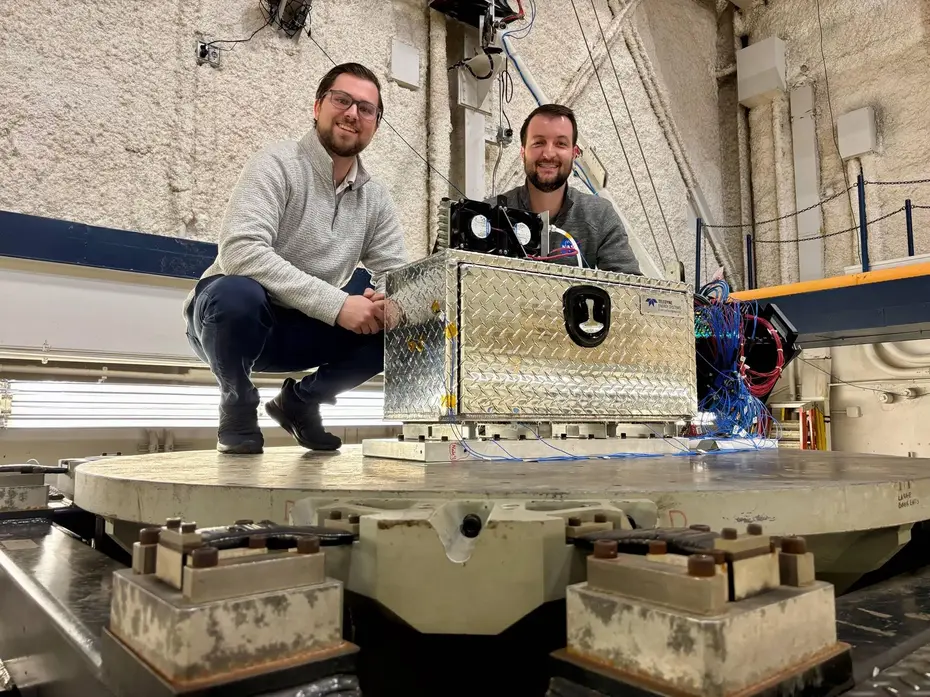
Teledyne Energy Systems, Inc. continues its collaboration with NASA on the Hydrogen Electrical Power System (HEPS).
The joint effort involves NASA’s Glenn Research Center and Johnson Space Center, which are contributing expertise to validate HEPS performance in simulated space environments. This development supports NASA’s longer-term plans for human exploration beyond Earth, where reliable, air-independent power sources would be required. The work is intended to support the development of power systems for extraterrestrial operations.
Advancing Hydrogen Energy Systems for Space
The progression of HEPS from TRL 5 to TRL 7 represents a significant increase in its technology readiness level. At TRL 5, a technology is typically validated in a relevant environment, demonstrating that its core functions have been tested under conditions representative of its intended application. TRL 7 indicates that a prototype has been demonstrated in an operationally relevant environment. However, this level should not automatically be described as readiness for flight qualification unless that status is confirmed by NASA or Teledyne.
This advancement represents a further stage in developing a system intended for space applications. For the hydrogen electrical power system, this advancement represents another stage in developing a system for space applications. The system is designed to provide air-independent power without relying on atmospheric oxygen, which could support applications where access to an atmosphere is limited or unavailable.
Barbara Stachowiak, Vice President and General Manager of Teledyne Energy Systems, has highlighted the role of collaboration in developing space power technologies. Barbara Stachowiak, Vice President and General Manager of Teledyne Energy Systems, has highlighted the role of collaboration in developing space power technologies. Such partnerships can support technology development by combining expertise from industry and government research organisations.
The Hydrogen Electrical Power System Explained
HEPS is a hydrogen fuel cell system designed to operate in environments without access to atmospheric oxygen. HEPS generates electricity through an electrochemical reaction involving hydrogen and oxygen, producing water as a byproduct.
This air-independent capability could make HEPS suitable for off-world applications where atmospheric oxygen is unavailable, such as lunar or deep-space environments. The system builds on Teledyne’s experience in space power and is intended to provide sustained power for space infrastructure. Potential applications include life-support systems in lunar habitats and power requirements for surface exploration vehicles.
Such power systems could support long-duration missions by providing an additional source of electricity. They could provide an additional power source alongside solar systems and radioisotope-based power technologies. Such systems could contribute to mission resilience by providing an additional source of power for isolated operations.
Teledyne’s Space Power Heritage
Teledyne Energy Systems has a long history of developing power systems for space applications. Its involvement dates back to earlier space missions, where the company contributed power technologies for spacecraft and other systems. This experience provides a foundation for HEPS development and draws on the company’s previous work in space power systems.
The company’s work covers power generation and storage technologies developed for space applications. This includes electrolysis systems and fuel cells that have supported numerous missions. This experience is relevant to NASA’s requirements for reliability and performance in space applications.
This accumulated knowledge allows Teledyne to refine its systems with each new generation, addressing requirements for power density, operating life, and system resilience. The ongoing collaboration with NASA further accelerates this refinement, with NASA providing additional testing and development input.
NASA’s Bold Vision for Beyond Earth
NASA is developing technologies to support future lunar missions and longer-term human exploration beyond the Moon. Central to these endeavours is the development of robust and self-sustaining energy infrastructure. Power systems are an important part of mission architecture because they determine how electrical energy can be generated and supplied to spacecraft and surface systems.
NASA’s work on technologies such as HEPS forms part of its broader development of systems for sustained human operations beyond low Earth orbit. This includes everything from powering scientific instruments and life support systems to recharging rovers and supporting manufacturing operations on other celestial bodies. NASA’s Glenn Research Center and Johnson Space Center provide the testing grounds, facilities, and technical expertise for testing and validation.
NASA’s technical expertise and testing facilities provide Teledyne with resources for validating HEPS. The collaboration provides access to testing environments designed to reproduce relevant space-operating conditions and assess system performance. It’s a model of public-private partnership driving advanced manufacturing automation in critical sectors.
Industrial Impact and Terrestrial Spin-offs
While HEPS is being developed for space applications, related advances in hydrogen fuel-cell technology could also have applications on Earth. The requirements of space applications, including operation in vacuum and under extreme environmental conditions, can drive developments that may also be applicable to terrestrial systems. Such development can also contribute to advances in materials science and engineering.
For example, developments in the durability and efficiency of space-grade fuel cells could inform the design of ground-based power systems. Potential terrestrial applications include off-grid power for remote industrial operations, disaster-response equipment and other applications requiring independent power sources. Such applications may require power systems capable of operating independently for extended periods.
Developments in compact hydrogen storage and delivery systems could also have applications in terrestrial hydrogen systems. Potential applications include heavy-duty transport and stationary energy storage, although their suitability would depend on the performance and cost of the resulting technologies. It demonstrates how high-stakes research can drive major industrial investments globally.
The testing and validation requirements for space technologies can also provide reference points for quality control and manufacturing precision in other industries. Industries manufacturing safety-critical or high-reliability products may also apply similar testing and quality-control approaches where appropriate.
