


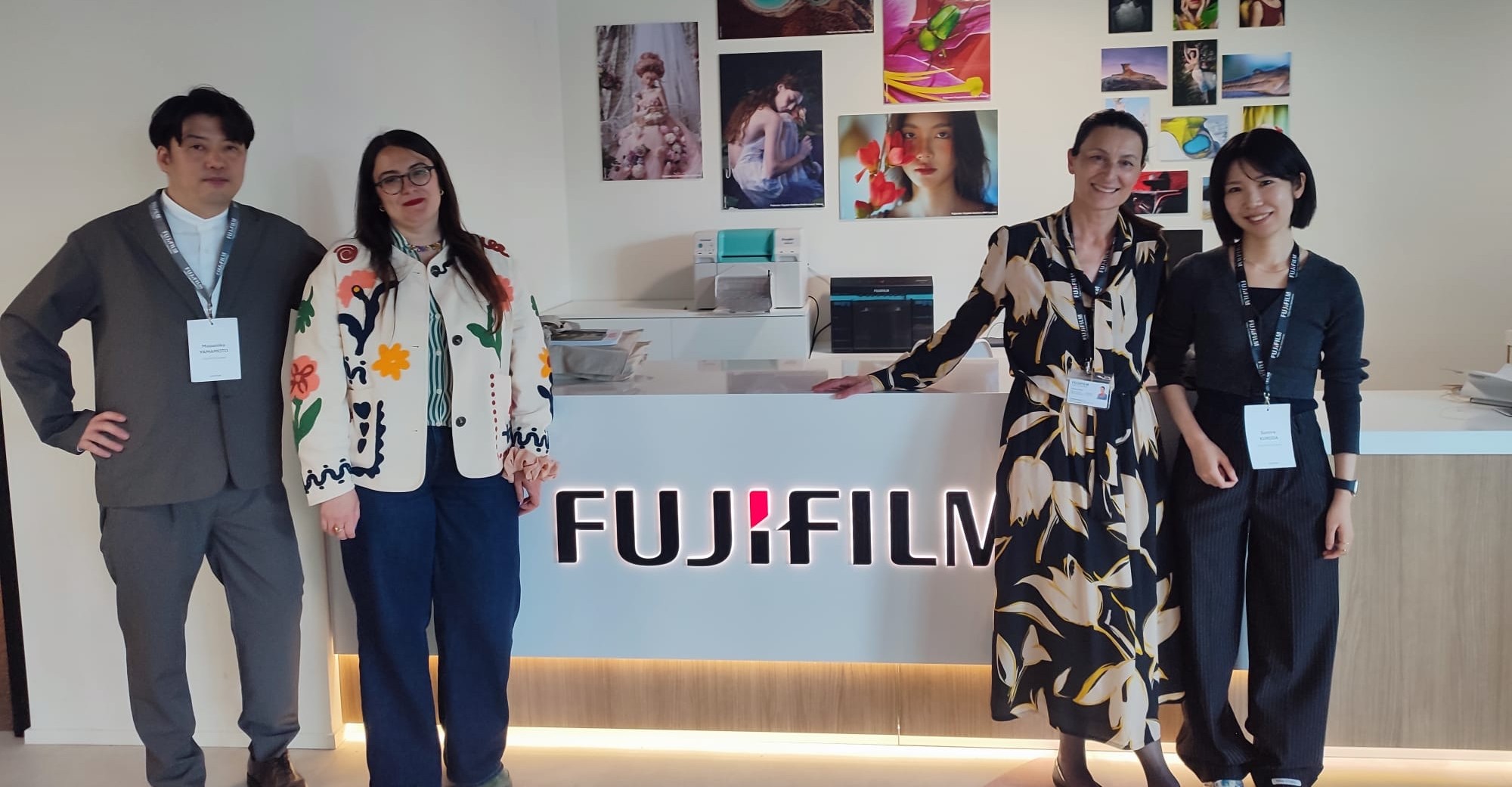
Fujifilm unveiled its ‘Faithful Design’ philosophy in Milan, Italy, on 22 April 2026. The approach places observation of users and their working environments at the centre of product development.
The approach extends beyond aesthetics, incorporating user research and iterative testing into the development of products ranging from office printers to medical imaging systems. Luana Porfido said Milan provided an opportunity to present the approach, which emphasises authenticity, innovation and attention to users’ needs.
Fujifilm unveils empathy in engineering
The ‘Faithful Design’ philosophy is based on observing human behaviour and the environments in which products are used, rather than relying solely on theoretical use cases. It shifts the focus from product specifications alone to a broader, user-centred approach to product development. The approach reflects the role of user-focused design in developing technical products.
Fujifilm’s designers begin projects by observing users in real-world settings and identifying needs that users may not readily articulate. These observations inform the design process, with concepts tested and refined in the environments where the products are intended to be used.
Uncovering unspoken needs for better solutions
Sumire Kuroda, a user interface designer at FUJIFILM Corporation, discussed this approach during the presentation in Milan. She said the focus was ‘not on what the product is, but why it exists and how it was shaped.’ This approach requires designers to look beyond assumptions about users and engage directly with them through interviews and on-site observation.
Kuroda explained that the process involves ‘identifying users’ unspoken, latent desires through interviews and other methods, and faithfully bringing them to life.’ The approach aims to identify frustrations and inefficiencies that users may have come to regard as normal.
These insights help translate users’ needs into design changes intended to improve usability and workflows. The approach is intended to ground design decisions in observed behaviour rather than assumptions.
Iterative testing informs product design
The philosophy uses an iterative process in which design concepts are tested with users. The process allows designers to refine products using practical feedback and testing in their intended environments, rather than relying solely on controlled studio evaluations.
For engineering teams, this involves closer integration with user research and regular feedback that can challenge initial assumptions. It also requires teams to adapt designs as new findings emerge from real-world testing.
A philosophy forged in reinvention
The ‘Faithful Design’ philosophy developed against the backdrop of a major shift in Fujifilm’s business. The growth of digital photography sharply reduced demand for traditional photographic film, which reportedly accounted for around 50–60% of Fujifilm’s turnover at the time.
Luana Porfido said photography accounts for 17% of Fujifilm’s revenue, while film accounts for 1%. The change prompted Fujifilm to expand into other markets, drawing on capabilities in materials science, nanotechnology, image processing and precision manufacturing.
These capabilities, developed through its photographic business, supported Fujifilm’s expansion into healthcare, semiconductor materials and life sciences. Porfido said the company’s experience reinforced its focus on understanding real-world needs, which she described as ‘Our North Star’. She said this principle now informs its approach to product design.
Redefining industrial equipment for user experience
Fujifilm applies ‘Faithful Design’ across its product portfolio, including consumer goods, industrial equipment and medical systems. The company says the philosophy guides product development across different product categories and markets.
Masahiko Yamamoto, an industrial designer at FUJIFILM Business Innovation Corp., illustrated the approach with two examples. The examples involved a new multifunction printer and a mobile X-ray system, both of which were redesigned in response to observations of how people used them.
Rethinking office multifunction printers
Yamamoto’s team began developing a new generation of multifunction printers (MFPs) by examining how workplaces and working practices might change. He posed two questions: ‘What will the workplace of the future look like? How will the relationship between workers, their environment and the devices they use evolve?’
The team interviewed people with different working styles to understand how MFPs fitted into existing workflows and how those workflows might change. The research suggested that some offices were moving away from layouts that placed printers in out-of-the-way corners towards more open, collaborative spaces.
The team concluded that the MFP needed to function as more than a standalone machine and fit more naturally into a flexible workplace. Yamamoto said the team considered the changing role of offices as ‘comfortable, stimulating places capable of fostering a sense of belonging’ when developing the design.
Designers simplified the MFP’s shape to create a clearer, more modern appearance. They grouped frequently used features, including the scanner handle and card reader, in one operating area.
Yamamoto said the team selected yellow knobs and handles after considering colour vision and visibility under different lighting conditions. The team also conducted usability tests to assess the design.
The mobile X-ray system redesign for critical care
One example of ‘Faithful Design’ is Fujifilm’s FDR Nano mobile X-ray system. Fujifilm’s designers observed emergency department staff using large X-ray units in crowded spaces and documented the difficulties they encountered when manoeuvring the equipment.
The team identified collisions and delays as problems to address in the redesign. Sumire Kuroda said that ‘for a long time, this situation had simply been accepted as normal’. The observation prompted the team to reconsider the equipment’s design in the context of emergency care.
The team aimed not only to reduce the system’s size and weight but also to improve clinical workflows. According to Fujifilm, redesigning the generator and batteries reduced the system’s weight from approximately 500 kg to 90 kg.
Fujifilm says the lighter system can move forwards and diagonally and rotate on the spot. The company should provide a technical basis for any claim that it can stop instantly or that these capabilities were unavailable in conventional mobile X-ray systems. The team also repositioned the detector and image monitor. A rotating arm allows clinicians to adjust the viewing position during examinations.
Cultivating design talent
Fujifilm describes design as part of its wider business strategy rather than a function confined to one department. Fujifilm says its Design Centre has operated as an independent studio since 2017.
Fujifilm opened CLAYSTUDIO in Tokyo in May 2023 as a space for design-related collaboration. The space brings Fujifilm employees together with external artists, musicians, craftspeople and researchers.
Sumire Kuroda said, ‘By engaging with forms of creativity beyond design, we gain new perspectives that rarely emerge from our routine work.’ This outward-looking approach enriches the design process, leading to innovative solutions, much like the partnerships that drive advanced chip design.
Fujifilm’s design work has received international recognition. Fujifilm says it has received between 80 and 90 design awards annually since 2017, including awards from iF Design, Red Dot and Japan’s Good Design Award programme. These accolades reflect a sustained commitment to design excellence.
The broader impact of people-centric engineering
Fujifilm’s ‘Faithful Design’ philosophy places user needs at the centre of product development. The approach begins with observing users and identifying needs that may otherwise be overlooked.
Across products such as office printers and mobile X-ray systems, the stated objective is to identify user difficulties and develop design changes that address them. The approach focuses on making products easier to use by integrating design considerations into everyday tasks.
The approach also reflects Fujifilm’s stated corporate philosophy of addressing social issues through its business activities, a principle the company traces to its founding in 1934. Fujifilm presents this philosophy as a way to align product development with users’ needs and its wider corporate objectives.
