


Bedrock Robotics has secured $600 million in Series C funding, propelling its valuation to $4.1 billion. This significant investment will further accelerate the development and deployment of their cutting-edge autonomous heavy equipment solutions.
The capital injection represents a significant leap for the company, more than doubling its $1.75 billion valuation from February 2026. Bedrock’s core offering involves retrofit kits that transform existing construction machinery into fully autonomous units. This innovative approach has seen its excavators perform paid work on live commercial sites since mid-August 2026.
Bedrock Robotics Secures $600 Million for Autonomous Heavy Equipment
Bedrock Robotics, founded in 2024, specialises in creating autonomous systems for heavy construction machinery. This latest funding round brings the company’s total capital raised to nearly $1 billion. The rapid increase in valuation reflects investor confidence in the commercial viability of AI-driven construction.
The Series C round saw participation from new investors such as US Innovative Technology Fund (USIT), Bessemer Venture Partners, and Temasek. Existing investors, including NVIDIA, 8VC, Georgian, Valor Equity Partners, Xora, Eclipse, and Perry Creek Capital, also contributed. This broad backing signals a mature market ready for scaled autonomous solutions.
Rapid Valuation Growth
The company’s journey to a $4.1 billion valuation has been notably swift. In July 2025, Bedrock secured $80 million in combined seed and Series A funding, led by Eclipse and 8VC. This initial capital laid the groundwork for its technological development and market entry.
By February 2026, the company had already raised a $270 million Series B round, pushing its valuation to $1.75 billion. This progression highlights the intense investor interest in companies that deliver tangible, revenue-generating applications of artificial intelligence in industrial settings.
Key Investors Backing Autonomy
Co-leading investors CapitalG and Emergence Capital bring significant experience in backing transformative technology companies. CapitalG, Alphabet’s independent growth vehicle, typically invests substantial sums in companies poised for major market disruption. Its continued support since the Series B round indicates strong belief in Bedrock’s trajectory.
Emergence Capital, known for early investments in B2B software giants like Salesforce, focuses on firms leveraging cloud and AI to reshape industries. The firm views Bedrock’s retrofit approach as effectively turning a hardware business into one with software-like economics.
Kevin Spain, General Partner at Emergence Capital, stated that “Bedrock’s AI lets heavy equipment reason through and adapt to the unpredictability of a live job site.” This capability translates to greater construction capacity, with projects completed faster and more safely.
From Pilot Projects to Commercial Scale
Bedrock Robotics has moved past theoretical models and pilot programmes, with its autonomous excavators now actively generating revenue on commercial sites. This transition is a critical validation for the practical application of physical AI robotics in demanding industrial environments. Their systems operate without an on-board human operator, streamlining construction workflows.
Since mid-August 2026, Bedrock-equipped machines have been deployed across three significant projects. These initial commercial successes have provided invaluable real-world data and proof of concept, reassuring both investors and potential clients about the technology’s reliability and efficiency.
On-Site Success in Texas and Nevada
One notable deployment involves a water-treatment facility in Nevada, managed by Sundt Construction. Another is an earthwork project in Texas, undertaken by Champion Site Prep. A third major civil sitework project, spanning 1.2 million cubic yards, is underway with Zachry Construction, also in Texas.
These varied projects demonstrate the versatility of Bedrock’s autonomous excavators across different phases and types of construction. They prove that AI can adapt to the unpredictable nature of live job sites, performing tasks accurately and continuously. This capability offers substantial operational advantages for contractors.
Expanding Customer Base
Bedrock’s client base has more than doubled since 2025, reflecting growing confidence in its technology. Arizona contractor Haydon recently partnered with Bedrock, planning to integrate autonomous machines into projects ranging from data centres and healthcare facilities to water infrastructure. Haydon will also test advanced applications like autonomous trench work.
Regional partners have also signed on in key US states, including Wagner Construction in Minnesota, Smith Trucking Company in Florida, B&S Site Development in Virginia, Native Excavating in Colorado, Clarkson Construction in Missouri, and C.W. Matthews in Georgia. This geographic spread highlights the widespread applicability and demand for Bedrock’s solutions.
Engineering Innovation in the Field
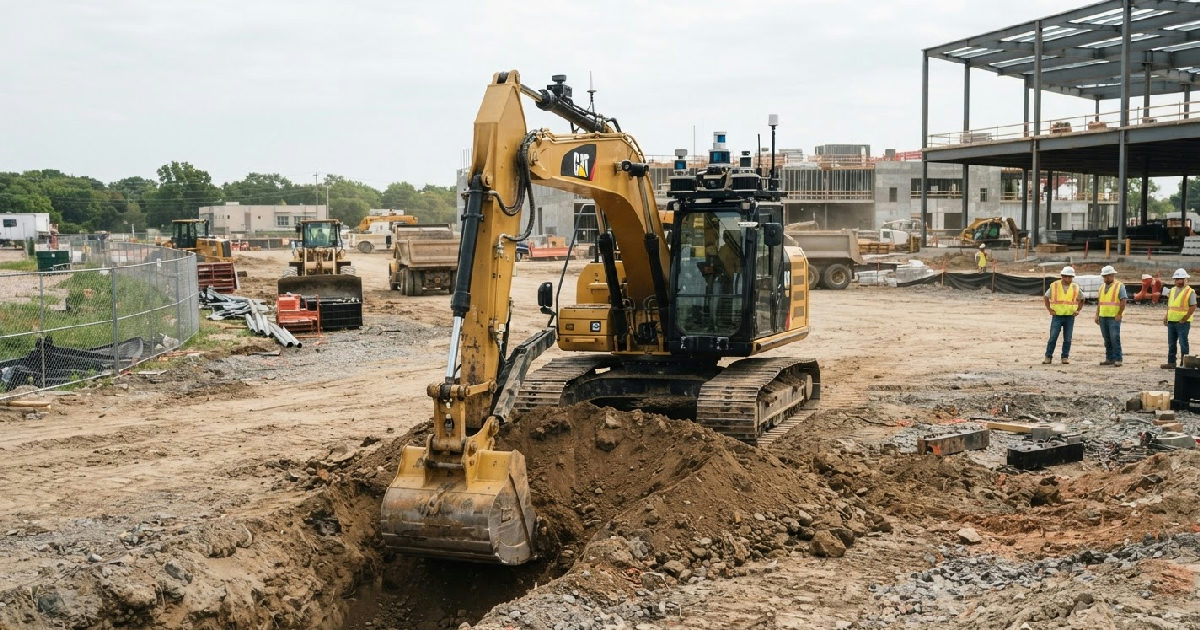
Bedrock Robotics doesn’t manufacture excavators; instead, it develops an AI-powered retrofit kit called the Bedrock Operator. This system integrates a suite of advanced sensors and computing, enabling existing heavy machinery to operate autonomously. It represents a significant advancement in AI autonomy within industrial contexts.
The kit comprises cameras, LiDAR, GPS receivers, and onboard computers, all running machine-learning software. It interfaces directly with drive-by-wire hydraulic controls found in modern excavators. This allows contractors to upgrade their current fleet without major capital expenditure on entirely new automated vehicles.
The Bedrock Operator System
The Bedrock Operator system employs 360-degree LiDAR, high-resolution cameras, RTK GNSS (Real-Time Kinematic Global Navigation Satellite System), and an IMU (Inertial Measurement Unit). This sophisticated sensor fusion provides precise navigation and real-time 3D occupancy mapping, crucial for safe and efficient autonomous operation on dynamic construction sites.
Boris Sofman, co-founder and CEO of Bedrock Robotics, emphasised the system’s capability. “We have proven that fully autonomous excavators can perform real work of value alongside the crews and workflows already in place on job sites,” he stated. The focus is now on delivering this capability dependably to more contractors, integrating it seamlessly into daily project execution.
Leadership from Waymo and Anki
Bedrock Robotics was co-founded in 2024 by Boris Sofman, Kevin Peterson, Ajay Gummalla, and Tom Eliaz. Three of the four co-founders have extensive backgrounds from Waymo, Google’s self-driving car project, bringing deep expertise in autonomous systems development. Mr. Sofman previously led Waymo’s self-driving truck programme.
Before his tenure at Waymo, Sofman also co-founded Anki, a consumer robotics company celebrated for products like Cozmo. This blend of experience from consumer robotics and advanced autonomous vehicle development provides a unique perspective on integrating complex AI into real-world applications, particularly for industrial robotics.
Addressing Construction’s Labor Challenge
The construction industry faces a chronic and escalating skilled labour shortage, a key driver for the adoption of autonomous heavy equipment. Experts predict significant workforce gaps, making traditional recruitment methods increasingly insufficient to meet project demands. This demographic shift makes automation less of an option and more of a necessity.
The Associated Builders and Contractors (ABC) estimates that 349,000 more construction workers are needed in 2026, with that figure rising to 456,000 by 2027. This represents a substantial challenge for an industry that relies heavily on skilled operators.
Looming Workforce Gaps
A significant portion of the current construction workforce is nearing retirement. Over 40% of construction workers are projected to retire within the next five years, creating a substantial void in experienced personnel. This exodus compounds the difficulty in filling open roles.
Current data shows that 87% of construction firms report open hourly craft positions. Moreover, 88% find these roles as difficult or more difficult to fill compared to a year prior. These statistics underscore a persistent and growing crisis in workforce availability, impacting project timelines and costs.
Economic Efficiency Drives Adoption
Beyond labour shortages, the economic benefits of autonomous equipment are compelling. Autonomous solutions enhance equipment utilisation, allowing machines to operate continuously without human shift constraints. This improved efficiency can significantly reduce project durations and associated financing costs for contractors.
Developers and contractors can achieve substantial savings by completing projects faster. The ability of autonomous machines to work around the clock contributes to accelerated timelines, directly impacting the financial overhead of large-scale construction ventures.
Future Roadmap and Strategic Vision
The $600 million funding will significantly accelerate Bedrock Robotics’ expansion plans and product development. The company aims to deploy triple-digit autonomous machines across the US in 2027, marking a substantial increase in its operational footprint. This aggressive scaling requires robust field and operational infrastructure.
Bedrock is also strengthening its leadership team to support this growth. Amy Jones Satrom, with experience from Amazon, Nuro, and Uber, joins as Vice President of Operations. Lando Juarez, formerly Head of Legal for Uber’s Autonomous Mobility & Delivery business, takes on the role of General Counsel, focusing on commercial partnerships and regulatory frameworks.
Accelerating Deployment and Support
A key focus for the new capital is to build the commercial and operational infrastructure necessary for dependable autonomous construction. This includes scaling up hardware, supply chains, and field support teams to ensure machines operate reliably on site. A breakdown costs contractors money by the hour, making uptime critical.
The company also plans to work with more partners, integrating its intelligent systems into everyday construction workflows. This collaborative approach aims to make autonomy a seamless and trusted part of how projects are built across the country. Reliable support ensures the technology delivers consistent value.
Expanding Equipment Capabilities
Beyond excavators, Bedrock Robotics has ambitious plans to expand its autonomous capabilities to other heavy machinery. Haydon, one of its new partners, will specifically test autonomous trenching applications. This signifies the first step towards diversifying the types of tasks autonomous systems can perform.
Looking ahead, bulldozers, articulated dump trucks, and wheel loaders are next on Bedrock’s roadmap. The company also eyes future expansion into the mining and agriculture sectors, industries that share similar challenges with labour shortages and demand for increased efficiency. This broader vision positions Bedrock for long-term growth across multiple industrial domains.
Broader Implications for Industrial Engineering
Bedrock Robotics’ success signifies a pivotal moment for industrial engineering, moving artificial intelligence from data centres to the physical transformation of landscapes. It validates the commercial imperative for automation in sectors facing chronic labour challenges and intense pressure for efficiency. This shift pushes the boundaries of what is technically and economically feasible in large-scale operations.
The retrofit model employed by Bedrock offers a practical pathway for existing contractors to embrace automation without entirely overhauling their fleets. This lowers the barrier to entry for many firms, accelerating the adoption curve of advanced robotics. As autonomous heavy equipment becomes more prevalent, it will reshape job roles, demanding new skill sets for managing and maintaining these intelligent machines.
For African markets, this development offers a glimpse into potential solutions for critical infrastructure development. While direct deployment might be some way off, the principles of autonomous efficiency and workforce augmentation could address similar challenges faced by construction and engineering sectors across the continent.
Leveraging such technologies could help African nations accelerate projects and overcome skilled labour constraints, albeit with adaptations for local conditions and existing equipment fleets.
