


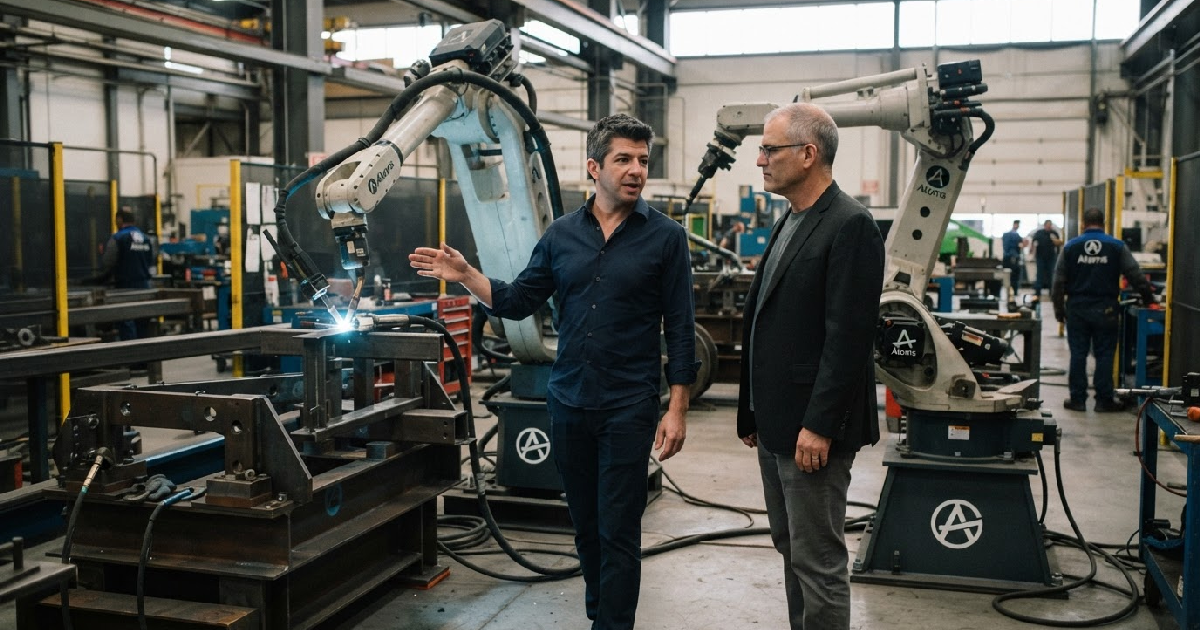
Travis Kalanick’s industrial AI and robotics company, Atoms, secured $1.7 billion in funding led by Andreessen Horowitz for industrial robotics automation. 7 billion in a funding round led by venture capital firm Andreessen Horowitz, focusing on industrial robotics automation.
The capital infusion comprises both equity and debt financing, signalling strong investor confidence in Atoms’ strategy to digitise and automate operations that pure software cannot manage alone. Ben Horowitz, co-founder of Andreessen Horowitz, will join Atoms’ board of directors as part of the transaction, linking Kalanick’s current venture with a long-standing industry figure.
Engineering specialised physical AI systems
Atoms centres its engineering strategy on purpose-built, task-specific machinery, deliberately diverging from the general-purpose humanoid robots pursued by many AI startups. Kalanick views these automated installations as “atoms-based computers,” believing that complex industrial work in sectors like mining, construction, heavy transportation, and commercial food production demands highly specialised hardware.
He describes heavy manufacturing as the processing unit, commercial real estate as physical storage, and transport logistics as the core network in this new paradigm. This approach, which Kalanick calls a culmination of a decade-long shift from “bits” to “physical atoms,” is designed to automate critical supply chain tasks. It’s an explicit move away from consumer technology and towards prioritising demanding physical labour.
Integrating core industrial operations
The funding round unifies Atoms’ three core operating divisions under a single equity structure. Each division targets a distinct yet interconnected segment of the industrial landscape, leveraging a comprehensive stack for automating physical production from the ground up.
Atoms Food: automating kitchens and logistics
Atoms Food integrates Kalanick’s previous ghost-kitchen enterprise, CloudKitchens. This division incorporates advanced automated cooking platforms such as Lab37 and sophisticated software systems like Otter. Otter, which reportedly handled 18% of US food delivery transactions as of 2024, helps restaurants manage orders, streamline workflows, and analyse sales data by consolidating multiple delivery platforms.
Atoms Mining: autonomous heavy machinery
The Atoms Mining division focuses on deploying autonomous heavy machinery in remote extraction sites, directly building on Atoms’ acquisition of Pronto. Pronto, founded by former Uber engineer Anthony Levandowski, specialises in camera-based, OEM-agnostic autonomous haulage systems (AHS) for semi-trucks and off-road environments.
Pronto’s AHS retrofits existing haul trucks with sensors and autonomy software, allowing them to operate without a driver in challenging quarry and mining sites.
Pronto has already demonstrated its capabilities by hauling over two million tons autonomously at Heidelberg Materials’ Lake Bridgeport quarry in Texas. The company also has a global deployment deal covering over 100 trucks across a dozen operations.
Their system, which relies on a vision-first approach, can be deployed in weeks and has expanded its offerings to include LiDAR-and-radar setups for deep-pit hard rock mining after acquiring SafeAI in 2024.
Atoms Transport: flexible robotics wheelbase
The third division, Atoms Transport, functions as a flexible wheelbase for industrial robotics. This unit helps move goods across complex logistics hubs, providing the foundational mobility for other automated systems. Together, these three divisions represent a formidable integrated approach to automating physical work.
Significant investment in hardware and deployment
The $1.7 billion investment reflects deep confidence from a broad consortium of major venture capital players and financial institutions. Leading the equity investment was Andreessen Horowitz, joined by prominent firms including Bain Capital, Fifth Wall, K5 Global, Abstract, Chemistry, A*, SV Angel, and Alpha Square Group.
Surprisingly, Uber, the ride-hailing company Kalanick co-founded in 2009, also participated as a direct equity investor. This brings Kalanick full circle with a company he departed in 2017. Beyond equity, Atoms also secured substantial debt facilities from financial giants such as JPMorgan, Goldman Sachs, Bank of America, Wells Fargo, and Barclays, providing the necessary capital for developing heavy hardware.
Atoms plans to use this substantial capital infusion to ramp up the pace of machine assembly, significantly increase its field deployments, and attract top engineering talent. This funding is crucial for tackling the multiple complex challenges inherent in automating the physical world, especially given the rising costs and persistent labour shortages affecting global supply chains.
Kalanick’s strategic shift to industrial automation
This funding round marks a significant chapter in Travis Kalanick’s post-Uber career. After co-founding Uber and departing in 2017, he established the 10100 venture fund in 2018 and subsequently invested $150 million in City Storage Systems (CSS), which eventually housed CloudKitchens. Atoms emerged from CSS in March 2026, after eight years of quiet development under its previous moniker.
Kalanick sees this as an “unfinished task,” a continuation of a journey he began at Uber, extended through CloudKitchens, and now aims to complete at Atoms. His focus has clearly shifted from the “bits” of digital platforms to the “atoms” of physical industrial processes. This strategic pivot highlights a belief that industrial AI, rather than consumer technology, will drive the next wave of technological transformation.
“Industrial AI is what will power the next industrial revolution,” Atoms stated in a LinkedIn post. Kalanick posits that sectors like mining, construction, heavy transportation, and food production, which are heavily reliant on physical objects, are ripe for large-scale digital transformation. The scale of this investment underpins the ambition to accelerate that transformation.
Implications for industrial productivity and workforce
The push for industrial robotics automation by companies like Atoms comes at a crucial time for global manufacturing and logistics. Labour shortages and escalating costs are pressuring supply chains worldwide, making reliable, automated physical systems increasingly attractive. Ben Horowitz of Andreessen Horowitz emphasised that specialised industrial machines are far better suited to tough environments than general-purpose humanoid robots.
This investment underscores a broader industry trend towards automating demanding physical tasks. For sectors such as mining in Africa, where operational efficiencies and safety are paramount, the deployment of autonomous heavy machinery could offer substantial benefits. Improved productivity and reduced human exposure to hazardous conditions are tangible outcomes of such technological adoption.
The continued growth of industrialisation across Africa presents a significant opportunity for companies focusing on physical AI. By optimising food production, raw material extraction, and transport logistics, these technologies could enhance the continent’s productive capacity. While the immediate impact will likely be felt in established industrial markets, the long-term potential for improving infrastructure and operational output in African industries is considerable.
