


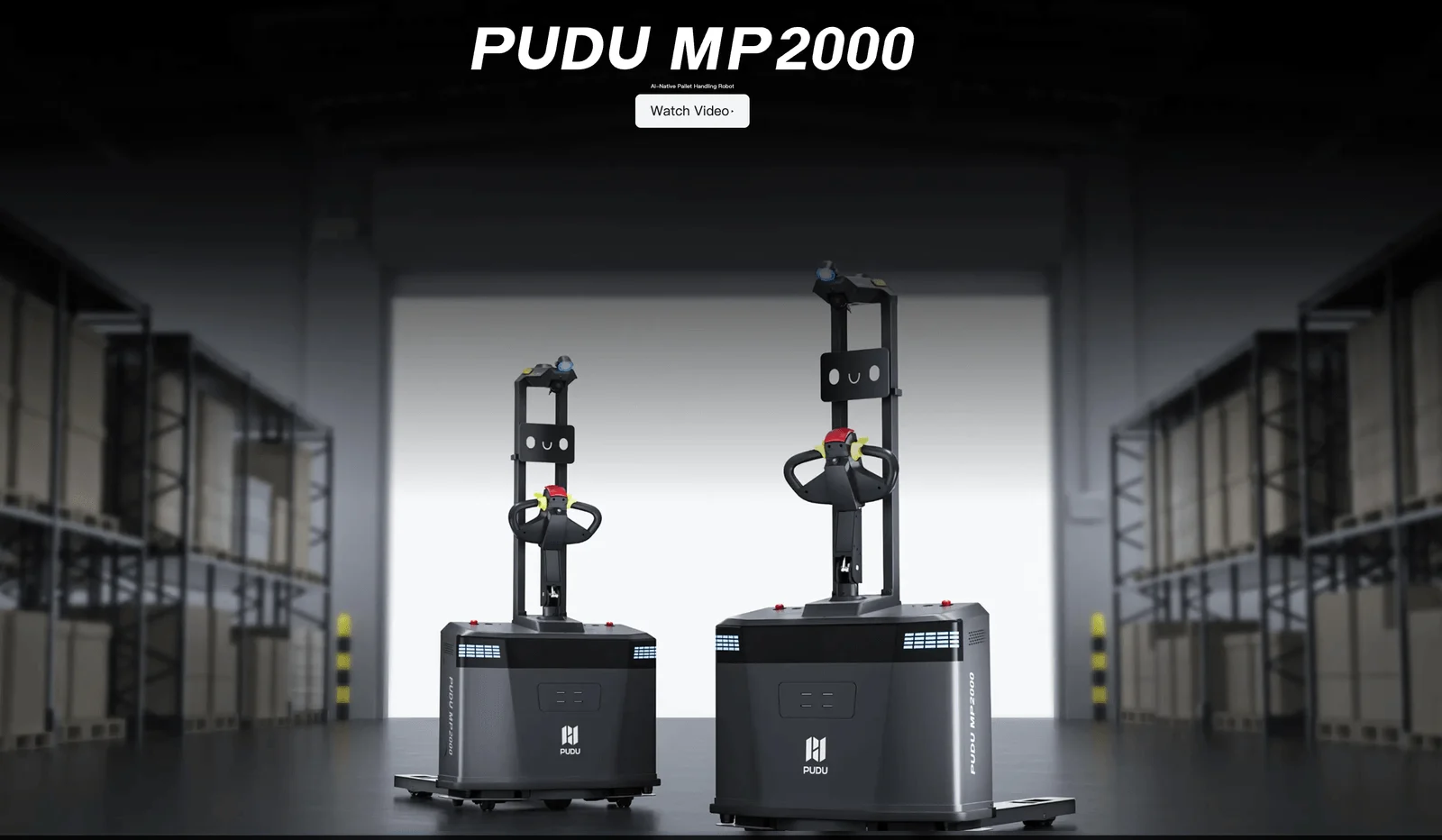
Pudu Robotics launched its PUDU MP2000 pallet robot on August 18, 2026.
The new robot marks a significant expansion of Pudu Robotics’ industrial portfolio. It addresses critical challenges in scaling autonomous pallet handling, particularly the need for extensive site preparation and complex integration often associated with traditional systems.
Simplifying PUDU MP2000 pallet robot deployment
One of the PUDU MP2000’s most compelling features is its plug-and-play deployment. Traditional autonomous forklift projects frequently demand substantial infrastructure changes, such as dedicated reflectors or QR codes, making initial setup a lengthy process.
This new robot leverages multi-sensor navigation, edge intelligence, and AI-native perception to autonomously map its operating environment. It does this without requiring extensive site modifications or complex platform integration.
Such capabilities mean deployment can be achieved in minutes, drastically reducing commissioning time and potential disruptions for manufacturers. Logistics operators, in particular, will find this standardised deployment model supports easier expansion of robotic capacity as operational needs evolve.
The ability to adapt quickly to diverse settings is crucial for modern industrial facilities. It minimises downtime and accelerates the return on investment for automation initiatives. This focus on rapid, non-disruptive integration could be a turning point for many companies.
AI-native adaptability for dynamic environments
Industrial pallet handling requirements are rarely uniform across different sites. The PUDU MP2000 supports common pallet formats, including three-runner and perimeter-base pallets, and can even adapt to customised or non-standard load carriers.
Its AI-native perception provides real-time, onboard understanding of handling conditions. This includes available storage locations, load positions, and even pallet misalignment.
The robot assesses a load’s size and shape in real time. This allows it to determine clearance and navigate through constrained spaces effectively. By connecting perception, decision-making, and execution, the PUDU MP2000 delivers autonomous handling that adapts to its environment, moving beyond reliance on predefined conditions alone.
This level of dynamic adaptation helps ensure consistent operational efficiency, even when conditions are less than ideal. It represents a practical application of AI in solving everyday industrial complexities. For example, it can automatically adapt to manually placed pallets that are offset by up to 15 cm and angled by up to 15 degrees.
Precision and speed in pallet movement
Designed for repetitive, high-frequency industrial movement, the PUDU MP2000 focuses on both precision and speed. Its fork-handling process enables fork-in operations in as little as 20 seconds, significantly shortening pickup cycles.
This rapid engagement supports quicker material movement between locations. The system also reduces repeated positioning and pickup attempts, leading to more consistent handling across complex warehouse and factory workflows.
An unloaded speed of up to 1.6 m/s and a loaded speed of up to 1.2 m/s contribute to overall operational efficiency. It can handle thresholds up to 10 mm and gaps up to 35 mm, further enhancing its navigational capabilities.
Enhanced safety with 3D perception and distributed intelligence
Safety is paramount in any automated industrial setting, particularly where humans and machines share space. The PUDU MP2000 integrates 3D LiDAR, depth cameras, and multi-sensor perception to build a comprehensive understanding of its surroundings.
This advanced perception system allows the robot to detect and interpret obstacles at various heights and positions. It can identify low-profile obstructions and overhead obstacles, navigate around static impediments, and react to dynamic elements in real time.
Such capabilities are vital for autonomous movement in environments where people, equipment, and materials frequently change locations. This ensures that the robot can operate reliably alongside human workers and other machinery. This is a common challenge in busy industrial facilities, making robust obstacle detection a necessity.
Furthermore, the PUDU MP2000 incorporates distributed intelligence alongside fleet-level coordination for autonomous operation. Each robot can make real-time decisions independently, while multiple units coordinate tasks to maintain organised workflows across the entire fleet.
This coordination continues even in offline environments, ensuring sustained operation when external network connectivity is unavailable. This resilience is a critical advantage for maintaining uninterrupted productivity in large-scale operations. The system also integrates with compatible peripheral equipment like elevator controls and automatic doors, expanding its functional reach.
Expanding Pudu Robotics’ industrial footprint
The launch of the PUDU MP2000 represents a strategic broadening of Pudu Robotics’ industrial portfolio. The company, which already ships robots globally, previously focused on flexible mobile delivery solutions, such as its PUDU T Series AMRs, including the PUDU T300.
With the PUDU MP2000, the firm extends its capabilities into heavier-load and standardised pallet handling. This new robot supports workflows across loading docks, warehouses, line-side storage, and production workshops, handling loads up to 2,000 kg.
This dual offering now connects flexible item delivery with robust pallet transport, creating a more comprehensive solution for industrial logistics automation. It positions Pudu Robotics as a more versatile player in the rapidly evolving industrial robotics sector.
Pudu Robotics has shipped more than 130,000 robots to customers in over 85 countries and regions. Felix Zhang, the company’s CEO, has 16 years of robotics R&D experience and holds nearly 300 patents. This background supports the firm’s expansion into new capabilities and heavier-payload applications. This move further solidifies Pudu Robotics’ commitment to advanced robotics for industrial applications.
The broader impact on manufacturing and logistics
The introduction of the PUDU MP2000 could mark a shift in how manufacturing and logistics facilities approach automation. Its focus on simplified deployment means that even businesses with less robust IT infrastructure or limited integration budgets might consider adopting autonomous pallet-handling systems.
This ease of integration helps accelerate the digitalisation of factory floors and warehouses. It provides a tangible path for companies to improve operational efficiency and worker safety. Moving towards more autonomous solutions reduces manual labour in repetitive and potentially hazardous tasks.
The robot’s ability to navigate narrow aisles and perform 90-degree pallet pickups in passages as small as 2 metres, with pallet spacing of as little as 15 cm, means it can operate in dense industrial environments. This versatility is crucial for optimising existing layouts without needing extensive renovations.
As industrial demand continues to grow globally, solutions that lower the barrier to entry for automation become increasingly valuable. Manufacturers and logistics providers in various regions could find the PUDU MP2000 a practical tool for modernising their operations. This aligns with a global trend towards smarter, more connected factories.
Developed in Shenzhen, a global hub for robotics innovation, the robot reinforces the city’s role in driving industrial technological advancement. Pudu Robotics is a prime example of Chinese firms pushing the boundaries of robotics, offering scalable and intelligent solutions to a worldwide market. This type of innovation contributes to a more automated industrial future, shaping how goods move from production to consumption.
The ongoing push for industrial automation is not just about replacing human labour; it’s about enhancing productivity, reducing errors, and creating safer working conditions. Solutions like the PUDU MP2000 free human workers from monotonous tasks. It lets them focus on more complex, value-added activities, ultimately boosting overall operational output.
This commitment to developing practical, scalable industrial robots demonstrates Pudu Robotics’ understanding of global manufacturing and supply chain needs. It is a direct response to the continuous pressure on industries to become more efficient, adaptable, and resilient in the face of fluctuating market demands.
