


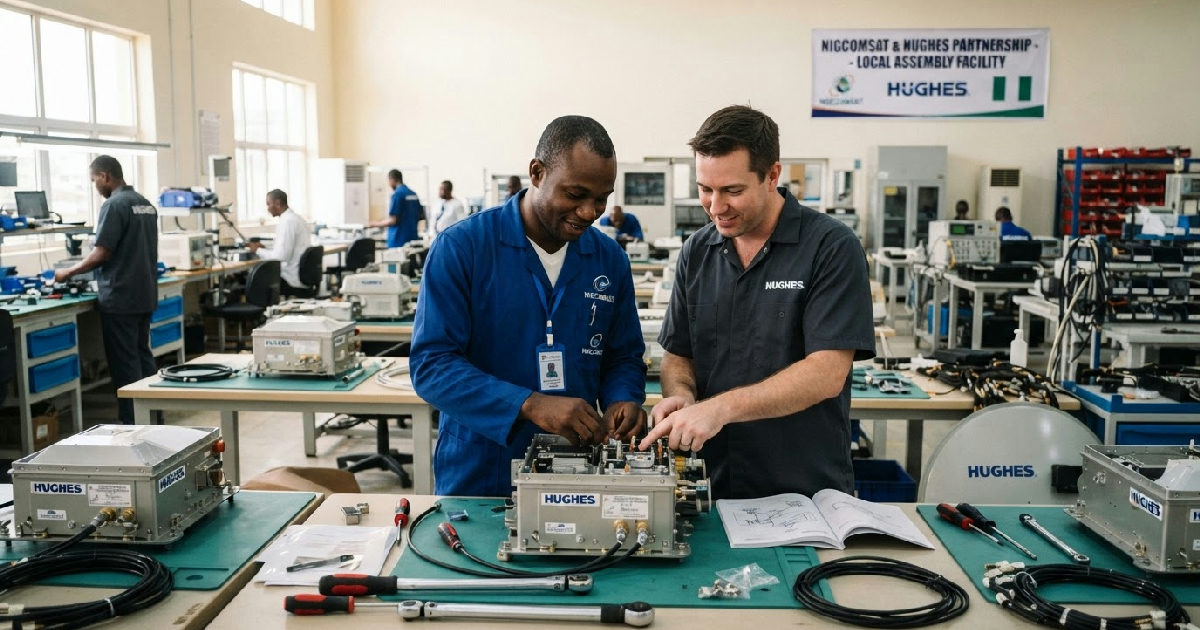
Nigerian Communications Satellite Limited (NIGCOMSAT) is developing local assembly capabilities for satellite terminals through a partnership with US satellite communications company Hughes Network Systems.
NIGCOMSAT-2A is targeted for launch in 2028, while NIGCOMSAT-2B is expected to follow in 2029. Crucially, the agreement includes technical and engineering support for a new facility in Nigeria dedicated to assembling satellite terminals.
Driving Localisation in Satellite Terminals
The initiative expands Nigeria’s satellite programme into local assembly and ground-system development. The focus is now on developing the capacity to build crucial equipment needed to transform satellite signals into connectivity services.
The Federal Executive Council approved the acquisition and deployment of the satellites on 22 August 2026, according to the government. The decision forms part of the government’s efforts to expand Nigeria’s satellite communications capacity. The initiative also aligns with broader Nigerian policies promoting local content and indigenous capacity development.
The partnership includes establishing local assembly capabilities for satellite terminals. The terminals form part of the ground infrastructure used to connect users and networks to satellite systems. These terminals support communication between ground-based networks and satellites.
Hughes Managing Director for EMEA Anshu Vij said the JUPITER platform would support NIGCOMSAT’s delivery of high-throughput connectivity.
Hughes and NIGCOMSAT say the collaboration is intended to support future connectivity, local skills development and manufacturing capacity in Nigeria.
The JUPITER System’s Technical Edge
Hughes’ JUPITER scalable gateway system is designed to support high-throughput satellite (HTS) networks. It supports a diverse range of applications for consumers, enterprises, and government users.
The system leverages a software-defined architecture and a 5G-ready design. Hughes says the architecture can support more than 50 Gbps per rack in high-density gateway configurations.
The JUPITER system is engineered to enable multi-band operations across Ka-, Ku-, and C-bands. The multi-band capability is intended to support broadband services across Nigeria and parts of West, Central and Southern Africa.
Preparation for the ground system and local manufacturing footprint is scheduled to begin in 2026, ahead of the planned satellite launches.
Nigeria’s Evolving Space Ambitions
Nigeria has pursued space and satellite technology programmes for several decades. Nigeria’s first Earth-observation satellite, NigeriaSat-1, was launched in 2003.
This was followed by its first communications satellite, NigComSat-1, in 2007. However, NigComSat-1 experienced a power-system failure in 2008 and was subsequently de-orbited.
Its replacement, NigComSat-1R, launched in 2011, has served for over a decade. Its original design life was expected to end in 2026, while fuel-conservation measures have been reported as supporting continued operations beyond that date.
The planned launches are intended to provide additional satellite capacity and expand coverage. The new satellites are intended to provide additional capabilities and capacity beyond the existing system.
Lessons from Past Satellite Operations
The operational history of NigComSat-1R also provides context for the commercial challenges facing satellite operators. NIGCOMSAT expanded its ground infrastructure with facilities in Lagos, Kaduna and Gombe, although commercial utilisation did not always match that expansion.
The expansion of subsea fibre networks within Nigeria, combined with relatively low demand for NigComSat-1R capacity, limited the commercial potential of some ground infrastructure. The experience illustrates the importance of aligning satellite infrastructure with demand.
Consequently, NIGCOMSAT has explored new service models, such as Teleport-as-a-Service. The model allows NIGCOMSAT to offer its ground infrastructure to a broader range of satellite operators and missions.
This experience underscores the importance of a comprehensive strategy. It connects satellite capability with market demand and local industrial development, moving beyond mere technological acquisition.
Engineering for National Security and Economic Diversification
The satellite programme and local assembly plan have applications beyond commercial connectivity, including government communications and potential economic-development activities.
The satellites are intended to support government and other communications applications. Separately, NITDA reported clearing 1,056 government IT projects valued at ₦3.84 trillion between July 2023 and July 2026. The relationship between that broader IT spending figure and the NIGCOMSAT programme should be stated only if a source explicitly connects the two.
The move also expands opportunities for local participation in the satellite and digital-technology value chain. Jane Nkechi Egerton-Idehen, Managing Director and Chief Executive Officer of NIGCOMSAT, stressed the partnership’s potential.
The partnership could create opportunities for local manufacturing, skills development and related employment. This approach aims to reduce Nigeria’s dependence on external satellite infrastructure, creating opportunities for skilled labour and technological advancement.
Broader Policy Framework for Local Content
The government’s Nigeria First Policy also places emphasis on domestic products and Nigerian businesses in public procurement. This policy prioritises Nigerian-made goods and services in government procurement.
The policy gives preference to Nigerian-made goods and local companies, with the government stating that foreign procurement should be considered where local alternatives are unavailable.
Complementing this, Nigerian ICT procurement frameworks promote the use of indigenous companies and local capacity. NITDA’s registration framework defines indigenous IT providers as companies in which Nigerians hold more than 51% of issued shares.
These policies provide a framework within which projects such as the satellite terminal assembly initiative could incorporate local participation and skills development.
Private sector initiatives also reflect this drive for local content. A Memorandum of Understanding was signed on 16 March 2026 between Nigus International Investment and Elmirate Investment LLC.
This MoU targets a $200 million investment for an advanced defence and satellite manufacturing platform in Nigeria. This platform will operate under a newly formed Special Purpose Vehicle (SPV), Nigus Tactical Systems Ltd.
The Road Ahead for Indigenous Space Engineering
The longer-term impact of the local assembly plan will depend in part on whether the facility develops capabilities beyond the initial satellite programme. If the facility proves successful, it has the potential to build enduring local expertise in satellite hardware.
If expanded successfully, the facility could support the servicing and assembly of satellite terminals for markets beyond Nigeria. Over time, expanded local production could reduce dependence on imported ground equipment in some markets.
The long-term vision involves fostering a sustainable industry that can attract further private sector investment and drive ongoing innovation. Thales Alenia Space has signed a contract with NIGCOMSAT to develop NigComSat-2A.
Israel Aerospace Industries (IAI) is also engaged by NIGCOMSAT as a technology partner for the manufacturing of the new satellites. NigComSat-2A will use Thales Alenia Space’s Spacebus B2 platform, have a launch mass of nearly four tonnes and an expected in-orbit service life of more than 15 years.
The approach combines international technology partnerships with local assembly and skills-development objectives. The programme therefore combines the acquisition of satellite technology with plans to develop local assembly and technical capabilities.
The initiative could create opportunities for local skills development, manufacturing and related services.
A longer-term measure of the project’s impact will be whether local assembly capabilities expand beyond the initial satellite programme. The immediate goal is to support the NIGCOMSAT-2A and 2B satellites.
The latest Hughes announcement targets the satellite launches for early 2028 and 2029, respectively. The broader objective is to develop local capabilities that could support future satellite hardware and ground-system activities.
But the broader aspiration is to create a dynamic ecosystem for satellite hardware development.
If the programme develops beyond the initial assembly project, it could provide an example for other African countries considering local satellite manufacturing and ground-system capabilities.
