


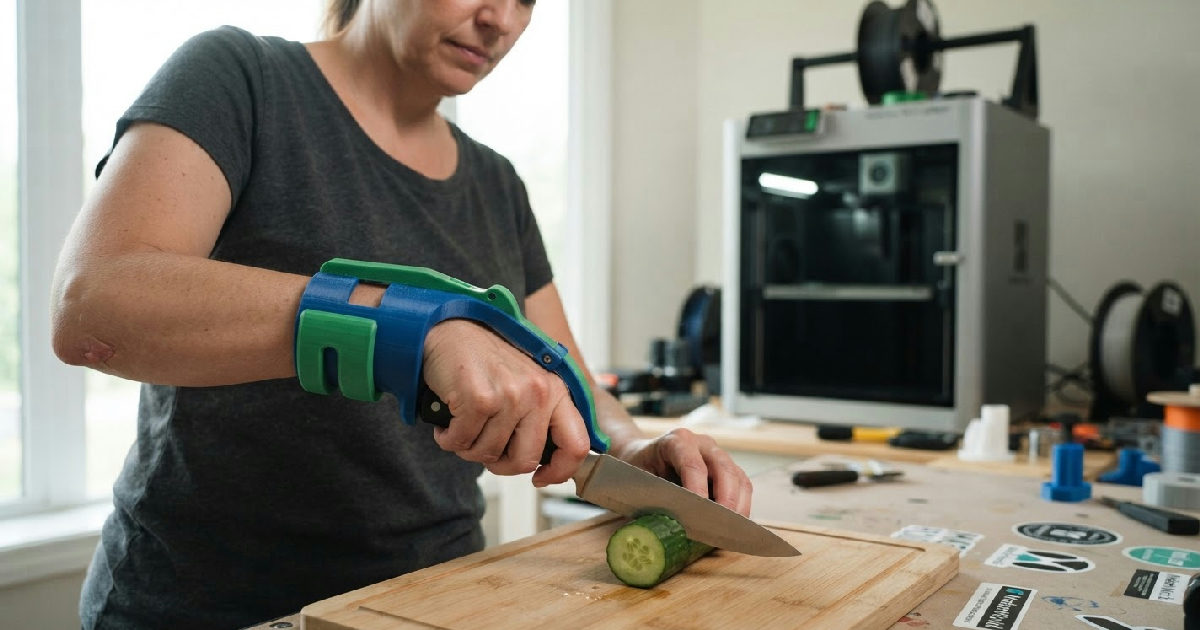
Bambu Lab has launched a global design competition aimed at developing practical, open-source assistive devices for people with disabilities, focusing on a 3D printing challenge assistive designs.
The “Make for Good: Accessibility Design Contest” represents a significant test for crowdsourced manufacturing. It moves beyond theoretical concepts to solve everyday problems identified by end-users and rehabilitation professionals. Winning designs will be tested, validated, and added to open libraries for global distribution, showcasing a powerful model for localised production of essential goods.
A new model for 3D printing challenge assistive designs development
The challenge is structured to close the gap between designers and the people who will ultimately use the products. It operates on Bambu Lab’s MakerWorld platform, an online community and library for sharing 3D models. The contest will present 24 distinct design briefs, crafted by the partner organisations, which will guide participants in creating solutions for specific daily activities.
Designers have a two-month submission window, ending November 15, 2026 UTC. Following the deadline, the partner organisations will spend a month shortlisting, printing, and testing the most promising designs with the intended users. This crucial evaluation phase ensures that final selections are not just clever, but functional and well-suited.
This rise of such targeted competitions highlights the rapid evolution of additive manufacturing innovations. It moves from industrial prototyping to consumer-level production. This demonstrates how desktop manufacturing can address specific needs.
This direct feedback loop sets the initiative apart from many design contests. It prioritises validated utility over pure aesthetics. The process ensures final products are genuinely helpful, having been put through their paces by the very people they intend to support. Results of this testing will be a key factor in determining the final winning entries in December.
From real-world problems to printable solutions
The power of this initiative lies in the specificity of its design briefs. These are not vague prompts, but detailed requests born from lived experience.
The participating organisations have translated the daily frustrations of people with disabilities into concrete engineering problems for the design community to solve, demonstrating how industrial AI turns factory data into actionable intelligence, though in this case, the data is human experience.
For example, the Rightfooted Foundation International, working with advocate Jessica Cox who was born without arms, submitted briefs for devices. These included aids to help put on a second sock, carry a service-dog waste bag, and independently fasten a bicycle helmet.
These are small, specific challenges that can have an outsized impact on a person’s independence. They are exactly the kind of custom solutions where 3D printing excels.
Other briefs from partners like the Emerging Tech Lab at Rancho Los Amigos National Rehabilitation Center focus on creating alternatives to commercial reachers. These commercial tools often require a strong squeezing grip, which many users lack. They also requested better storage and retrieval systems for wheelchair users.
From Spain, Ayúdame3D asked for a toothbrush that doesn’t need a pinching grip. It also requested a tool for tying a ponytail with one hand. These briefs turn abstract accessibility needs into tangible design specifications.
The requests span a wide range of activities. Makers Making Change, a Canadian program, proposed a knitting-needle support for stroke survivors and a guitar pick holder for players with limited grip.
Meanwhile, PrintLab in the UK is seeking a tabletop game accessible to children with cerebral palsy. Each brief represents a chance for a designer to create a device that could be printed anywhere in the world to immediately improve someone’s quality of life.
A global network of makers and partners
The collaboration with seven established accessibility organisations is central to the project’s potential impact. These partners provide the critical link to end-users and the infrastructure to distribute the resulting designs. They bring years of experience in creating and delivering assistive technology, ensuring the contest is grounded in reality.
The partners include Ayúdame3D (Spain), which reports distributing more than 1,000 free 3D-printed prosthetic arms in 70 countries, including in Africa. E-NABLE France reports that its volunteers have fitted more than 200 3D-printed hands. These groups will be instrumental in disseminating the winning designs through their established channels.
In North America, partners include Makers Making Change (Canada), which reports delivering more than 30,000 devices via 40,000 volunteers. Several US-based groups also participate. MakeGood, founded in 2021, specialises in free, custom assistive devices.
The Emerging Tech Lab at Rancho Los Amigos National Rehabilitation Center brings clinical expertise. It helps evaluate how well designs fit user goals. Finally, Rightfooted Foundation International will champion needs from the limb-difference community.
The UK’s PrintLab contributes its human-centred design toolkit. This toolkit has been honed through its own assistive technology challenges since 2020. This global coalition ensures that designs are not only created, but also tested, promoted, and distributed to communities that need them.
The significance of open-source hardware
This challenge highlights the transformative potential of combining open-source principles with digital fabrication. Traditional assistive devices are often expensive, have long development cycles, and may not be perfectly suited to an individual’s specific needs.
3D printing offers a powerful alternative: bespoke designs that can be produced locally and affordably. This approach ensures greater accessibility and customisation for users.
By making the final selected files available in open libraries, Bambu Lab and its partners are creating a permanent, growing resource. A volunteer in Canada can print a device designed in Spain for a user in Kenya. This model of distributed manufacturing empowers local communities and bypasses complex global supply chains.
It treats a design not as a finished product, but as a digital asset to be reproduced wherever it is needed. This approach democratises access to technology. An individual with a 3D printer can become a micro-manufacturer of assistive devices for their community.
The challenge is effectively a call to action for the hundreds of thousands of engineers, hobbyists, and designers with these tools on their desktops. The increasing use of advanced design software, such as tools that embed simulation in product design, allows even small-scale designers to create highly optimised and effective parts.
Ultimately, initiatives like this one showcase a future where highly customised physical objects can be designed collaboratively and produced on demand, anywhere on the planet. It is a powerful demonstration of how desktop technology can be marshalled to address profound human needs, one printable file at a time.
