


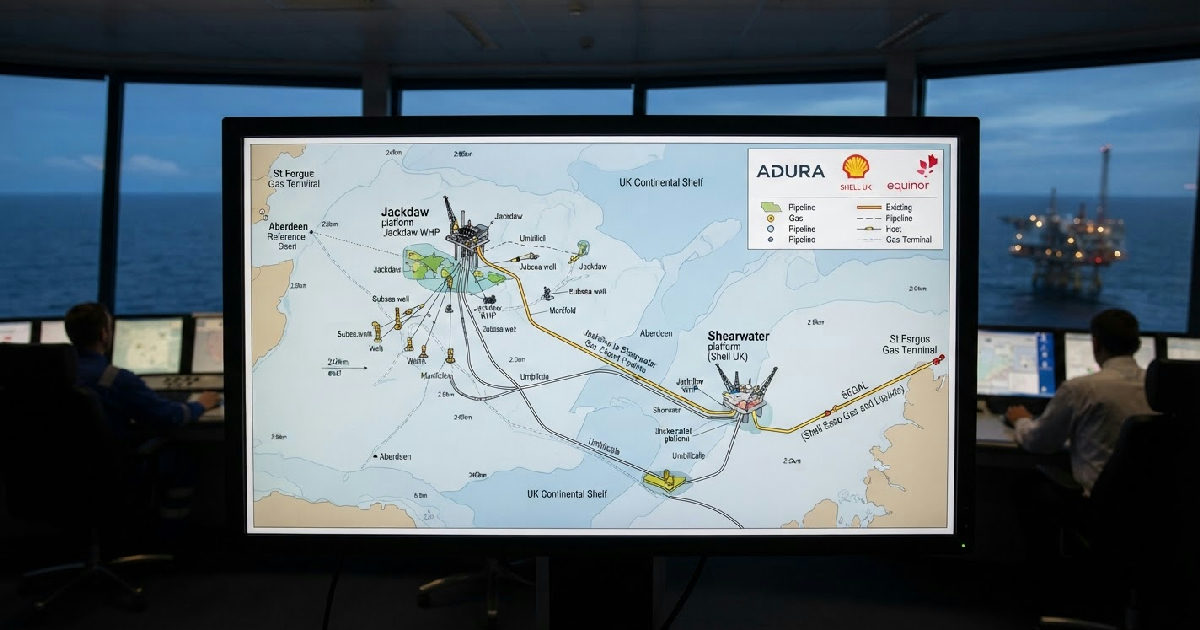
The UK government re-approved the Jackdaw gas field development, enabling gas supplies to British homes and businesses by October 2026.
This decision, formalised on 21 October 2026, allows operator Adura – a joint venture between Shell UK and Norway’s Equinor – to proceed with a project estimated to boost domestic gas production by approximately 6% at its peak.
Navigating Complex Approvals for the Jackdaw Gas Field
Energy Secretary Miatta Fahnbulleh agreed that the North Sea Transition Authority (NSTA) could grant consent for the field, located approximately 240 kilometres east of Aberdeen. The government framed the approval as a critical step to bolster the UK’s energy security amidst global instability, safeguarding hundreds of jobs and adding an estimated £2.9 billion to the national economy.
This re-approval follows a complex regulatory journey. British authorities first sanctioned the project on 6 October 2022. However, environmental challenges led to the rescinding of that initial consent in January 2025.
A legal ruling mandated a more comprehensive environmental assessment. This assessment had to include “Scope 3” emissions, which account for the carbon released when consumers burn the extracted gas. Adura subsequently submitted revised environmental statements in November 2025.
Prime Minister Andy Burnham underscored the government’s rationale for the decision. He stated that “at a time of global instability, homegrown energy can be a source of national strength.” This position reflects a pragmatic approach to the North Sea.
Mr Burnham reiterated the UK’s commitment to achieving net zero by 2050. He acknowledged, however, that oil and gas will remain necessary for decades to come. This provides a clear framework for continued domestic extraction alongside renewable investment.
Energy Secretary Miatta Fahnbulleh highlighted the immediate impact. She noted that Jackdaw would supply the UK with gas “this winter.” This decision helps minimise reliance on imported, higher-emission fuels during the transition to renewables.
Alongside the Jackdaw approval, Chancellor Jeremy Hunt announced a new Energy Wealth Fund. This fund will channel tax revenues from North Sea oil and gas directly into renewable and low-carbon energy projects. The initial injection stands at £2 billion.
This strategic investment aims to accelerate the transition to electrification. It also seeks to reduce energy bills long-term by delinking gas and electricity prices. The government expects this shift to occur by the end of this Parliament.
Engineering the North Sea: Jackdaw’s Operational Blueprint
The Jackdaw field itself presents significant engineering challenges. It is classified as an ultra-high pressure, high-temperature (uHPHT) accumulation. This requires specialised infrastructure and operational expertise for safe extraction.
Adura, the joint venture between Shell UK and Equinor, is spearheading the field’s development. Their plan includes a “not permanently attended” Wellhead Platform (WHP) with four wells. This minimises personnel presence on the offshore facility.
Well fluids from Jackdaw will travel via a 31-kilometre subsea pipeline. This connects directly to the existing Shell UK operated Shearwater platform for initial processing. This integration leverages established North Sea infrastructure.
After processing at Shearwater, the produced gas will move onshore. It uses the SEGAL (Shell Esso Gas Associated Liquids Line) system. From there, it reaches the St Fergus gas terminal for further treatment and distribution.
Shell’s investment in the Jackdaw project has already exceeded £1 billion. The total project represents a £2.1 billion investment. This substantial capital commitment underscores the field’s strategic importance and the scale of the engineering undertaking. Complex industrial projects often require significant upfront capital.
The development cost for the Jackdaw project is estimated at $610 million. These investments support a complex array of offshore and onshore infrastructure. They ensure the safe and efficient delivery of natural gas to the UK grid.
The official list of detailed operational milestones for the Jackdaw gas field beyond its initial gas supply date has not yet been announced.
Economic Impact and Energy Supply Projections
Jackdaw’s re-approval is projected to deliver substantial economic benefits. It could add £2.9 billion to the UK economy over its lifespan of up to 11 years. This provides a boost to national finances.
The project also carries significant employment implications. It is expected to create 27 new direct jobs. It will also safeguard 273 existing jobs on the Shearwater platform. Shell’s broader investment has supported over 1,000 jobs, mostly in the UK.
In terms of energy supply, Jackdaw’s peak production is estimated at 40,000 barrels of oil equivalent per day. It could produce up to 25 terawatt-hours (TWh) a year. This is enough to heat around 1.4 million UK homes.
Weighing Emissions and Industry Reaction
However, the project faces criticism regarding its environmental footprint. Jackdaw is estimated to produce approximately 23 million tonnes of carbon dioxide emissions over its lifetime. The majority, 85%, will come from consumers burning the gas.
Environmental groups have vocally opposed the decision. Ami McCarthy, Head of Politics for Greenpeace UK, stated that approving Jackdaw “shows the toxic grip fossil fuel lobbyists still hold over our energy policy.” She argued it would not lower energy bills or significantly boost energy security.
Ross Greer, Co-leader of the Scottish Greens, labelled the approval a “devastating betrayal of our children’s future.” He described it as “outright climate vandalism.” These strong reactions highlight deep divisions on energy policy.
Katherine May, Head of Oxfam Scotland, questioned the Prime Minister’s commitment. She reminded that Mr Burnham “promised to rise to the climate challenge.” The approval presents a difficult balancing act for the government.
Tessa Khan, Executive Director of Uplift, downplayed Jackdaw’s overall impact on supply. She noted it would provide “around just 2 per cent of our gas demand for roughly 10 years.” This perspective challenges the government’s rhetoric on energy security.
The manufacturing sector has largely welcomed the government’s decision. Stephen Phipson CBE, Chief Executive of Make UK, described it as “a very good start.” He emphasised its role in boosting UK energy security.
Mr Phipson stressed that Jackdaw provides “much-needed certainty” for manufacturers. This comes ahead of a challenging winter. He also voiced support for progressing the Rosebank field, another North Sea development.
Make UK also praised the new Energy Wealth Fund. They see it as a mechanism to accelerate electrification. Ultimately, it should bring down energy costs long-term for industrial consumers. Industrial shifts towards electrification are a key concern for the sector.
However, Mr Phipson also called for further government action. He urged the Chancellor to permanently reduce energy costs. This could be achieved by removing policy levies from energy bills. This would be a priority for reindustrialisation.
Chemical manufacturer INEOS, an energy-intensive industry player, welcomed the approval. But a spokesperson criticised the “punitive” North Sea Levy. They argue it discourages vital investment.
The INEOS spokesperson asserted that the 78% tax has been an “abject failure.” They contended it reduces tax receipts and increases imports. This impacts job creation and tax revenues. The potential for regulatory shifts remains a key concern for operators.
They urged the government to amend the levy in the upcoming Budget. Maintaining it would “compound the mistake.” This highlights a tension between immediate revenue generation and long-term industrial health.
Other industry voices offered nuanced perspectives. Greg Jackson, Founder and CEO of Octopus Energy Group, welcomed Jackdaw. But he paired it with the need to accelerate heat pump adoption. This suggests a dual approach to energy transition.
Charles McAllister, Director of the Green Gas Taskforce, noted the decision acknowledges gas’s enduring role. He believes gas will remain “part of Great Britain’s energy mix for years to come.” This reflects a realistic view of energy demand.
Former UK energy secretary Chris Huhne called the decision “sensible.” He highlighted that “home grown gas beats imported LNG on security, on cost and on carbon.” This underscores the strategic benefits of domestic production.
The Path Ahead: Balancing Domestic Supply with Net Zero
The UK government’s commitment to achieving net zero by 2050 remains firm. However, the Jackdaw decision illustrates the complexities of this transition. It balances immediate energy needs with long-term climate goals.
The new Energy Wealth Fund is central to this strategy. It aims to finance renewable and low-carbon energy infrastructure. This investment is crucial for building a sustainable future. It reduces reliance on fossil fuels over time.
Engineers and industrial operators across the UK will be watching closely. They seek to understand how these policies will shape the energy landscape. Predictable and affordable energy supplies are vital for industrial competitiveness.
The Jackdaw approval also sets a precedent for future North Sea projects. Decisions on fields like Rosebank will face similar scrutiny. Each project must navigate economic, energy security, and environmental concerns. The engineering community has a critical role in developing these complex projects responsibly.
