


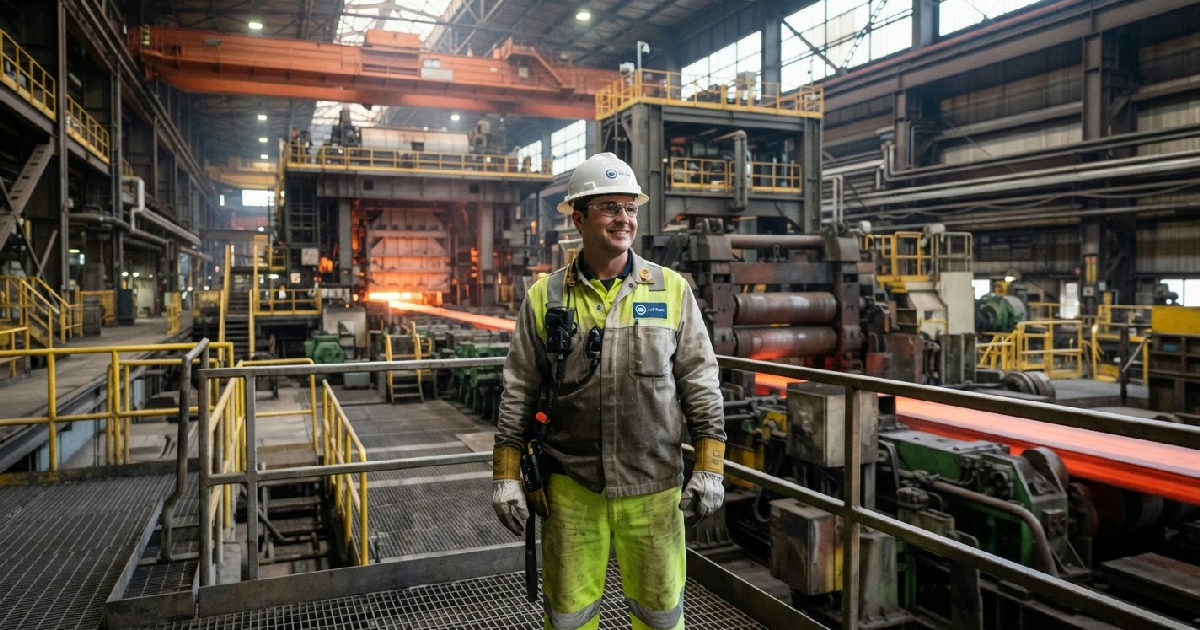
U.S. Steel is investing nearly $3 billion in new hot strip mill technology in Pennsylvania. S. Steel is investing nearly $3 billion in new hot strip mill technology in Pennsylvania.
This major capital injection will replace ageing equipment with modern steelmaking processes, significantly boosting the site’s capabilities. It represents one of the largest investments in American steel manufacturing in recent years and a major commitment from its parent company, Tokyo-based Nippon Steel.
A technological leap for the U.S. Steel hot strip mill
The core of the investment is the construction of a new hot strip mill featuring advanced walking beam furnaces and an in-line slab sizing press. This technology is designed to significantly improve efficiency, product quality, and the range of steels the plant can produce. The process will be more energy-efficient and generate less waste.
By consolidating slab production and hot rolling at a single site, the company expects to use less fuel, eliminate an entire cutting step, and reduce scrap. U.S. Steel’s Executive Vice President and Chief Manufacturing Officer, Scott Buckiso, stated, “The steel this country needs for the future is coming to the Mon Valley today.”
The upgrade will directly impact the plant’s output, increasing its annual production capacity by nearly 60%, from 2.2 million tons to 3.5 million tons. This expansion is aimed squarely at high-value markets.
Buckiso noted the investment allows the company to “compete across the automotive, appliance and line pipe markets like never before.” As carmakers themselves invest heavily in AI and robotics, their demand for higher-specification steels continues to grow.
Strategic investment follows Nippon Steel acquisition
This nearly $3 billion project is a cornerstone of a broader, $11 billion investment strategy for U.S. Steel’s facilities planned by Nippon Steel through 2028. The Japanese steel giant acquired U.S. Steel for $14.9 billion last year, and this move delivers on promises made during the acquisition process to modernise the American steelmaker’s operations.
The funding commitment for the Mon Valley Works has grown substantially over time. Initial plans disclosed in August 2024, contingent on the acquisition, floated a figure of at least $1 billion. This was later increased to a range of $2 billion to $2.5 billion in June 2026, before the board approved the final, nearly $3 billion figure.
“There are moments when an investment can change the trajectory of a company and a community. This is one of those moments,” said David Burritt, President and CEO of U.S. Steel. The project is expected to support thousands of jobs and generate up to $58 million in state and local tax revenue over three years, according to an economic impact study by Parker Strategy Group.
Replacing history and reshaping operations
The new mill will be built at the Edgar Thomson Plant, a site first opened by Andrew Carnegie in 1875 and U.S. Steel’s oldest continuously operating facility. It will directly replace the hot strip mill at the nearby Irvin Plant in West Mifflin, which has been in service since 1938. This operational consolidation is key to the project’s efficiency gains.
Currently, steel slabs are produced at Edgar Thomson and then shipped to the Irvin Plant for rolling. The new facility will bring this entire process under one roof. The company has clarified that while the 87-year-old hot strip mill and reheat furnaces at Irvin will be decommissioned, the plant’s finishing operations will continue.
A spokesperson confirmed that the move will not result in job losses, with affected positions from the Irvin Plant being consolidated at the new facility in Braddock. This effort to update legacy systems with new technology reflects a wider industrial trend, where advanced software modernises physical test workflows and streamlines production, bridging the gap between old and new infrastructure.
Alongside the hot strip mill, a separate $100 million project is already underway at the Edgar Thomson Plant. A new slag granulator will cool and process blast furnace slag, turning a steelmaking byproduct into a valuable material for the cement and construction industries. Construction on the main hot strip mill will begin after permits are received, with production expected to ramp up in late 2029.
Community hopes and environmental concerns
The announcement has been met with a mix of optimism and apprehension. Political leaders praised the investment for its economic promise. Pennsylvania Governor Josh Shapiro said the project “will keep thousands of jobs here in our Commonwealth.” U.S. Senator Dave McCormick called it “a major step toward delivering on the promises of the U.S. Steel–Nippon Steel partnership.”
For some locals, the news brings hope for economic revitalisation. “I think it’s very motivational to see something like that coming into Braddock, considering that it’s a struggle for jobs around here,” said resident Khalil Carpenter. The United Steelworkers union also welcomed the long-overdue upgrade, with District 10 Director Bernie Hall confirming the union’s focus would be ensuring the mill gets built.
However, the project also raises environmental questions. While U.S. Steel says the new mill will lower its overall pollution footprint in Allegheny County, emissions at the Edgar Thomson Plant itself are projected to rise. The company is seeking an air permit for the facility, which could see fine-particle emissions (PM 2.5) increase by 43% and nitrogen oxides (NOx and NO2) jump by 98%.
This has alarmed some environmental advocates and local officials. Braddock borough council member Nathan Mallory expressed concern that the large facility would bring more pollution to his neighbourhood. Despite the projected increases, modelling by the Allegheny County Health Department indicates the project would not push the county beyond federal air pollution limits.
This debate highlights the complex trade-offs involved when integrating massive new industrial processes, with some looking to different methods entirely and seeking additive manufacturing insights to envision cleaner production futures.
