


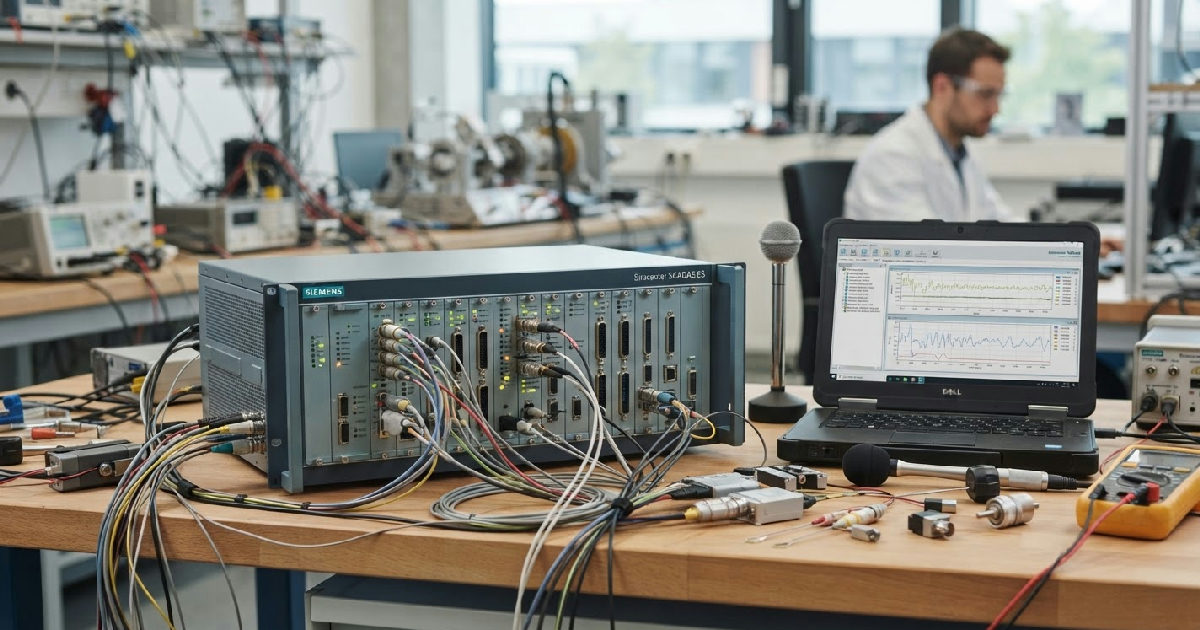
Siemens Digital Industries Software has launched Simcenter SCADAS ES, a modular data acquisition (DAQ) system designed to modernise physical testing workflows. Announced on 15 October 2026, the system is designed to support laboratory, field and mobile testing through a flexible, connected platform.
The system is designed to address challenges associated with disconnected test setups, inconsistent data handling and coordination across distributed engineering teams. Its modular architecture supports remote configuration, multi-user operation and synchronised measurements for applications including noise, vibration and harshness (NVH), durability testing and structural dynamics.
A Modular Approach to Complex Testing Requirements
Scalability is a central feature of Simcenter SCADAS ES. The system shares modular technology with the Simcenter SCADAS RS, which is designed for demanding outdoor testing conditions.
Organisations can begin with a small number of measurement channels and expand the system as requirements grow, providing flexibility across projects of different sizes.
The system’s scalability extends beyond the number of channels it supports. The system supports centralised, distributed and hybrid measurement configurations, enabling engineers to synchronise data from sensors located in one laboratory or across a large test structure. Multiple units can be daisy-chained to expand the system while maintaining time synchronisation, allowing engineers to correlate measurements such as vibration, acoustics, strain, temperature and rotational data.
The system supports configurable signal conditioning for a range of input types, including voltage, ICP, bridge, charge and pulse signals.
This versatility allows one DAQ system to support multiple types of physical testing, potentially reducing the need for separate hardware and bringing measurements into a common acquisition environment. Synchronised digital audio can also be captured alongside other measurement channels.
Designed for connectivity and remote collaboration
A key feature of the new hardware is its support for remote access and multi-user collaboration through onboard software tools. The approach allows geographically distributed engineering teams to access test data and system controls without being physically present at the test site.
Onboard and browser-based software
Each Simcenter SCADAS ES unit runs Simcenter SCADAS Go, license-free browser-based software that serves as the primary user interface. Because it runs directly on the DAQ hardware, multiple users can connect remotely using compatible devices with a web browser.
This enables parallel activities, allowing one engineer to configure channels while another monitors live data and validates measurements in real time, potentially reducing setup time and configuration errors.
For routine tasks, the browser-based interface reduces the need to install specialised software on user devices. It also reflects a wider industry move towards browser-based and platform-independent tools that can improve accessibility and reduce IT overhead. The ability for engineers to collaborate on a single test setup from different locations is a powerful tool for accelerating product development cycles.
Remote channel configuration can simplify deployment when engineers are working away from the test system.
Integration with the Simcenter ecosystem
For more advanced tasks, the hardware integrates with the broader Siemens Simcenter portfolio. Simcenter Testlab Go, a Windows desktop application, provides tools for instrumentation, advanced visualisation, and live monitoring. For advanced analysis, automated processing and data management, measurements can be transferred to the Simcenter Testlab software suite.
The platform also supports integration with existing workflows and third-party technologies through its open architecture. Test Connect, a hardware-to-software data exchange interface, enables customers to develop custom applications. These applications can connect to the acquisition systems, stream measurement data to external software and integrate additional technologies into testing workflows
Advancing digital engineering with AI-ready data
Simcenter SCADAS ES is designed to support engineering workflows that increasingly incorporate artificial intelligence and digital twin technologies. The system is designed to produce synchronised, annotated and traceable measurement data that Siemens describes as ‘AI-ready’. This data structure is intended to make measurements more suitable for analytical and machine-learning applications.
The approach can support engineering applications such as digital twin validation and correlation between physical test results and simulations. Structured physical test data can be used to refine virtual models and improve the correlation between digital twins and real-world measurements.
Bruno Massa, Vice President of Simcenter Testing Solutions at Siemens Digital Industries Software, said the system is designed to move testing beyond isolated workflows.
Engineers can use the data to support predictive maintenance models, optimise performance parameters and inform design decisions. The integration of physical testing with digital engineering workflows through the Siemens Xcelerator portfolio connects measurement data with broader engineering processes. This enables test results to be compared with simulated performance, supporting iterative model and product development.
Siemens’ strategic push in industrial software
The release expands Siemens Digital Industries Software’s portfolio of testing and engineering tools. The division provides a portfolio of product lifecycle management (PLM) software and engineering solutions. The Simcenter portfolio forms part of the Siemens Xcelerator business platform.
Siemens expanded its testing and simulation portfolio through its 2012 acquisition of LMS International NV, which brought testing and mechatronic simulation technologies into the company’s software portfolio. The acquisition helped establish the testing and simulation capabilities that now form part of Siemens’ Simcenter portfolio.
The new hardware expands Siemens’ SCADAS portfolio and complements existing systems such as Simcenter SCADAS RS, which is designed for rugged outdoor environments. Other Simcenter SCADAS offerings, including Simcenter SCADAS Lab, Simcenter SCADAS Mobile, and Simcenter SCADAS Recorder, remain available.
These systems support applications including environmental testing, ground vibration analysis and pass-by noise measurements.
Enabling multi-domain testing versatility
Simcenter SCADAS ES supports multi-domain testing across a range of engineering applications. It is designed to capture synchronised multiphysics data under real-world conditions. The ability to capture these measurements can support assessments of product durability, reliability and operator comfort across different industries.
upported applications include noise, vibration and harshness (NVH), durability testing, structural dynamics analysis and rotating machinery evaluation. The system also supports testing of electrification components and other multiphysics applications. This range of applications could allow organisations to use the same DAQ hardware across multiple departments, potentially reducing equipment and training requirements.
The system comprises several hardware modules that provide connectivity, power, synchronisation and signal-conditioning functions. The SCES-PNI unit serves as the central connectivity point, powering and linking modules while managing synchronisation and system control. The Simcenter SCADAS RS Digital Pulse unit provides connectors for digital pulse conditioning and CAN bus communication and supports compatibility with TCK8 thermocouple modules.
An EtherCAT unit provides a digital interface for connecting Simcenter SCADAS RS systems to EtherCAT-based networks.
Siemens Digital Industries Software positions Simcenter SCADAS ES as a platform for integrating physical testing into modern product development workflows. The system is designed to support more connected and data-driven engineering workflows. Its backward-compatibility features are also intended to allow organisations to expand their testing capabilities without replacing all of their existing hardware.
