


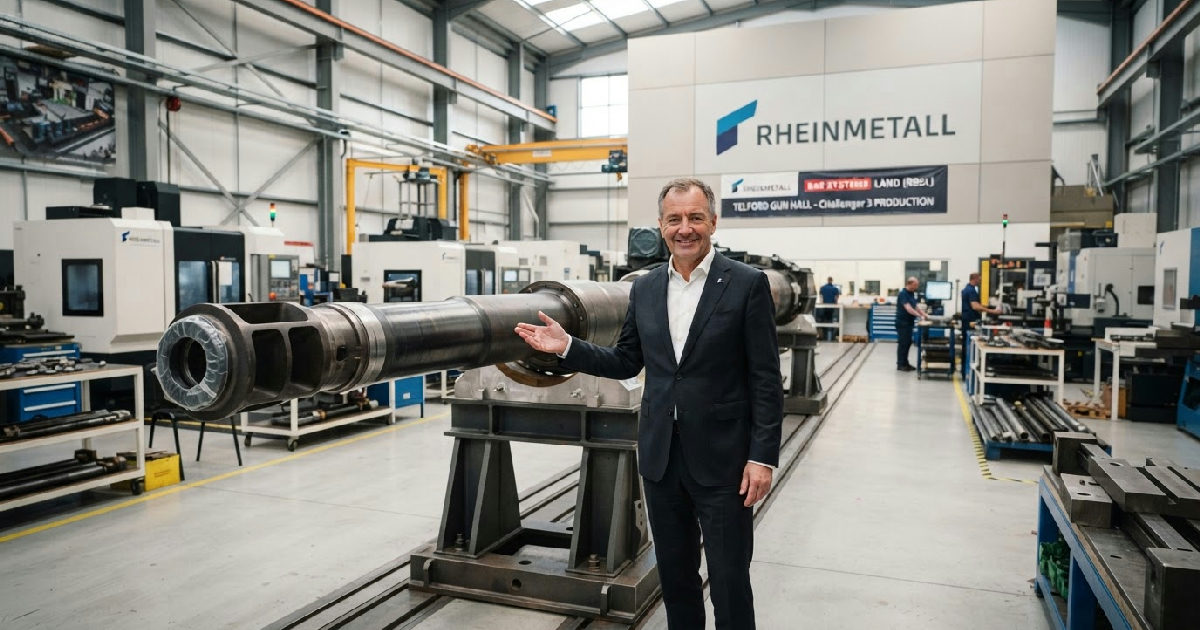
The UK has restored domestic production of large-calibre gun barrels with the official opening of Rheinmetall’s new UK Gun Hall in Telford.
The facility forms part of Rheinmetall’s reported £200 million investment in its UK operations. It is intended to support programmes including the Challenger 3 main battle tank and future artillery systems. The move addresses growing demand from the UK, NATO, and international partners for advanced weapon systems.
New Telford Facility Restores UK Large-Calibre Weapons Production
The UK Gun Hall at Hadley Castle Works in Telford, Shropshire, provides 11,500 square metres of production space. It will manufacture components for 120mm and 155mm weapon systems. The facility will support the Challenger 3 main battle tank programme and artillery projects, including the RCH 155 wheeled self-propelled howitzer.
At peak capacity, the factory can produce up to 245 gun barrels annually across both calibres, alongside more than 50 breeches each year. This capacity provides crucial industrial resilience, enabling the UK to meet its defence commitments and contribute to collective deterrence within NATO.
Rheinmetall says it converted an empty facility into an operational manufacturing site in eight months.
Strategic Investment and Rapid Deployment
The facility’s development received support through a £53 million contract announced in March 2026, with £30 million allocated to the Gun Hall. The project forms part of Rheinmetall’s wider investment of more than £200 million in its UK operations over five years. The swift conversion of the site, from acquisition in Autumn 2025 to operational readiness, underscores the urgency and strategic importance placed on this project.
Production of breeches and breech blocks began in May 2026, followed by barrel production in June.
The successful manufacture of the first UK-produced breech, breech block, and barrels demonstrates the immediate capability to produce these complex weapon components on British soil. The first components mark the establishment of domestic manufacturing capacity for parts previously sourced from outside the UK.
Bolstering Skills and Domestic Supply Chains
The Gun Hall currently employs 35 people, with the workforce expected to grow to more than 100 as production expands. Rheinmetall has around 685 employees across its Telford operations.
The project is also expected to support additional jobs among UK suppliers and other businesses in the defence supply chain. Factory automation and advanced manufacturing processes underpin much of this new capability.
Investment in human capital has been central to the programme. UK employees trained at Rheinmetall’s facility in Unterlüß, Germany, where they developed skills in precision manufacturing, quality assurance and specialist weapons production before returning to Telford.
Rheinmetall also recruited specialist skills from across the local Telford region, reflecting the strength of its engineering and manufacturing sector.
The Trinity House Agreement’s Influence
The Gun Hall is one example of the UK–Germany defence cooperation outlined in the Trinity House Agreement, signed in October 2024. This accord commits both nations to closer cooperation on defence equipment, weapons production, and military technology.
The joint venture combines Rheinmetall’s established manufacturing expertise with Britain’s need for sovereign production capability, demonstrating how allied industrial collaboration can accelerate delivery and enhance NATO’s collective security.
Rheinmetall also plans to use steel supplied by Sheffield Forgemasters, which could strengthen domestic sourcing for the programme. This move not only supports the UK steel industry but also enhances the resilience of the defence sector’s material sourcing.
The planned steel supply is linked to the UK government’s nearly £1 billion contract for 72 RCH 155 howitzers, announced in May 2026. The contract supports the wider programme and UK defence supply chain.
Implications for National Security and Economic Growth
The facility restores UK production of large-calibre weapon components after an absence of around two decades. Defence Secretary Wes Streeting described the development as “rapid reindustrialisation in action”, adding that Britain was “back in the business of making the weapons that our Armed Forces need”.
This capability reduces reliance on imported military equipment, bolstering the UK’s strategic autonomy in an increasingly complex global environment.
Armin Papperger, CEO of Rheinmetall AG, said the facility would strengthen Britain’s defence industrial base for decades to come. The facility directly supports warfighting readiness and contributes to the government’s ambition to position defence as an engine for economic growth. The facility is expected to support jobs and business activity across the UK defence supply chain.
Long-Term Vision for UK Defence Manufacturing
The Telford facility is a cornerstone of a broader vision for the UK’s defence industrial future. Rheinmetall’s UK operations are also involved in the Boxer mechanised infantry vehicle and Challenger 3 programmes. The new gun hall integrates seamlessly into this existing ecosystem, creating a more cohesive and resilient defence manufacturing base.
Telford & Wrekin Council is campaigning for Telford to be designated a Defence Growth Zone, which it says could attract further investment and defence-related businesses.
Telford College is also expected to contribute to defence-sector skills development through the Defence Technical Excellence Colleges programme, helping prepare workers for specialist roles in the industry.
Engineering Challenges and Achievements in Production
Establishing the Gun Hall required the installation and commissioning of specialised manufacturing equipment within an eight-month period. This involved the rapid installation and commissioning of advanced manufacturing equipment, tailored for the extremely tight tolerances required in gun barrel production. The manufacturing process requires precision machining and quality-control procedures to ensure that components meet the required specifications.
The transfer of specialist expertise from Germany to the UK workforce was a critical success factor. This involved comprehensive training modules covering every aspect of the manufacturing workflow, from material science and metallurgy to sophisticated CNC programming and metrology.
The production of the first breeches, breech blocks and barrels marks the establishment of the facility’s manufacturing capability.
The ability to rapidly establish such a complex manufacturing capability speaks to the adaptable nature of modern industrial engineering. It demonstrates how, with strategic investment and focused technical transfer, sovereign capabilities can be quickly re-established to meet national security imperatives. This accelerated reindustrialisation serves as a model for other sectors looking to enhance domestic production resilience.
