


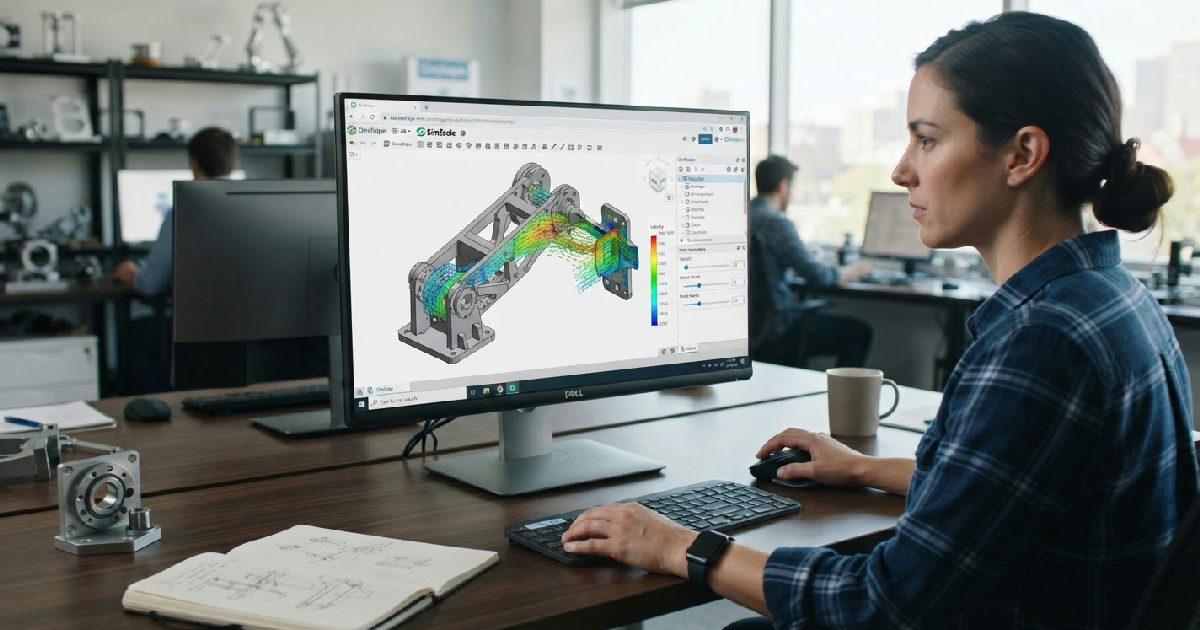
SimScale has launched its Engineering AI Agent inside PTC’s Onshape, embedding physics analysis within the cloud-native design environment. The integration brings simulation capabilities directly into the CAD platform, streamlining the design and analysis workflow for engineers.
This development aims to reduce the separation between product design and simulation. Historically, engineers had to export CAD models, import them into separate analysis software, and often hand the task off to a dedicated specialist. SimScale’s agent is designed to consolidate that multi-step process into a workflow managed from a single interface, potentially reducing the time required for analysis and iteration.
How SimScale embeds simulation with the integrated AI agent
The SimScale Engineering AI Agent is available as an integrated application through the Onshape App Store. Once enabled, it functions as an assistant within the user’s workspace. An engineer can initiate an analysis by entering a natural-language command, such as asking the agent to assess a design for thermal stress or fluid flow. This approach is a significant step forward for core engineering expertise in the modern era.
From a single natural language prompt, the agent can perform several automated tasks that were once manual and time-consuming. It prepares the CAD geometry for analysis, a process that can include simplifying complex models and generating a suitable mesh.
The agent then proposes a simulation setup, recommending the relevant physics and boundary conditions while allowing the engineer to review and override its assumptions before the simulation is run.
Once the setup is approved, the analysis runs on SimScale’s cloud platform. This platform supports computational fluid dynamics (CFD), finite element analysis (FEA), thermal analysis, and electromagnetic (EMag) simulation. The results are then returned directly within the Onshape environment, with the agent capable of explaining its findings in standard engineering terminology. This workflow supports iterative design and optimisation.
A shift from standalone software to embedded simulation
This integration represents a broader strategic shift in the engineering software industry. The focus is moving away from standalone, specialised tools and toward embedding intelligent capabilities directly within the primary work environment. SimScale says its strategy is to bring its AI agents into the platforms engineers use for design decisions, reducing the need to switch between software environments.
The traditional workflow can also introduce opportunities for errors and data loss. Exporting and importing complex geometry between different software packages can introduce translation problems. By keeping the process within a cloud-native environment, the SimScale and Onshape integration is intended to reduce data-transfer issues between design and simulation.
This approach becomes increasingly relevant as product complexity and demands for faster development increase.
The technology behind the integration
The seamless experience is made possible by the cloud-native architectures of both platforms. SimScale GmbH, founded in 2012 in Munich, Germany, by five graduates of TU Munich, including David Heiny and Vincenz Dolle, built its Software-as-a-Service (SaaS) platform from the ground up.
Its platform provides cloud-based simulation and uses Physics AI surrogate modelling frameworks and Graph Neural Networks to support virtual testing.
SimScale says its platform is used by more than 900,000 engineers for CFD, FEA, thermal and electromagnetic simulation. The company has secured $60.3 million in funding over six rounds, with its latest Series C round concluding in October 2021. The funding has supported SimScale’s development and expansion of its cloud-based simulation platform.
Similarly, Onshape was created in 2012 in Cambridge, Massachusetts, by a team that included former SolidWorks CEOs Jon Hirschtick and John McEleney. The company’s initial vision was to develop a fully cloud-native CAD and product data management (PDM) system. Onshape launched after raising $9 million in its first funding round in December 2012.
Onshape’s architecture, which supports real-time collaboration and API-driven connections, provides a foundation for integrations such as this one.
The SimScale Agent API
The connection between SimScale’s simulation engine and Onshape is managed through the SimScale Agent API. The interface handles the automated provisioning of computing resources required to run analyses in the cloud. It provides access to the required computational resources without requiring engineers to manage hardware directly, with resources scaled according to demand.
The API is also designed with rigorous enterprise needs in mind, providing mechanisms for auditability and data governance. Customers can maintain control and visibility over their intellectual property, reviewing all agent activities and data handling within their existing environment.
These capabilities are particularly relevant to industries such as aerospace, automotive and medical devices, where traceability and data security are important requirements. Similar developments in other sectors reflect a broader interest in AI-assisted workflows, particularly where traceability and data security are important.
Expanding access to high-fidelity simulation
One potential implication of the launch is broader access to simulation tools for engineers. Some smaller companies and design teams may have limited budgets for simulation software licences or dedicated analysis specialists. This creates a bottleneck, slowing innovation and increasing reliance on costly physical prototypes for validation.
By embedding conversational AI into a SaaS CAD tool, the integration could lower the barrier to accessing simulation capabilities. The integration allows design engineers to obtain simulation feedback within the design environment, including those who may not specialise in CFD or FEA. The capability is intended to support more iterative design and potentially reduce the time required to develop new products.
According to SimScale, health technology company Withings used the platform to reduce its design-to-prototype cycle sevenfold. SimScale presents the result as an example of how early simulation can reduce the time required to reach the prototype stage. It allows teams to refine designs virtually before committing to expensive physical builds.
This development doesn’t necessarily replace the need for dedicated simulation experts, but it augments the capabilities of the entire product development team. It frees specialists from routine analysis tasks to focus on more complex, multi-physics problems, while empowering design engineers to make more informed decisions from the outset. This aligns with a broader vision for the future of industrial engineering, fostering greater efficiency and innovation across various sectors.
