


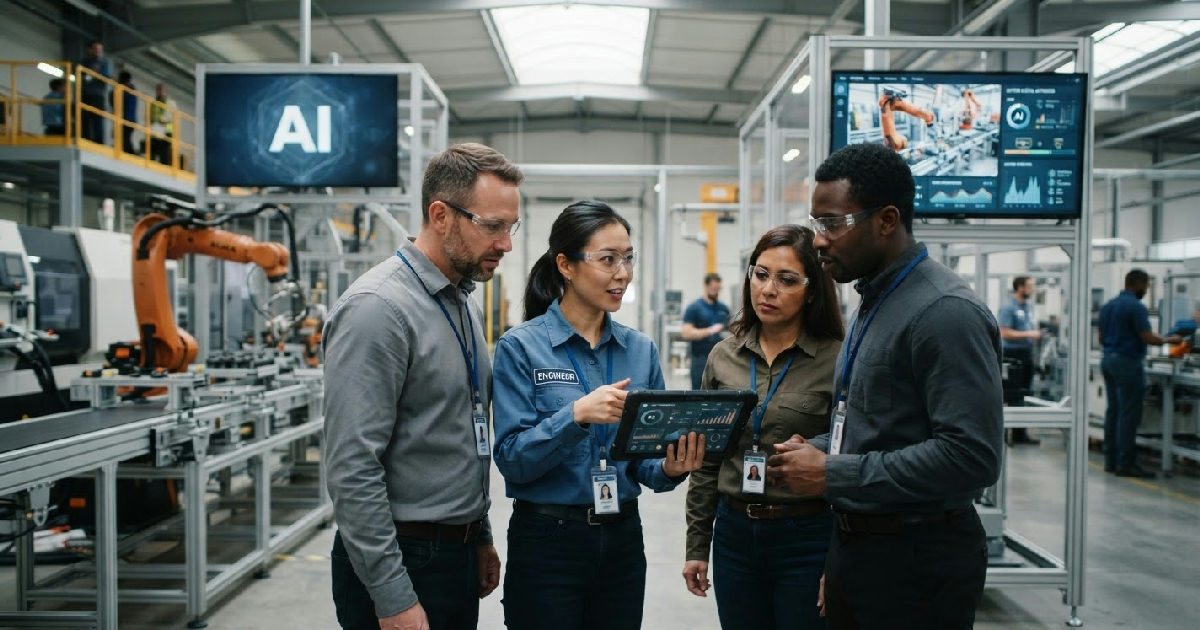
The manufacturing sector is at an early stage of AI adoption, even as the market continues to expand.
This early-stage adoption comes as the global AI in the manufacturing market is projected to reach USD 9.7 billion in 2026, with forecasts estimating growth to USD 34.1 billion by 2030 and USD 128.81 billion by 2034. The projected growth reflects increasing commercial interest in AI, although widespread implementation remains uneven.
AI adoption fuels rapid market growth
The data indicate that manufacturers are moving beyond initial exploration of AI. Although many manufacturers are still exploring AI, attention is increasingly focused on implementation and measurable outcomes. According to the 2026 RSM Middle Market AI Survey, 88% of manufacturing respondents reported at least partial AI integration, while 32% reported full integration.
In 2026, approximately 60% of manufacturing companies are using AI, with this figure projected to rise to 80% by 2030. This growth indicates increasing adoption, although a readiness gap remains. While 98% of manufacturers are investing in or exploring AI, only 20% reported feeling fully prepared to implement it at scale, according to recent research.
North America accounted for 35.1% of the market in 2024, with the United States representing about 75% of the regional market. In 2025, Asia Pacific accounted for the largest regional market share, at 42.80%.
The compound annual growth rate (CAGR) for the AI in manufacturing market is projected at 37.90% from 2026 to 2034, compared with a forecast CAGR of 42.1% from 2026 to 2030. These projections indicate expectations of continued AI adoption across industrial operations.
Practical Applications Driving Production Value
AI is being used to improve existing processes in manufacturing. Companies are using AI for applications including cost reduction, productivity improvement, task automation and workflow optimisation. These initial efficiency gains represent the most accessible benefits for many organisations.
For example, predictive maintenance systems can use AI to analyse sensor data and, according to cited industry research, reduce maintenance costs by up to 40% and extend machine life by 20%. Such applications can reduce unplanned downtime and improve equipment management, potentially generating financial benefits.
Quality control is another area seeing substantial benefit. AI tools can support quality assurance through real-time inspections, helping to identify defects earlier and potentially reduce product waste. These capabilities can be particularly relevant in industries where minor defects can affect product performance or safety.
Beyond current processes, AI supports innovation in product design and performance analysis. Technologies such as digital twin modelling can support design simulation and detailed modelling, potentially reducing development times. This can be particularly relevant in sectors such as aerospace and automotive, where generative design can be used to evaluate multiple design options.
Other key applications include demand forecasting, which leverages historical data for better inventory and production planning, and production planning itself, which uses AI to optimise schedules and reduce bottlenecks. The integration of AI with industrial automation is another area in which manufacturers are seeking to improve operational efficiency.
Data and Skills Requirements for AI Adoption
High-quality, reliable data is an important foundation for effective AI deployment. Robert Garratt, a partner at IBM, highlighted this issue, noting that poor or insufficient data can contribute to inaccurate AI outputs, including “hallucinations”, which can reduce confidence in AI systems. He described manufacturing as a precision-driven industry and said that “data is everything”.
Dominic Regan, Senior Director, Logistics Solutions at Oracle, echoed this sentiment, highlighting that the skills challenge extends beyond technical AI proficiency. Manufacturers also need a detailed understanding of their business processes and clear definitions of the outcomes they want AI to achieve, including where AI could improve or redesign existing processes.
A lack of clean, structured and application-specific data remains a challenge. About 47% of manufacturers view data fragmentation as a major obstacle to successful AI integration. Many manufacturers are still working to establish the data foundations required for AI deployment.
Workforce readiness is equally critical. There is a shortage of workers with skills in data science, machine learning, and robotics. Projections indicate that 54% of manufacturing workers would require significant upskilling by 2025 to adapt to AI-driven environments. This points to a need for comprehensive training and development programmes.
Overcoming Operational Hurdles
Integrating AI solutions into existing factory systems can present technical and operational challenges. Many manufacturers continue to use legacy systems, with 65% reportedly using older infrastructure that can create compatibility challenges for newer AI applications. This can make AI integration more complex and increase implementation costs and timelines.
Asad Afzal, global director of transformation at A-Safe Global, highlighted a gap in physical infrastructure readiness. He stated, “Most facilities weren’t built for the level of automation AI now supports.” The gap between digital capabilities and physical infrastructure can create challenges for wider AI deployment.
High initial investment costs also create a barrier, particularly for smaller and medium-sized enterprises. The cost of AI technology, infrastructure and skilled personnel can be a barrier for smaller manufacturers, particularly where the expected return on investment is uncertain.
Security and privacy concerns were identified as barriers to wider AI deployment by 37% of respondents in a recent survey. Protecting sensitive operational data and intellectual property becomes increasingly important as AI systems are integrated into manufacturing processes.
Research has identified a potential “productivity paradox”, in which the introduction of AI may initially be associated with a temporary decline in productivity before longer-term gains materialise. Kristina McElheran, a professor at the University of Toronto, noted that “AI isn’t plug-and-play. It requires systemic change, and that process introduces friction, particularly for established firms.”
Future Trajectory and Strategic Imperative
Despite these challenges, manufacturers are continuing to explore and deploy AI across a range of applications. More than 90% of manufacturers surveyed said they planned to deploy generative, predictive, and language AI within the following 18 months.
Some industry analysts expect AI adoption to change the skills required in manufacturing rather than eliminate large numbers of jobs, with AI potentially being used as a “co-pilot” to support human decision-making and technical work. Steve Shepley, Industrial Products and Construction Sector leader at Deloitte, said AI could make technical expertise more accessible while retaining a role for human judgement and experience.
AI is used in Industry 4.0 initiatives, including smart manufacturing and real-time data analysis. Industry 5.0 places greater emphasis on human-centred approaches, sustainability and the interaction between people and technology. This approach places greater emphasis on ethical considerations, worker wellbeing and the interaction between technological development and human workers.
These views reflect arguments from technology leaders about the potential impact of AI on work and productivity. OpenAI CEO Sam Altman has argued that people who use AI could gain an advantage over those who do not. NVIDIA CEO Jensen Huang has described artificial intelligence as “the most transformative technology of the 21st century”.
These perspectives form part of the wider discussion about how manufacturers should approach AI adoption, including among UK manufacturing leaders.
The Manufacturer AI Readiness Index provides one measure of the sector’s current approach to AI adoption. It provides information on current levels of AI adoption and highlights barriers such as data quality, skills shortages, infrastructure limitations and security concerns. These findings provide context for organisations considering how and where to integrate AI into their operations.
