


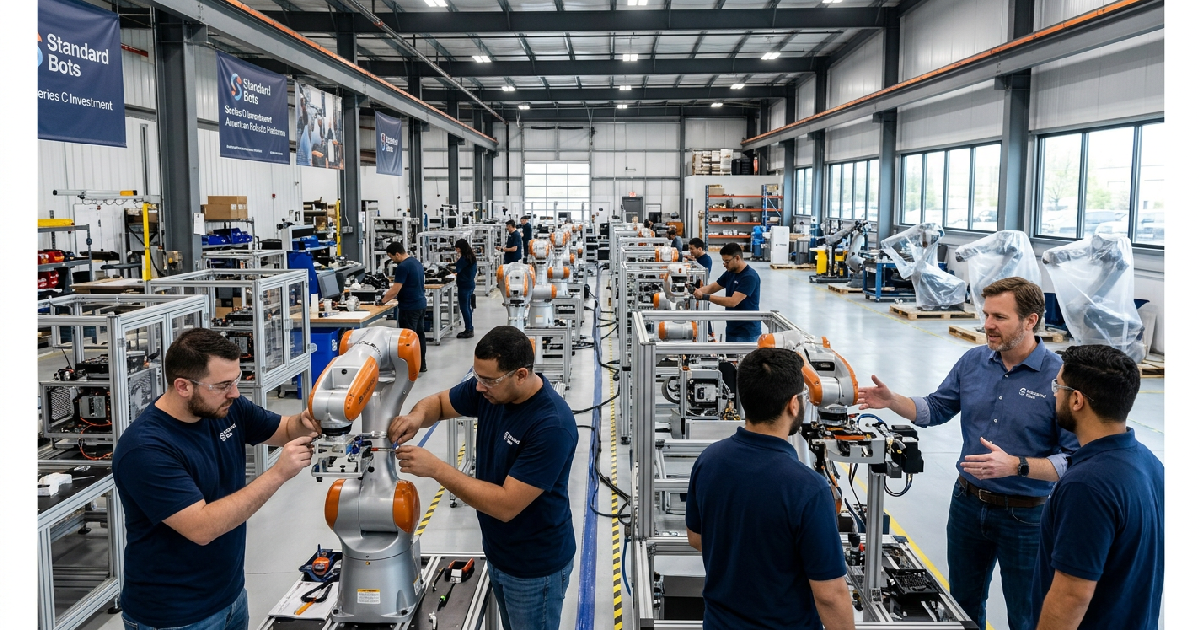
Standard Bots secured $200 million in Series C funding on June 9, 2026, to expand its vertically integrated manufacturing operations for AI-native industrial robotics. The funding round, led by RoboStrategy with participation from existing investors including General Catalyst, elevates the New York-based company to a $1 billion valuation.
CEO Evan Beard confirmed the capital will scale American-made production at its 70,000-square-foot facility in Glen Cove, Long Island.
The investment arrives as domestic industries seek self-reliant supply chains for physical automation, reducing dependency on legacy hardware from China and Europe. Standard Bots designs almost all its structural parts in-house, including proprietary actuators, and performs final assembly at its New York plant. This vertical integration strategy aims for a fully domestic supply chain by 2027 to bypass international shipping disruptions and licensing fees.
Standard Bots currently employs 122 people and has raised a total of $291 million to date across its funding history. “AI-native robots are the essential power tool of the 21st century – the tool that will grow American manufacturing,” said Beard. The company’s growth is reflected in its ambitious commercial target to deliver 10% of all new U.S. industrial robot deployments by 2027.
Eliminating complex engineering through demonstration-based learning
Traditional industrial robotics often requires specialised engineers to write thousands of lines of code for every specific movement. Standard Bots replaces this with “AI-native” foundations that allow machines to learn tasks through behavioural demonstration. A technician simply guides the robot arm along a path or demonstrates a process visually, allowing the system to learn the task independently.
This no-code approach dramatically reduces the implementation timeline and lowers the barrier for small and medium-sized manufacturers. By removing the need for formal programming, the company enables smaller workshops to access high-end automation previously reserved for giants. This shift mirrors wider trends as the cobot market continues to grow toward mainstream adoption.
The technical shift also provides a significant cost advantage. Standard Bots predicts its AI-native systems will be 30% cheaper than legacy hardware because they avoid international licensing charges and use more efficient software architectures. This “physical AI” allows robots to handle complex floor uses like high-precision welding, palletising, and assembly with minimal downtime.
Scaling the Glen Cove plant for high-volume commercial shipments
The 70,000-square-foot Glen Cove facility is the hub for the company’s “metal-to-robot” production philosophy. By handling everything from raw material processing to final assembly on American soil, the firm protects its customers from global trade volatility. This operational scale is necessary to support a client list that includes Amazon, Lockheed Martin, NASA, the U.S. Army, and Sunoco.
These industrial users deploy Standard Bots for various tasks, including CNC machine tending, parts inspection, and grinding. As engineers increasingly pivot to manufacturing execution systems for better plant agility, the role of autonomous, learnable hardware becomes central. Standard Bots further strengthened this software-hardware link through its acquisition of READY Robotics in late 2024.
The company’s rapid scaling coincides with its presence in national policy discussions. Standard Bots has advised the White House and Congress on a National Robotics Strategy. Its recommendations include financial support for domestic robot adoption and bans on Chinese-made industrial components to ensure national security and supply chain resilience.
RoboStrategy leads investment as US market share grows
Lead investor RoboStrategy, which listed on the NASDAQ under the ticker “BOT” in May 2026, has aggressively backed the shift from experimental to commercial robotics. Andrew Kang, CEO at RoboStrategy, noted that the industry is moving toward systems that deliver immediate, real-world value. Standard Bots is positioned at the forefront of this trend, already serving hundreds of small manufacturers alongside its Fortune 100 clients.
The economic logic of this expansion extends beyond the factory floor. Standard Bots’ data suggests that manufacturing supports roughly one-third of the U.S. economy, with every factory worker supporting five additional jobs elsewhere. This multiplier effect is a key driver behind the company’s push to outpace global competitors who currently dominate the installation volumes.
As the company moves toward its 2027 goal of total vertical integration, it represents a broader movement to secure critical industrial supply chains within the United States. By combining proprietary hardware with physical AI, the firm aims to prove that domestic manufacturing can be both technologically superior and more cost-effective than imported solutions.
