


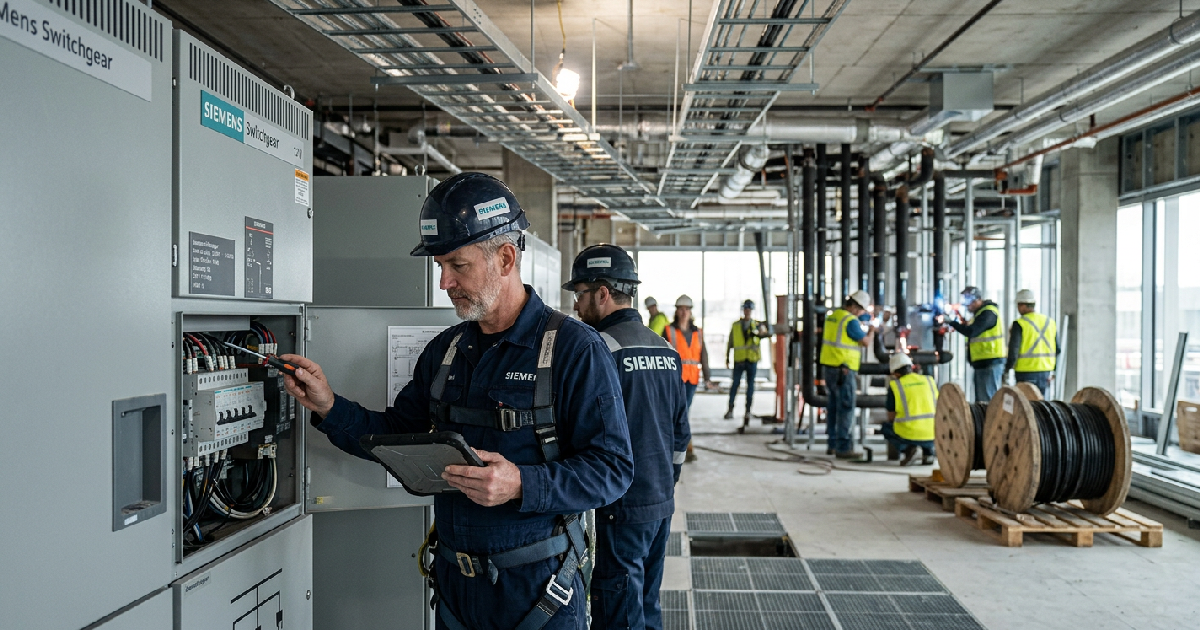
Industrial manufacturers are retooling production lines to meet a surge in data center construction that has seen spending triple over the last three years.
Recent data from Goldman Sachs Research and internal company reports show that specialized firms like Georgia-based Southeastern Hose and global giant Siemens are seeing double-digit revenue growth as they pivot away from contracting sectors like coal and petroleum to serve the heating, cooling, and power needs of artificial intelligence (AI) infrastructure.
The scale of this shift is transformation in real-time. While traditional manufacturing sectors struggle with high interest rates and falling demand, the data center vertical has become a critical lifeline for companies building the physical components of the digital world.
This isn’t just about chips; it’s about the massive quantity of electrical switchgear, liquid cooling systems, and metal hoses required to keep high-density AI servers running safely.
For operations professionals, this boom represents a distinct supercycle of investment. Trey Travis, VP of operations at Southeastern Hose, noted that his business is on track for 40% growth this year, with two-thirds of that revenue coming directly from data center orders.
The company, which traditionally served the petrochemical industry, recently completed a 40,000-square-foot expansion in Bremen, Georgia, to handle the deluge of orders for corrugated metal hoses used in data center exhaust systems.
Industrial spending surges as AI workloads drive facility expansion
The financial figures underscore a dramatic migration of capital into industrial capacity. U.S. spending on data center construction soared by 34% year-over-year in March 2026 to a seasonally adjusted annual rate (SAAR) of $50 billion. This figure represents a 437% increase since early 2021 and a 688% jump since early 2018.
Manufacturers are moving to capitalize on this by pivoting to manufacturing execution systems that allow for the agility needed to serve tech giants like Amazon and Microsoft.
These hyperscalers now account for approximately 70% of total data center spending. To satisfy their demand for rapid deployment, manufacturers are standardising designs. Siemens, for instance, has invested $165 million to expand facilities in North and South Carolina and opened a $190 million manufacturing hub in Fort Worth, Texas. These sites focus on high-volume, low-mix production of electrical equipment specifically for the AI market.
The pressure to scale is also visible in the workforce. Siemens has launched training programs to pull workers from retail and food delivery roles, teaching them the specific manufacturing skills needed to build power distribution units. This strategy addresses the tight labour market while training new staff to support operations at the 500,000-square-foot Fort Worth facility.
Semiconductor and cooling sectors see record-breaking revenues
While electrical infrastructure is the backbone, the cooling and chip sectors are seeing the most immediate windfall. Modern AI chips consume significantly more power than previous generations, requiring a total overhaul of thermal management. Spending on liquid cooling technology is projected to grow 60% annually through 2028. This presents a massive opportunity for companies that can produce precision-engineered cooling loops and heat exchangers at scale.
Semiconductor manufacturers are already reporting the impact on their balance sheets. Intel reported a 22% year-over-year increase in its data center and AI business unit during its most recent quarter. Meanwhile, Micron Technology’s core data center business unit reached $5.7 billion in revenue, up from $2.4 billion in the previous quarter.
These numbers reflect the high-stakes race to ramp up as AI models require faster processing and larger memory capacities.
The broader impact is also being felt in the African industrial connectivity space, where similar infrastructure requirements are emerging to support regional digital economies. As global supply chains tighten to meet U.S. and European demand, regional manufacturers must decide whether to invest in similar specialised production lines to capture local growth.
Managing capital risk in an infrastructure investment supercycle
Despite the optimism, the transition carries significant financial risks for smaller manufacturers. Bill Pellino, national leader of BDO’s manufacturing practice, warns that the massive capital expenditures required to expand capacity can severely strain cash flow. Making multi-year business decisions in an environment of rising energy costs and uncertain long-term AI demand requires a calculated approach to risk.
To mitigate this, companies like Siemens are securing two- to three-year contracts with customers that commit to specific volumes. This shared risk allows firms to build dedicated factories with more confidence. However, the question remains: how long can this rate of growth be sustained?
While AI training is the current driver, the industry expects a shift in 2027 toward AI inference, which may require a different configuration of hardware and facility design.
For now, the momentum shows no signs of stalling. With nearly $7 trillion expected to be invested in data center upgrades globally by 2030, the manufacturing sector has found a reliable engine of growth. Companies that successfully navigate the shift from traditional industrial sectors to tech-supply chains are essentially rebuilding the floor of the global economy, one rack and one cooling pipe at a time.
