


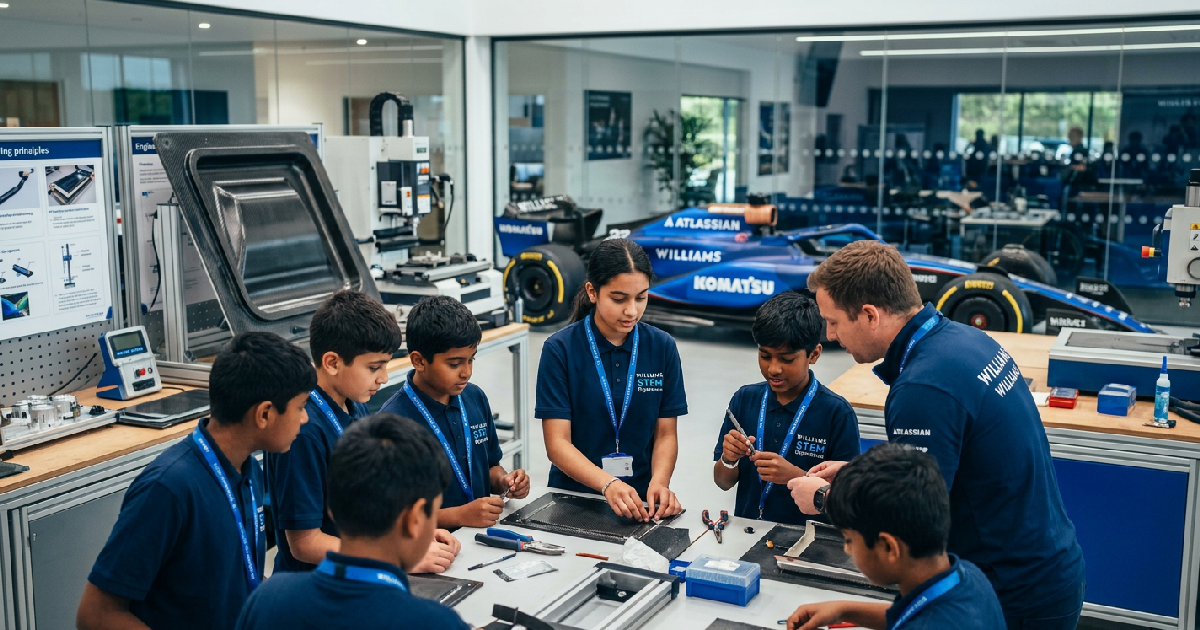
The Atlassian Williams F1 Team is expanding its STEM education initiatives globally, aiming to host 10,000 students at its Grove headquarters by the end of 2025. This industrial-scale outreach leverages the technical appeal of motorsport to address a persistent engineering skills gap. By providing hands-on workshops that include composite challenges and autonomous robot programming, the programme has increased student interest in engineering careers from 52% to 87%.
The engineering sector currently faces a shortage of new talent, often hampered by outdated stereotypes of industrial work. Williams is countering this by opening its doors to students aged 8 to 16, offering free F1-themed education days. These sessions, which moved to a permanent Experience Centre in Oxfordshire in 2024, now operate five days a week. The team even provides support for transport costs to ensure the profession remains accessible to all socio-economic backgrounds.
This focus on developing a new generation of technical experts mirrors a broader shift in the sector, where manufacturers pivot to Manufacturing Execution Systems to digitalise complex production workflows. For Williams, these initiatives are not just about corporate social responsibility; they are a strategic tool to build a team capable of winning championships again.
Hands-on engineering at the Williams STEM Experience
The curriculum at the Grove facility is designed to take students out of the classroom environment to boost engagement. Every session includes three core components: a workshop where teams build and “crash test” Formula 1 nose cones, a museum tour, and a session on professional-grade simulators. These activities are mapped to the UK National Curriculum framework to ensure educational rigour.
The Williams Composites Challenge serves as the centerpiece of the day. Students must navigate the entire manufacturing cycle, from initial ideation and prototyping to final presentation. This practical application of maths and physics allows young people to see the immediate result of their engineering decisions. Instructors also lead vocational Q&A sessions to demystify the various roles available within a modern factory and racing team.
Growth in the programme’s reach has been steady. The Williams STEM Experience welcomed over 4,000 students in 2025, and total data for the 2025-2026 period shows over 13,000 students have now attended. With 2,000 registered faculty contacts across 1,000 schools, the demand for these technical workshops remains high.
Simulation and robot programming in Grove
Beyond physical builds, students engage with industrial technology through autonomous robot vehicle programming and simulator sessions. These experiences bridge the gap between software and hardware, showing how data drives performance on the track. Similar technological integration is seen in other sectors, such as how the cobot market expands to bring collaborative robotics into mainstream assembly lines.
Soft skills receive as much attention as technical ones. Students are assigned specific roles—such as Team Principal, Finance Manager, or Marketing Lead—to simulate a real-world engineering environment. If a team struggles with internal communication, instructors use the friction as a teaching moment to discuss active listening and collective problem-solving. Head of Education Katherine Solomon notes that if one aspect of the team fails to pull its weight, the entire vehicle project fails.
Global expansion through the Komatsu Williams Engineering Academy
Williams is taking this model beyond the UK through international partnerships. The third edition of the Komatsu Williams Engineering Academy launched on May 28, 2026, targeting elite talent from Formula Student and Formula SAE competitions. Members are selected through global assessment centres and receive direct mentorship from experts at both Komatsu and Williams.
This academy transition highlights a structured pathway from student competitions to the workforce. The 2025 class of 10 students began their tailored journeys in January, participating in e-learning and visiting manufacturing facilities. For younger fans, the team launched Fan Zone activations starting with the Miami Grand Prix in April 2026. these zones feature vertical wind tunnels and aerodynamics exhibits designed to bring the engineering side of the sport to tens of thousands of fans.
Looking further ahead, Williams has confirmed plans for a first-of-its-kind motorsport camp concept in North America starting in 2027. These weekend-long day camps will eventually evolve into week-long summer intensives. By providing direct access to technical staff and hands-on F1 engineering challenges, the team aims to inspire a global pipeline of talent ready to tackle the complex infrastructure and manufacturing hurdles of the next decade.
