


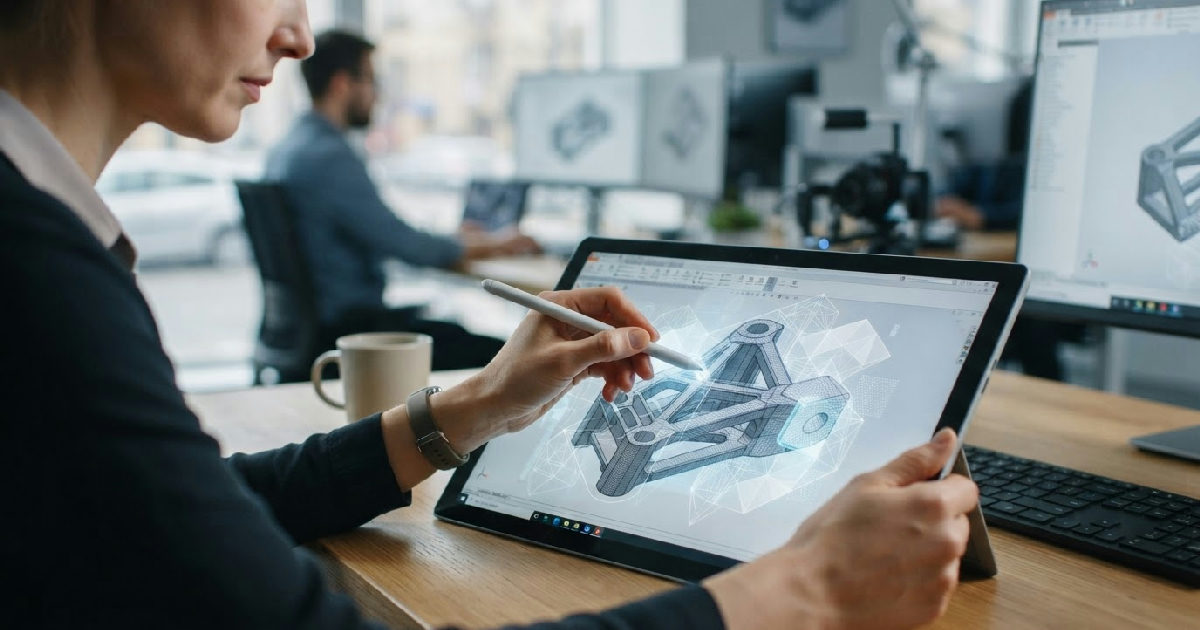
Industrial design software is blending artificial intelligence with human expertise, demonstrating how human-in-the-loop systems can improve CAD conversion and spatial computing.
Meanwhile, Hololight, an enterprise extended reality (XR) streaming platform, is tackling latency challenges in immersive design environments. These developments underscore a pivotal shift in how manufacturers and engineers approach digital design. They are moving towards systems where AI handles geometric extraction and pattern recognition at speed.
Human-in-the-loop sharpens CAD với AI
SP3D’s Theia isn’t just another automated AI tool; it is a service built around the principle of human-in-the-loop validation. Hugo Manning, Theia’s lead product manager, emphasised the importance of human oversight. He stated that the solution offers a “fully validated file” in which an engineer confirms that all dimensions and features are correct.
This approach contrasts with many market offerings that simply feed drawings into AI systems and output models without human checks. Theia, developed over three years in a collaboration between SP3D and the University for Research in Automated Production (LURPA) at École Normale Supérieure Paris-Saclay, enables AI to handle geometric extraction and pattern recognition rapidly. Engineers then perform the critical validation and handle edge cases.
The development project, initiated in 2022, also received financial support from the French Defense Innovation Agency (DIA). Professor Nabil Anwer, professor at Paris-Saclay University and Deputy Director of LURPA, noted that Theia specifically addresses the complex challenges of interpreting 2D drawing information and accurately reconstructing 3D shapes. This includes ensuring that geometric and dimensional specifications are respected.
Theia converts 2D mechanical drawings in PDF, TIFF, and PNG formats into production-ready parametric STEP files. These files are compatible with most major CAD systems. The system automatically assesses a drawing’s complexity based on factors such as the number of dimensions, views, and geometric features. This assessment determines its cost and turnaround time.
Prices range from €9 to €200 ($10.50 to $233) per drawing, with payments made in credits through a monthly subscription. The basic monthly plan provides 100 credits for €100 ($117). Despite the human validation process, which means the service is not instantaneous, Theia offers impressive turnaround times.
This deliberate trade-off prioritises higher quality over purely automated, unvalidated AI outputs. Theia’s beta program launched in March 2024. Its exclusive testing phase continued through July 2025. Future enhancements will include handling complex drawings with orthogonal sections and third-angle views. It will also expand to include 3D reconstruction from point cloud data.
SP3D, a French deep-tech software company founded in 2015, focuses on digitising industry, particularly spare parts management. Its core offerings include DigiPART software, which identifies and enables 3D printing of parts, and Theia for 2D to 3D conversion. The company estimates that Theia could save businesses $34 billion (€31 billion) annually through inventory digitisation.
This figure is based on a 2018 study by Theano Advisors. The study valued the global inventory of printable parts at $174 billion (€160 billion), based on an average inventory cost of 20%.
Hololight advances spatial computing for design
Spatial computing, encompassing technologies like virtual and augmented reality (VR/AR), has long promised to revolutionise industrial design. Yet its widespread adoption has faced hurdles. Hololight is directly addressing these challenges with its enterprise extended reality (XR) streaming platform. It aims to make immersive design reviews faster and more stable.
Florian Haspinger, Hololight’s co-founder and managing director, helped establish the company in 2015. He was driven by the frustration of interacting with 3D models on 2D screens. His solution, pixel streaming, offloads heavy computational tasks to a server equipped with powerful graphics processing units (GPUs). The approach renders everything server-side and streams the resulting pixels to end devices.
By shifting the computational burden, Hololight enables XR headsets to be lighter, cooler, and more energy-efficient. The platform is designed for broad compatibility, integrating with numerous devices, including Snap, Quest, HTC, Pico, and Apple Vision Pro headsets. It also supports HoloLens One and HoloLens Two, as well as iPads, Android devices, and web browsers.
A client device can simply be a browser running on Windows or macOS, allowing content to be streamed directly to the browser.
Latency remains a significant concern for any streaming technology, particularly in spatial computing, where even slight delays can cause choppiness or motion sickness. Haspinger acknowledges that network latency depends on factors like server-client distance and is beyond their direct control. However, he asserts that Hololight’s system adds “very minimal” latency.
To counteract network delays, Hololight employs a predictive algorithm that anticipates the user’s trajectory and calculates future frames. This allows the headset to project its best guess at a properly timed image. This technique delivers an experience that “feels real-time” even with 200 milliseconds of network latency. It prevents motion sickness and maintains immersion in complex industrial applications.
Integrating human feedback into AI systems
The “human twist” in technologies like Theia highlights a broader trend: the deliberate integration of human-in-the-loop AI across industrial applications. This design pattern ensures human intelligence, judgment, and creativity enhance AI system performance. It’s especially vital for complex or high-stakes tasks, proving crucial in modern industrial automation workflows.
Researchers at MIT, including Ghadi Nehme, Brandon Man, Ferdous Alam, and Associate Professor Faez Ahmed, are developing an AI agent alongside the VideoCAD dataset to advance this approach.
Announced in November 2025 and presented at the Conference on Neural Information Processing Systems (NeurIPS) in December 2025, the system learns from more than 41,000 video examples of human CAD operations. This “CAD co-pilot” can suggest next steps or automatically execute tedious build sequences, translating high-level commands into precise user-interface interactions.
Autodesk also applies HITL principles in its Fusion 360 software, particularly through its Sketch AutoConstrain feature and generative design tools. This approach employs Reinforcement Learning from Human Feedback (RLHF). The AI proposes sketch constraints, and Fusion’s constraint solver provides “verifiable feedback,” acting as a reward signal.
This feedback loop enables the AI to generate stable, fully constrained sketches that preserve design intent, a critical aspect for parametric modelling.
The impact of such systems is significant. Autodesk Fusion 360’s AI alignment research, published in October 2025, showed 93% of sketches becoming fully constrained using its best method, RLOO. This marked a stark improvement from the base model’s 8.9%. This drastically reduces the risk of unpredictable behaviour among the 92% of sketches in their SketchGraphs dataset that would otherwise behave unpredictably when edited.
Beyond automating constraint application, other developers are also pushing the boundaries. Vizcom offers AI Sketch-to-Render, while Ragnar CAD and BricsCAD are integrating AI into their platforms. Zoo Design Studio’s “Zookeeper” is a conversational CAD agent that allows engineers to delegate tasks and design based on intent.
Copilot Studio’s Human in the Loop feature, introduced in October 2025, allows customisable intervention points, validation criteria, and approval workflows. This means the AI suggests solutions, but the user always retains the final say.
Evolving CAD landscape and productivity gains
The integration of AI into CAD tools is rapidly transforming the design workflow, offering substantial productivity gains. AI-powered CAD tools can increase overall productivity by up to 66% and cut design time by as much as 20%. DraftAid, another solution in this space, reports that it can reduce 2D drawing time by up to 90%.
This efficiency is vital for industries where rapid prototyping and iteration are key. The broader adoption of AI reflects a growing confidence in its capabilities. As of 2025, more than 700 million people interacted with ChatGPT each week, a fourfold increase from the previous year.Similarly, one in three designers shipped an AI-powered product in 2024–2025. This represented a 50% increase from the previous year.
Conversational AI agents like ARES AI Assist (A3) and Siemens Designcenter Copilot respond to natural language requests. They assist users in generating ideas, optimising drawings, suggesting corrections, and navigating workflows
Research by the University of Surrey and Stanford University on sketch understanding, published June 18, 2024, achieved 85% accuracy in identifying and labelling objects in informal sketches. This outperformed models relying on labelled pixels, underscoring advances in AI interpretation.
The $11 billion CAD industry serves a vast professional user base. This includes approximately 438,000 CAD graduates in the U.S. alone as of 2023. These professionals increasingly rely on tools that blend AI efficiency with human precision.
As technologies like Theia and Hololight mature, they are not only improving existing processes but also fundamentally reshaping the possibilities within design and manufacturing. Their development could contribute to a more efficient and accurate industrial future.
