


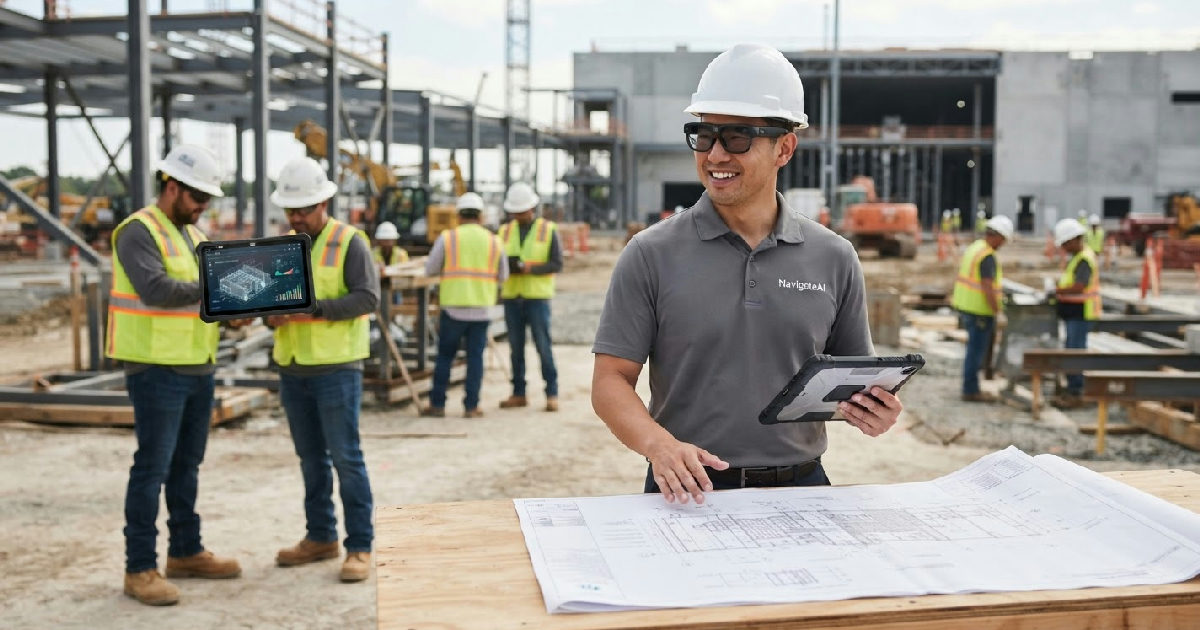
Eric Wu, co-founder and former Chief Executive Officer of Opendoor, launched his latest venture, NavigateAI, on May 26, 2026, introducing AI copilots for construction to address the industry’s significant labour shortages.
NavigateAI secured $25 million in seed funding, giving the company a post-money valuation of $225 million. This funding round was led by Elad Gil, with additional participation from prominent firms including Khosla Ventures, Fifth Wall, real estate giant Lennar, Tishman Speyer, and electrical contractor Helix Electric, as well as a group of angel investors.
Addressing the construction labour shortage with AI copilots
The construction sector faces an acute and worsening labour shortage, creating a critical constraint on major infrastructure and housing projects across the United States. Data from the Associated Builders and Contractors indicate that the country required approximately 349,000 additional workers in 2026 to meet existing construction demand. Residential construction specifically needed around 723,000 more workers, underlining the scale of this crisis.
This shortfall costs the industry an estimated $10.8 billion annually, comprising $8.1 billion in lost construction opportunities and $2.7 billion in costs due to project delays. Compounding the issue, the workforce is ageing, immigration enforcement policies are becoming stricter, and demand for new projects, particularly large data centres, continues to surge.
Major AI data centre campuses, which once required about 750 workers at their peak, now require thousands. Meta’s Hyperion campus in Richland Parish, Louisiana, for instance, reportedly requires 5,000 construction workers, highlighting the immense staffing pressures created by these new industrial demands.
The global staffing company Kelly reports that 90% of data centre operators consider staffing shortages a critical barrier to expansion. This environment creates a clear opportunity for technological intervention to augment the existing workforce and improve efficiency.
NavigateAI’s AI Copilot Technology
NavigateAI’s core offering is an AI-native system that functions as an expert coach for field workers. The software operates on standard smartphones and can be integrated with Meta’s AI glasses, providing a hands-free experience that is crucial on active construction sites. This setup allows workers to point a camera at their work and verbally query the system.
Workers can ask, for example, whether an installation is correct, whether torque specifications have been met, or whether work complies with building codes. The system then accesses and displays relevant building specifications, manufacturer manuals and company policies in real time. Eric Wu emphasises that the hands-free interface offers a superior experience, particularly where looking at a phone would be impractical or unsafe.
The company is collaborating with Meta to ensure that its AI glasses receive safety certification for environments requiring protective eyewear. Such certification is vital for widespread adoption in industrial settings where safety regulations are paramount. These industrial technology deployments are often scrutinised for their safety implications.
Strategic Partnerships and Business Model
NavigateAI has forged strategic partnerships to accelerate its market penetration and development. Beyond Meta for hardware integration, the company has also partnered with AIM, a Meta-backed fibre installation trade school. This collaboration provides NavigateAI with a direct channel to introduce its AI-assisted work methods to new recruits even before they enter job sites.
Key deployment partners include Lennar in homebuilding, Roofstock in property management, AIM in electrical trade training, and Tishman Speyer in commercial real estate. These partnerships are instrumental in integrating the AI copilot into diverse construction workflows. Building familiarity with AI tools during training is proving essential, with younger workers reportedly showing higher adoption rates than more experienced journeymen.
Initially, NavigateAI used a usage-based SaaS pricing structure. However, it has since transitioned its newer contracts to a value-share model. This revised model aims to align NavigateAI’s success directly with the cost savings and efficiency gains delivered to its clients.
The company aims to improve speed, cost, and quality in construction, focusing on tangible benefits for builders. This value-sharing approach ensures that NavigateAI’s financial success is tied to measurable improvements on project sites.
Long-Term Vision and Challenges
Eric Wu’s long-term vision extends beyond aiding current construction efforts; he sees immense value in the data generated by NavigateAI’s operations. Every job completed with the AI copilot generates labelled, egocentric video footage of field workers performing tasks correctly and incorrectly. This dataset could be highly valuable.
Wu believes this proprietary data will eventually be as valuable to robotics companies as the software itself is to NavigateAI’s construction clients. Such data could significantly advance the development of autonomous construction robotics and automation systems. Indeed, the increasing use of AI-driven maintenance and operational improvements is a growing trend across manufacturing sectors.
However, the venture is not without its challenges. The value-based pricing model, while attractive, introduces an attribution dilemma. Proving that savings are directly attributable to NavigateAI rather than to other variables, such asd weather or crew experience, requires rigorous A/B testing and remains difficult to quantify precisely. This could complicate disputes with client over attribution of savings.
Another significant hurdle is resistance from veteran workers. While their extensive knowledge could help make NavigateAI’s product more intelligent, these experienced journeymen may be more inclined to trust their own instincts than new technology. Integrating advanced automation effectively requires careful management of human factors.
Liability also presents a complex issue. If NavigateAI’s software approves a connection that later fails, questions of defect liability in a notoriously litigious area remain unresolved. The competitive landscape also poses a threat, with larger AI companies possessing extensive model capabilities and hardware distribution networks.
Despite these challenges, Wu remains focused on customer needs and has intentionally delayed forming a board to prioritise product development over governance, drawing lessons from his time leading Opendoor through its public listing.
Founder’s Background and Broader Implications
Eric Wu’s return to company building underscores a broader conviction among technology founders that AI will be the defining technological platform of their lifetimes. His earlier success with Opendoor, which he co-founded in 2014 and led as CEO until 2022, gave him significant experience in scaling ambitious real estate technology ventures.
Before Opendoor, Wu founded RentAdvisor, which was acquired by Apartment List in 2013, and Movity, which was acquired by Trulia.
His latest move into industrial AI, alongside his role on the board of Brain Co — a firm integrating AI into sectors such as healthcare, government, and oil and gas — highlights a strategic shift towards using artificial intelligence to solve real-world, labour-intensive problems.
This focus on industrial application suggests a future where AI extends beyond digital realms to physically construct and maintain the built environment.
The implications for regions such as Africa, where infrastructure development is critical and skilled labour shortages are often pronounced, could be substantial. Technologies such as NavigateAI’s AI copilot could provide a pathway to upskill local workforces and accelerate construction projects, helping to address housing and infrastructure deficits more efficiently and precisely. This presents an opportunity to overcome traditional labour constraints and build vital infrastructure more quickly.
