


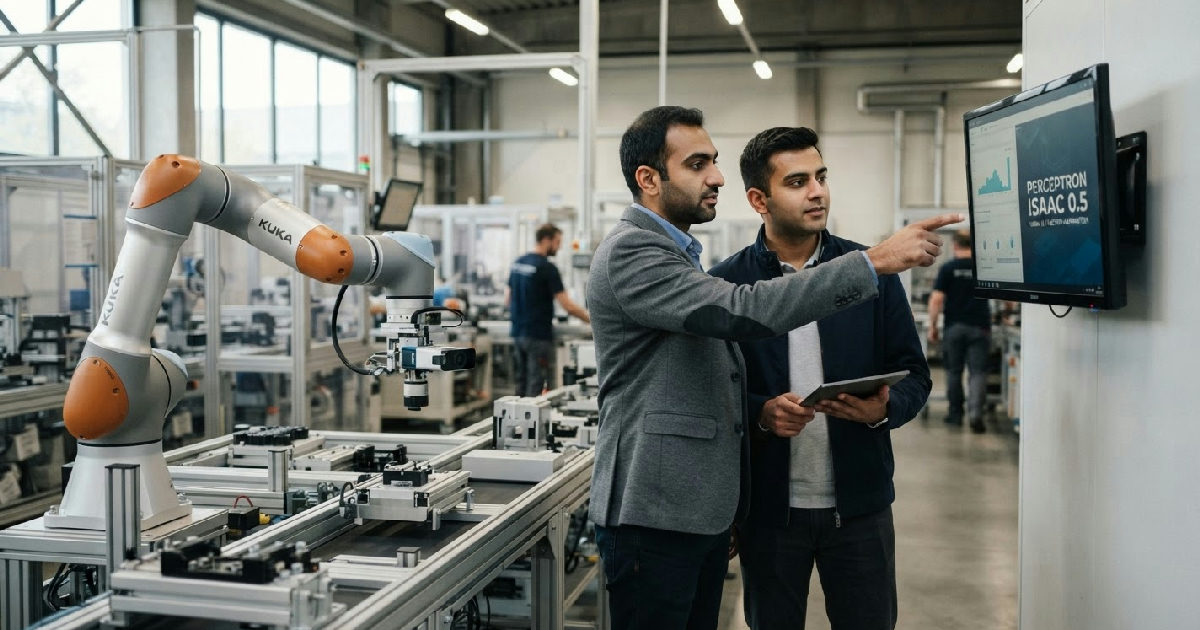
Perceptron has launched its latest visual AI model, Isaac 0.5.
Founded in November 2024, the company recently secured $21 million in funding in a round led by Bessemer Venture Partners. This investment signals strong confidence in Perceptron’s ambition to redefine automated deployment in a range of sectors, starting with manufacturing and logistics.
Perceptron launches Isaac, a new approach to industrial AI
Isaac 0.5 represents a notable shift in physical AI capabilities, providing vision-guided robots with sophisticated tools to navigate complex industrial settings. This general-purpose model extracts visual intelligence directly from robot-recorded video, offering a level of adaptability that traditional narrow AI models often lack.
Armen Aghajanyan and Akshat Shrivastava, who previously honed their expertise at Meta’s Fundamental AI Research (FAIR) division, have built Perceptron on a core principle: flexibility. They argue that existing physical AI solutions force a difficult choice between overly broad foundation models or highly specialised, rigid systems.
Bridging the gap in physical AI
The co-founders contend that many current AI models either demand extensive cloud GPU resources for every instance or are limited to performing single, repetitive tasks. Isaac 0.5 sidesteps this by offering a versatile model designed to adapt to varied environments and situations.
This adaptability is crucial for industrial applications where environments are rarely static. AA robot organising boxes, for instance, must perform multiple steps, including reading labels, analysing spatial relationships, and dynamically deciding on pickup sequences. Perceptron’s software helps robots manage this entire multifaceted process.
How Isaac 0.5 learns operational skills
The effectiveness of Isaac 0.5 hinges on its extensive training data, which include a million hours of general video footage. This vast dataset allows the model to develop an understanding of specific settings, visual cues, and operational scenarios crucial for industrial tasks.
Perceptron has heavily relied on two specialised forms of video data: ego video and UMI video. Ego video captures tasks from a human perspective, often through wearable cameras, offering direct insight into human execution of physical work.
The role of diverse video data
UMI video complements this by capturing repetitive human actions, providing AI systems with templates for movement and interaction. While Perceptron remains tight-lipped about the exact sources of its training material, Shrivastava confirmed that the company has petabyte-scale datasets covering images, text, video, and robotic trajectories.
This comprehensive data ingestion allows Isaac 0.5 to learn operational skills that enable robots to function more competently and autonomously. It moves beyond simple object recognition to encompass complex spatial reasoning and task planning.
Significant investment in automation technologies
The $21 million funding round led by Bessemer Venture Partners underscores growing investor confidence in the industrial AI sector. This capital injection will allow Perceptron to accelerate development and market penetration for Isaac 0.5.
Industrial automation continues to attract substantial investment as companies seek to boost efficiency and reduce operational costs. Technologies that offer flexible, general-purpose solutions are particularly appealing given the dynamic nature of modern manufacturing and logistics operations.
Backing the future of factory automation
Bessemer Venture Partners’ backing suggests a belief that Perceptron holds a unique position in the burgeoning physical AI market. The firm is betting on the co-founders’ vision to integrate their intelligence layer into a broad array of industrial applications.
The sheer utility of software that can significantly enhance robot operations in complex environments like warehouses offers a compelling investment case. This funding validates the potential for widespread adoption across various industries.
Broader applications across industrial sectors
While the immediate applications of Isaac 0.5 are most apparent in manufacturing, logistics, and warehousing, Perceptron envisions a much broader impact. The model’s general-purpose nature makes it suitable for integration into diverse sectors.
Beyond traditional industrial settings, the technology could find relevance in areas such as security, improving the autonomous capabilities of surveillance robots. Mobility is another key area, where visual AI can assist in the navigation and interaction of autonomous vehicles within complex urban or industrial landscapes.
Expanding the reach of intelligent machines
The adaptable nature of Isaac 0.5 means it isn’t confined to a single type of robot or task. This flexibility could open up new possibilities for automation in unexpected areas, potentially extending into media and entertainment for specialised robotic tasks.
Armen Aghajanyan highlighted the unique position of the company’s product, stating that no comparable product truly exists in the current market. This confidence stems from Isaac 0.5’s ability to offer a unified solution for perception, reasoning, and action without the trade-offs of existing models.
Implications for modern manufacturing operations
For operations professionals and engineers, the emergence of advanced visual AI solutions for factory floors, such as Isaac 0.5, promises a new era of automation. It suggests that robots could soon handle more nuanced tasks, requiring less human intervention and greater autonomy in dynamic settings.
The ability to extract detailed visual intelligence from robot-recorded video also offers manufacturers unprecedented insights into their processes. This data can drive continuous improvement, identify bottlenecks, and enhance overall operational efficiency.
Driving efficiency and flexibility
Perceptron’s model could significantly reduce the need for highly customised, single-purpose robotic systems. Instead, companies might deploy more flexible, AI-driven robots capable of adapting to changing production demands or varied inventory types.
This shift towards general-purpose physical AI has the potential to lower the barrier to entry for advanced automation, making it more accessible to a broader range of manufacturers seeking to optimise their production lines and supply chains.
