


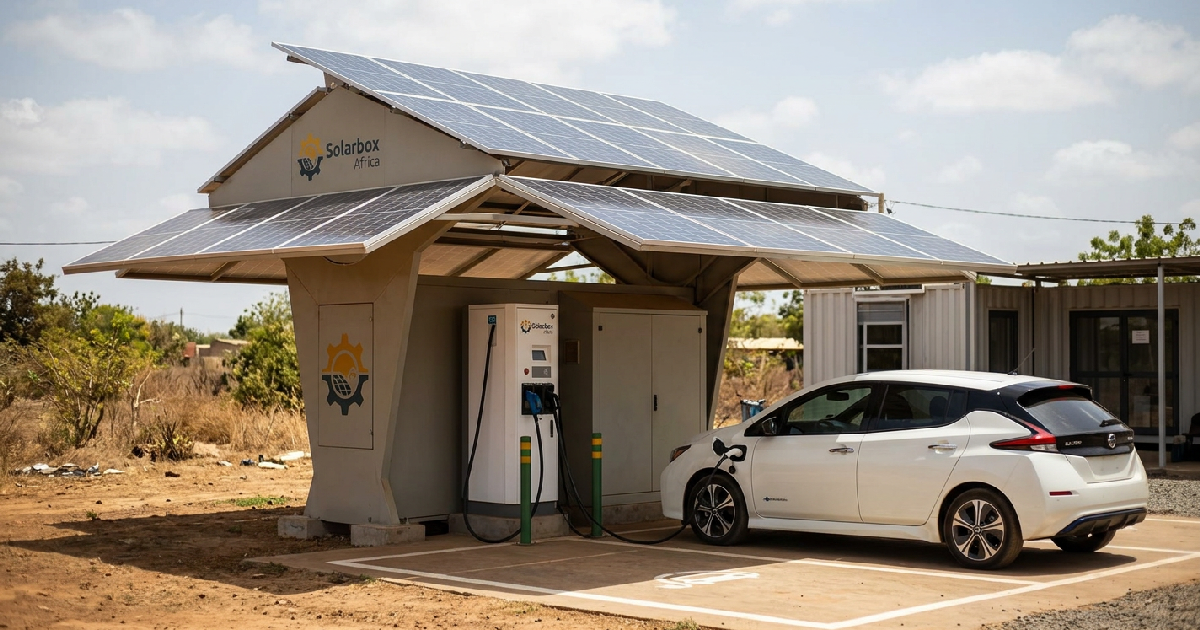
Dakar-based Solarbox Africa is decentralising Senegal’s transport infrastructure by deploying a solar-powered electric vehicle (EV) network designed to operate independently of the national grid. Founder Tijan Watt, who also co-founded Wuri Ventures, launched the startup in 2022 to address the high costs of imported petroleum, which currently drain approximately $2 billion from the Senegalese economy every year.
By localising vehicle assembly and integrating photovoltaic charging hubs at corporate sites, the company is bypassing the infrastructure gaps that typically slow EV adoption in West Africa.
The engineering logic behind this “sun-first” model rests on Senegal’s vast solar endowment. 32 kWh/m², a figure that ranks it among the top three globally and provides roughly double the energy yield of Germany. For logistics firms, this untapped resource translates into immediate operational efficiency.
50 for a standard gasoline vehicle. According to company data, this 60% saving is paired with a reduction of 10 tons of carbon emissions per vehicle annually.
Solarbox is not waiting for government incentives or grid upgrades to scale its operations. Instead, the firm instals solar charging stations directly at the facilities of corporate partners, including DHL, FedEx, and Orange Energies. This B2B strategy ensures that the light trucks and two-wheelers used by clients like Paps Logistics and Fleetch have guaranteed uptime without placing additional load on municipal transformers.
Local assembly and charging infrastructure integration
The technical backbone of the Solarbox ecosystem is the local assembly of its utility vehicles. By putting together its electric bikes and tricycles in Dakar, the company can customise hardware to withstand the regional heat and terrain, which are critical factors for battery longevity. This shift toward local production reflects a broader trend where the African IoT sector expands through industrial connectivity, allowing engineering teams to monitor battery health and energy consumption in real-time across a fleet.
Beyond the mechanical assembly, Solarbox utilizes a proprietary software layer to manage energy storage and fleet duty cycles. This integration allows operations managers to treat energy as a fixed, predictable cost rather than a variable expense subject to global oil market volatility. While Senegal recently discovered offshore oil and gas, Tijan Watt argues that solar remains the superior path to energy sovereignty because prices are determined locally rather than by international commodity cycles.
The engineering of these hubs allows for a modular rollout. Each solar-powered station can be expanded as a client’s fleet grows, preventing the capital-heavy bottlenecks associated with large-scale charging plazas. This ensures that even as manufacturers pivot to Manufacturing Execution Systems for complex plant management, smaller-scale logistics operators can maintain agility through decentralised power.
Financing the transition with pay-as-you-go technology
Expanding beyond the corporate sector requires solving the financing hurdles that block individual drivers in the informal economy. High interest rates for asset financing in West Africa—often reaching 35% to 60%—frequently make vehicle ownership impossible for small-scale operators. To circumvent this, Solarbox introduced a pay-as-you-go (PAYG) model that allows drivers to access vehicles with no upfront deposit.
Instead of undergoing traditional credit checks, drivers scan a QR code and pay for usage via mobile money. This model mirrors the prepaid telecommunications revolution and aligns costs with the daily income patterns of independent transporters. Financial engineering of this type is necessary to transition the “last-mile” delivery sector, which is currently the most inefficient segment of the regional transport chain.
The expansion of this model is supported by a US$1 million pre-seed funding round. This capital injection included a diverse group of backers: the Digital Energy Facility (a collaboration involving the Agence Française de Développement, IetP, and Gaia Impact Fund), Launch Africa Ventures, the JLL Foundation, Teranga Capital, and On.Capital. These funds are earmarked for scaling production in Dakar and conducting research into enhanced energy storage solutions.
Regional precedents and the path to energy sovereignty
Solarbox’s strategy draws parallels from other African nations that have successfully accelerated EV adoption. Ethiopia, for instance, saw EV penetration jump from less than 1% to 8.3% in just two years by utilizing its domestic hydroelectric capacity. While Senegal’s path is built on solar rather than hydro, the principle of using cheap, domestic renewable energy to power the transport sector remains identical.
For industrial practitioners, the reliability of this infrastructure is the ultimate metric of success. As Africa digital payments shift focus to infrastructure reliability to support economic growth, the transport sector must follow suit with dependable energy sources. Solar-powered mobility offers a way to decouple industrial productivity from the risks of geopolitical shocks and fuel shortages.
Solarbox now plans to explore opportunities in neighbouring countries within the West African Economic and Monetary Union (UEMOA). With transportation accounting for 40% of Africa’s energy needs and over $40 billion in annual fuel imports across the continent, the transition to solar-powered logistics represents a significant shift in how West African nations manage their trade and energy balances. Tijan Watt maintains that harnessing abundant sunlight is more than an environmental choice; it is a fundamental requirement for long-term economic sovereignty.
