


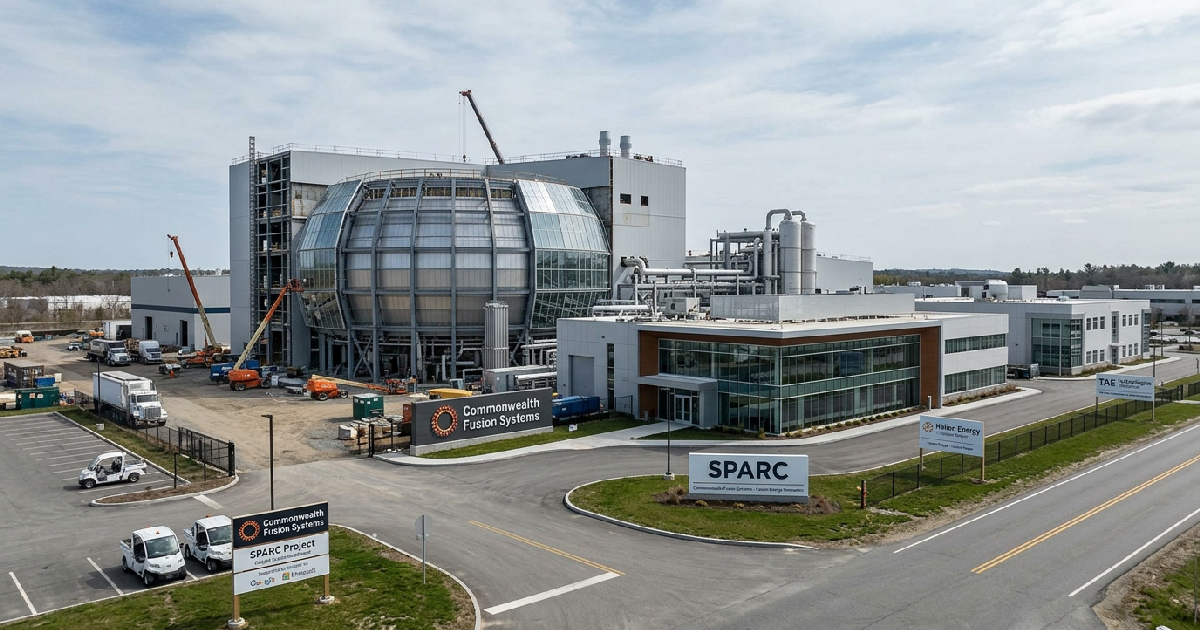
Private investment in the fusion energy sector has surpassed $13 billion as of June 19, 2026, with 17 startups now having raised more than $100 million each to commercialise the technology. Leading the pack is Commonwealth Fusion Systems (CFS), co-founded by CEO Bob Mumgaard, which has secured approximately $3 billion in total capital. While the industry has historically faced scepticism, recent engineering milestones and massive capital injections from firms like Google and Microsoft are moving fusion toward a legitimate industrial reality.
This wave of funding reflects a transition from laboratory experiments to the infrastructure required for power generation. CFS remains the only firm to have officially announced plans for a grid-scale commercial power plant, a 400-megawatt facility called ARC to be built in Virginia. Other major players like Helion Energy and TAE Technologies are rapidly advancing their own proprietary reactor designs, supported by sophisticated AI and high-temperature superconducting magnets.
Global demand for carbon-free baseload power is driving these investments. Ally Yost, Senior Vice President of Corporate Development at CFS, noted that “the demand is just through the roof,” adding that the company could sell power plants “every day” if they were available now. This industrial pull is creating a strategic lever for plant agility as companies race to build out the first viable fusion supply chains.
Commonwealth Fusion Systems nears SPARC operational milestone
Commonwealth Fusion Systems currently accounts for roughly a third of all private fusion capital. The company’s demonstration reactor, SPARC, is approximately 75% complete at its facility in Devens, Massachusetts. This tokamak design uses D-shaped magnets wound with high-temperature superconducting tape to contain the superheated plasma necessary for the reaction.
The company expects SPARC to be operational by late 2026 or early 2027. Success at this site is a prerequisite for the ARC commercial plant in Chesterfield County, Virginia. Google has already signed a direct corporate power purchase agreement to buy 200 megawatts of power from the ARC project.
Furthermore, Italian energy major Eni secured a $1 billion deal in September 2025 to use power from the first CFS reactor. These commitments provide the necessary financial runway for CFS to complete its transition from a spin-off of the MIT Plasma Science and Fusion Center to a primary energy provider by the early 2030s.
Helion Energy secures $15.5 billion valuation for Microsoft supply
Helion Energy, based in Everett, Washington, has raised more than $1.5 billion to date to fund its aggressive timeline. The company recently closed a $465 million Series G round on June 4, 2026, which valued the business at $15.5 billion. Helion’s approach differs from the tokamak; it uses a field-reversed hourglass reactor designed to harvest electrical current directly from the reactor’s magnetic coils.
The company plans to produce electricity from its reactor as early as 2028, with Microsoft signed on as its first customer. This direct energy harvesting eliminates the need for steam turbines, potentially simplifying the manufacturing automation trends required to scale these plants. Investors including Sam Altman and Ford Motor Company’s Bill Ford are backing this unconventional reactor geometry to deliver on the 2028 target.
TAE Technologies merges with Trump Media in $6 billion transaction
TAE Technologies, a veteran player founded in 1998, completed a merger in late 2025 with the technology arm of Trump Media & Technology Group. This all-stock deal valued the combined entity at approximately $6 billion. Under the new structure, TAE CEO Michl Binderbauer serves as co-CEO alongside Devin Nunes, who was previously the sole CEO of Trump Media.
TAE receives $200 million through the deal, with an additional $100 million contingent on SEC filings. The company uses an advanced beam-driven field-reversed configuration, spinning plasma into a cigar shape and stabilising it with particle beams. TAE has already achieved temperatures exceeding 75 million degrees Celsius with its Norman reactor.
The fresh capital will support the construction of Copernicus, TAE’s next-generation research reactor. With over 1,500 patents, the firm is leveraging decades of data to solve the stability issues that have historically plagued fusion research.
Pacific Fusion secures tranches for electromagnetic pulse technology
One of the newest high-cap entrants, Pacific Fusion, recently emerged with a Series A round topping $1 billion. Led by CEO Eric Lander, former head of the Human Genome Project, the startup is pursuing a unique form of inertial confinement. Rather than using lasers, it employs 156 Marx generators to deliver 2-terawatt electromagnetic pulses that must converge on a target within a 100-nanosecond window.
Pacific Fusion’s funding is structured through tranches, meaning investors pay out only as the company hits specific technical milestones. This disciplined approach to industrial connectivity and precision is becoming a hallmark of the sector’s maturation.
The industrial implications for regions like Africa and the United Kingdom are significant. If these ventures succeed in providing limitless energy, the cost of manufacturing and smelting would drop precipitously. While widespread commercial deployment is still years away, the current scale of investment suggests the engineering foundation is finally being poured.
