


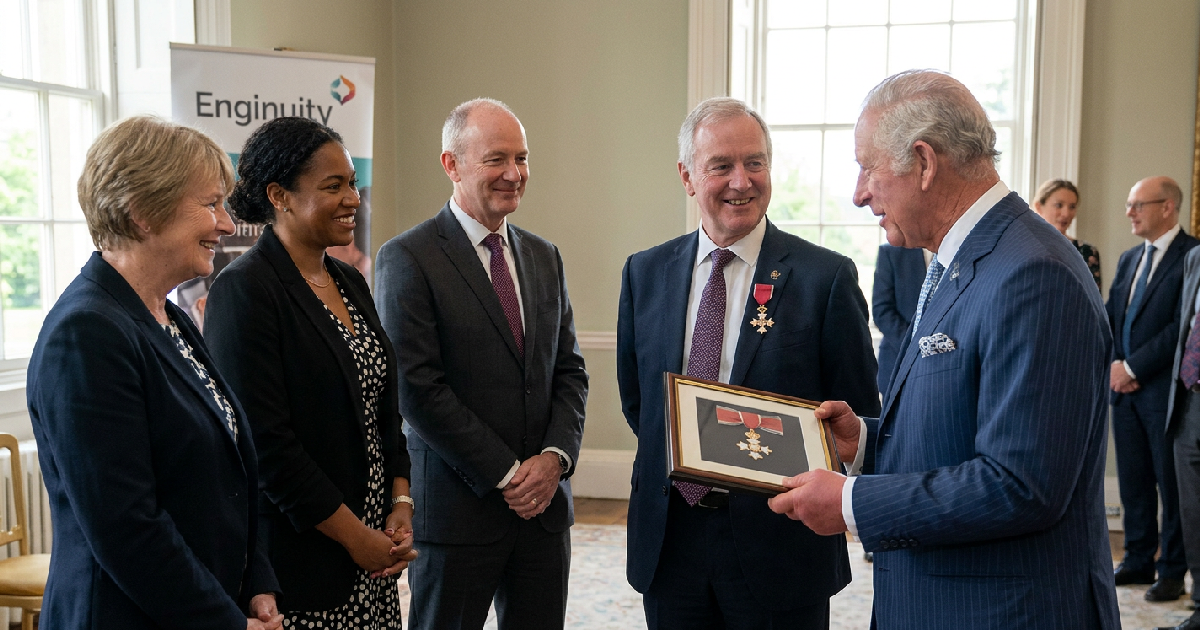
King Charles III has conferred royal honours upon four senior leaders from Enginuity, the engineering and manufacturing skills charity, as part of the 2026 King’s Birthday Honours. Ann Watson, Alexia Williams, Dr Ian Ritchey, and Sir Jim McDonald were each recognised for their career-long efforts to address the chronic skills shortages and workforce development challenges currently facing the United Kingdom industrial sector.
The awards mark a major strategic endorsement for the charity, which has spent decades building the pipeline of technical talent required for advanced manufacturing. Chief Executive Ann Watson and trustee Alexia Williams both received the Member of the Order of the British Empire (MBE), while Deputy Chair Dr Ian Ritchey was named an Officer of the Order of the British Empire (OBE).
Sir Jim McDonald, the organisation’s Chair, received one of the monarchy’s most prestigious distinctions with his appointment to the Most Ancient and Most Noble Order of the Thistle. This exclusive order is limited to just 16 Knights and Ladies outside of the Royal Family, highlighting the critical importance of engineering leadership at the highest levels of British society.
Recognising the architects of industrial skills development
The honours list reflects years of high-level advocacy for technical education and vocational pathways. Ann Watson, who joined the Enginuity Group in 1998 and rose to the position of Chief Executive in 2015, has focused her tenure on closing the rift between educational output and industrial demand.
Her connection to the sector is generational; she grew up in South Bank on Teesside, where her late father worked as a welder at British Steel. This lived experience has shaped her leadership, focusing on how education systems can be modernised to serve both young people and the broader economy through rewarding technical careers.
Watson noted that the recognition of four colleagues simultaneously is a reflection of the vital contribution the sector makes to national prosperity. The collective honours serve as a signal to the industry that workforce development is no longer a peripheral HR concern but a core pillar of national economic strategy.
Breaking down the 2026 royal honours for Enginuity
- Sir Jim McDonald: Appointed to the Order of the Thistle (one of only 16 non-royal members).
- Dr Ian Ritchey: Awarded an OBE for his role as Deputy Chair and his services to engineering.
- Ann Watson: Awarded an MBE for her decade of leadership as Chief Executive.
- Alexia Williams: Awarded an MBE for her contributions as a professional trustee supporting skills.
Addressing the chronic engineering talent deficit
The UK engineering sector has long grappled with a “skills gap” as veteran practitioners retire faster than new trainees enter the field. Enginuity operates at the intersection of these two demographics, developing data-driven tools and qualification frameworks that help manufacturers identify where their workforce needs strengthening.
These efforts coincide with a period of rapid technological change. As firms increasingly view a manufacturing execution system as a strategic necessity rather than an optional upgrade, the demand for “digital-ready” engineers has skyrocketed. The charity’s work ensures that training standards evolve as quickly as the hardware on the factory floor.
By focusing on both traditional trades and advanced industrial informatics, the charity aims to prevent production bottlenecks caused by a lack of qualified personnel. These royal honours suggest that the “people” aspect of manufacturing is finally receiving the same level of prestige as the “product” side of the business.
Wider impact on the manufacturing and engineering sector
The timing of these awards is significant as the UK seeks to stabilise its industrial output amidst global supply chain shifts. Leaders in the sector hope that such public recognition will help rebrand engineering as a top-tier career choice for the next generation of students.
Beyond the UK, the challenges Enginuity addresses resonate in other industrialising markets. For example, the engineering initiatives in Nigeria often mirror these efforts to bridge the gap between technical training and actual export-led manufacturing growth.
The success of organisations like Enginuity provides a blueprint for how public-private partnerships can foster a more resilient industrial base. As the charity continues its work, the momentum provided by these royal appointments is expected to accelerate new programmes aimed at industrial electrification and automated production systems.
Moving forward, the focus remains on ensuring that these honours translate into tangible policy support. With a clearer spotlight on the individuals driving the skills agenda, the industry is better positioned to lobby for the long-term investment required to maintain a competitive global manufacturing footprint.
