


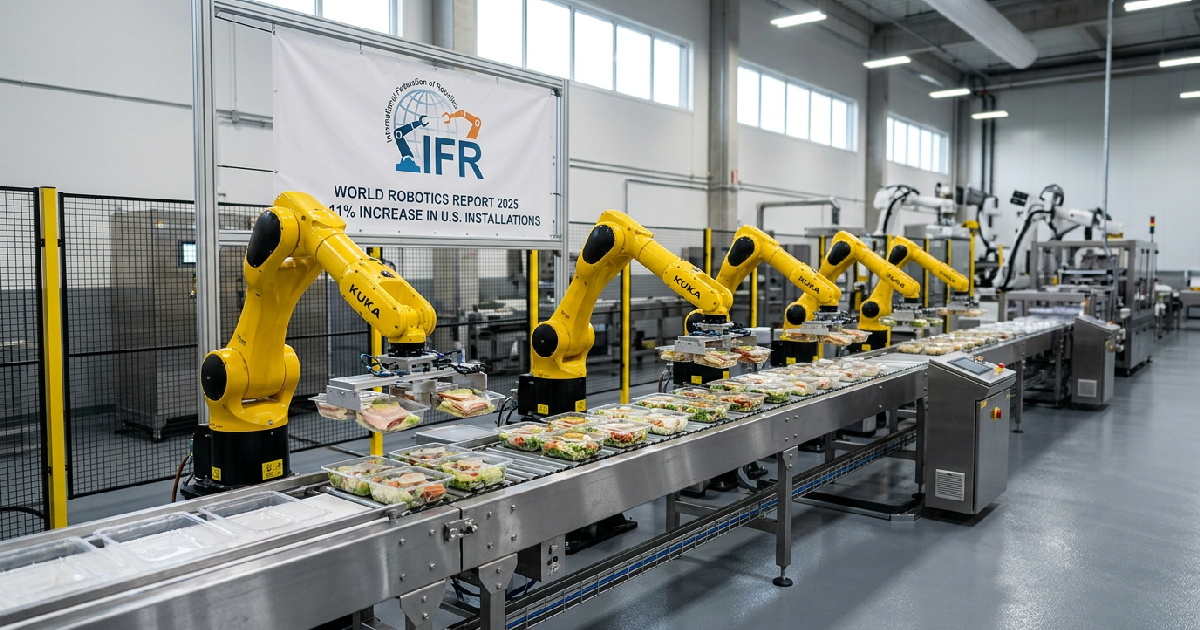
U.S. industrial robot installations rose 11% in 2025 to reach a total of 38,000 units, according to preliminary statistics from the International Federation of Robotics (IFR). President Takayuki Ito confirmed the recovery, noting that the United States is “back on the growth track” following a surge in demand across non-manufacturing sectors. The food industry emerged as a primary driver of this rebound, with robot adoption in the sector jumping by 30% over the previous year.
The 2025 results represent the third-best performance for the American market in seven years. While the automotive industry remains the largest adopter with 13,500 units installed—a figure just 1% below its prior-year result—diversification into other sectors is accelerating. The food industry now ranks alongside the metal and machinery and electrical-electronics sectors, with each logging approximately 3,000 installations in 2025. This shift reflects a broader regional push toward industrial modernization.
This growth is largely fueled by factory reshoring initiatives and a persistent shortage of skilled labor across North America. Manufacturers are increasingly turning to manufacturing execution system platforms and robotics to mitigate structural workforce gaps. By automating repetitive or high-precision tasks, companies are looking to maintain volume while navigating a tightening labour market.
Food industry adoption surges due to hygiene and labour gaps
The 30% surge in food industry installations marks a significant deepening of automation in processing and packaging. While the food and beverage sector demonstrated strong growth in 2021 with 3,402 installations—a 25% increase that year—the current 2025 figures highlight a move toward more integrated smart factories. This trend is partially driven by increased hygiene and food safety concerns that became a priority in the wake of the COVID-19 pandemic.
Beyond cleanliness, the food sector faces specific technical challenges, such as the need for gentle, high-precision handling of perishable produce. Robots are now being deployed to handle delicate items and supplement human labor in environments that require strict traceability and quality compliance. The value of the U.S. food robotics market has climbed steadily in recent years, reaching exactly USD 983.1 million in 2025.
Industry 4.0 adoption is also playing a role, as manufacturers seek to improve productivity through increased consumption of processed and ready-to-eat foods. Alex Shikany, Executive Vice President at the Association for Advancing Automation (A3), noted that these investments are vital for manufacturers to strengthen their competitiveness in an evolving global market.
U.S. robot density improves in global rankings
The degree of automation in U.S. manufacturing, measured by robot density, reached 307 industrial robots per 10,000 employees in 2025. This improvement moved the United States up two ranks to 8th position worldwide. While the U.S. remains ahead of China, which recorded a density of 166 robots per 10,000 workers in the same period, it still trails the leading global automation hubs.
South Korea continues to lead the world with a density of 1,220 robots per 10,000 employees. Germany and Japan follow with 449 and 446 robots respectively. To catch up, North American manufacturers are investing in specialized hubs like the Kawasaki Physical AI Center in San Jose to foster closer integration between robotics and industrial processes.
Outlook for long-term automation growth
The International Federation of Robotics expects the growth trajectory for U.S. automation to remain resilient. President Takayuki Ito predicts that manufacturers will continue increasing investments to address workforce gaps as demand diversifies beyond traditional sectors like automotive. This strategy is essential for domestic plants looking to remain flexible in the face of supply chain volatility.
IFR Vice President Jane Heffner will present the final preliminary figures for the North American market at the Automate Show in Chicago on June 24, 2026. Her presentation will likely expand on the “World Robotics 2025” report, which showed global annual installations exceeding 500,000 units for the third consecutive year.
For engineers and operations managers, the data confirms that automation is no longer a luxury reserved for high-volume car assembly. With the cobot market expanding and traditional industrial robots becoming more accessible, the barrier to entry for food and machinery sectors continues to fall. This shift toward a more automated industrial base is increasingly becoming the standard for maintaining manufacturing output in high-cost labor markets.
