


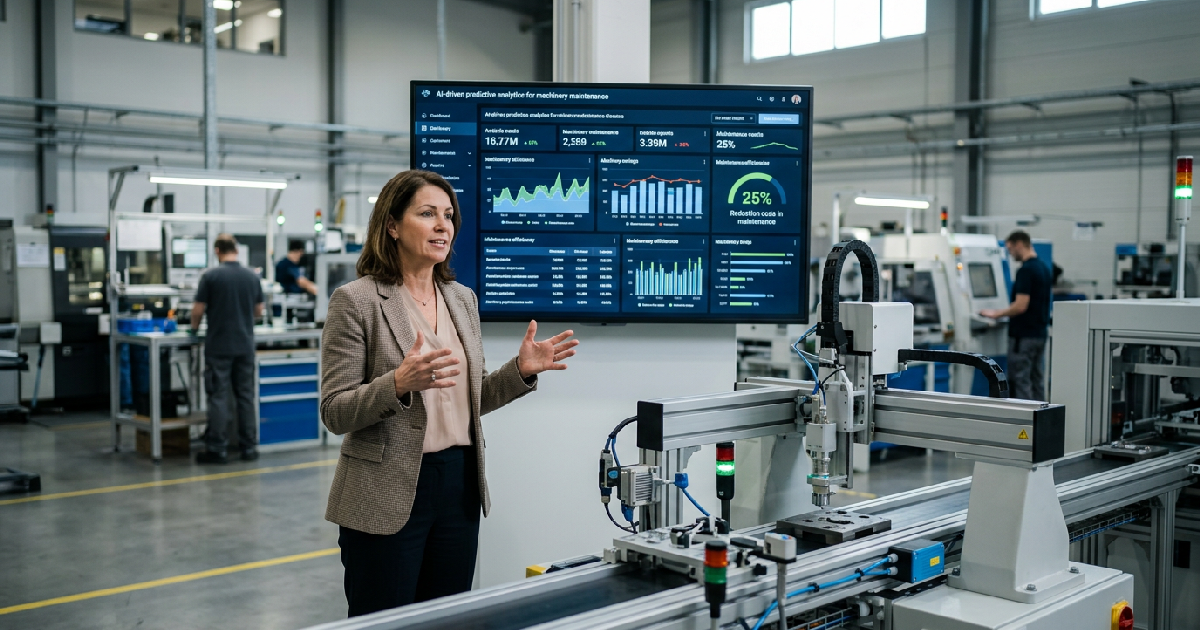
President Kathie Mahoney of the Massachusetts Manufacturing Extension Partnership (MassMEP) detailed how industrial facilities are using artificial intelligence to bridge the productivity gap during a Manufacturing Dive event on June 16, 2026.
Addressing the evolution of the sector over the last 30 years, Mahoney explained that while technology and geopolitical shifts have redrawn the industrial map, the current push for digital transformation is driven by immediate supply chain and workforce pressures.
Her message to smaller producers was direct: artificial intelligence won’t take your job, but the companies that use it will.
The urgency behind this transition is supported by data from facilities already running these systems. Manufacturers adopting AI technologies have recorded a 25% reduction in maintenance costs and a 15-18% increase in production output.
These gains stem from moving away from binary “run-to-failure” models toward systems that predict equipment fatigue before it stops a production line. This shift mirrors a wider trend where manufacturers pivot to Manufacturing Execution Systems to gain the operational agility needed to navigate volatile raw material supplies.
Smaller firms often struggle with the internal capacity to deploy these tools alone. To address this, MassMEP offers programs like the “AI Fundamentals in Manufacturing” class, designed to demystify complex algorithms for shop-floor applications. This educational push is occurring globally, as seen in projects where com/enugu-smart-schools-education-technology-reform/”>smart schools invest in technology reform to ensure the next generation of workers can manage data-driven production environments. Success now depends on human operators supervising automated systems rather than performing repetitive manual tasks.
Applying artificial intelligence to shop floor reliability and quality
The applications for AI in the factory environment focus on four core pillars: predictive maintenance, quality control, production optimisation, and workforce support. Predictive maintenance uses sensors to monitor vibration and temperature, allowing managers to schedule repairs during planned downtime.
This preventative approach is critical for maintaining delivery times in high-precision sectors such as bioindustrial manufacturing and robotics where a single machine failure can stall an entire contract.
Quality control has also seen a shift through the use of AI-powered sensors. These systems identify microscopic defects and irregularities that human inspectors frequently miss, particularly at the high speeds required for modern FMCG or electronics production. By analysing real-time production data, these tools recommend optimal scheduling and material utilisation.
This prevents the waste of expensive raw materials and ensures that the factory operates at peak efficiency regardless of shift changes or staffing levels.
Supporting the workforce through collaborative digital tools
Artificial intelligence is increasingly used as a safety and productivity tool for the human workforce. AI-powered systems now handle dangerous or repetitive tasks, guide workers through complex assembly sequences, and offer real-time problem-solving suggestions. This integrated approach allows manufacturers to handle talent shortages by making individual workers more effective.
Surveys conducted by MassMEP indicate that over 80% of manufacturers are now investing in training and automation to counter these persistent labor gaps.
The rise of these intelligent systems correlates with the growth of the collaborative robot market, where physical automation and digital logic work in tandem. For small and mid-sized manufacturers, however, the primary barrier remains the cost of implementation. Mahoney highlighted that these firms rely heavily on external support and state grants to move from traditional methods to a fully digital workflow.
Funding pathways for Massachusetts industrial innovators
To support the high capital requirements of “hardtech” manufacturing, several state and federal funding streams are available to Massachusetts companies. The Massachusetts Manufacturing Innovation Initiative (M2I2) provides essential grants for innovators ready to scale operations in electronics, robotics, and additive manufacturing. These funds are designed to help firms move beyond the prototype stage into full-scale commercial production.
Clean energy is another significant focus area for development. Programs like the Equity Workforce Training Implementation Grants expand career pathways for underrepresented groups in the green energy sector. Furthermore, the MassCEC Minority and Women Business Enterprise (MWBE) program assists firms in using Technology Driven Market Intelligence (TDMI) to find gaps in the clean energy market.
These initiatives ensure that the growth of new industrial sectors is inclusive and strategically sound.
Securing the digital backbone through cybersecurity grants
As factories become more connected, cybersecurity has transitioned from an IT concern to a fundamental production requirement. To protect industrial assets, the Manufacturing Cybersecurity Program provides up to $30,000 in capital cost share for infrastructure improvements. This funding allows small plants to secure their networks against digital threats that could otherwise halt production or compromise proprietary designs.
Further support is available through the Cyber Resilient Massachusetts Grant Program. This initiative, managed by the Mass Cyber Center, awards up to $25,000 to municipal utilities, small businesses, and non-profits.
The grant covers Managed Detection and Response services for up to three years, providing a vital layer of protection for makers who do not have the resources for a dedicated in-house security team. In the modern industrial era, protecting data is as important as maintaining physical machinery.
