


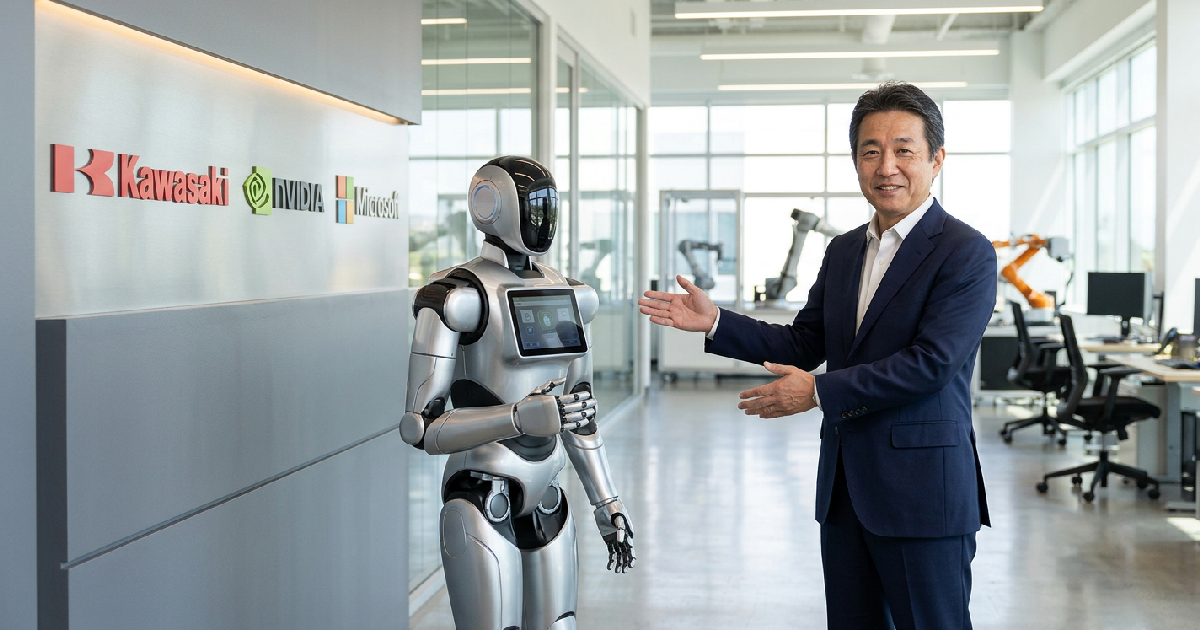
Kawasaki Heavy Industries CEO Yasuhiko Hashimoto launched the Kawasaki Physical AI Center in San Jose on May 21, 2026, marking a strategic pivot for the industrial giant toward advanced robotics. The new Silicon Valley hub, developed in partnership with NVIDIA, Microsoft, Analog Devices, and Fujitsu, aims to merge heavy-machine telemetry with high-level computing to address global labor shortages in healthcare and elder care. By establishing this base within its existing Kawasaki Robotics Inc.
facility, the company intends to move beyond traditional automated arms toward machines that autonomously perceive and reason in real-world environments.
The facility serves as a direct bridge between Japanese manufacturing expertise and California’s software ecosystem. Yasuhiko Hashimoto confirmed during the opening ceremony that the center will initially focus on a “hospital one-stop solution.” This initiative seeks to automate the patient journey from arrival and diagnosis to complex surgery and post-operative monitoring. Instead of replacing medical staff, the technology is designed to act as a digital safety net, supporting human judgment in high-pressure clinical settings where staff burnout remains a critical bottleneck.
com/african-iot-sector-growth-industrial-impact/”>African IoT sector growth through industrial connectivity is mirrored in the global North. Kawasaki is not just building robots; it is building a data pipeline. By linking decades of operational data from its semiconductor and heavy industries divisions with NVIDIA’s computing platforms, the company is attempting to solve the “edge-to-cloud” problem that has historically limited how robots handle unpredictable physical spaces.
This integration of localized data with scalable cloud frameworks allows for rapid prototyping on real machines rather than just digital twins.
Industrial collaboration with NVIDIA and Microsoft to drive Physical AI
The choice of partners highlights the multifaceted nature of what Kawasaki calls Physical AI. While NVIDIA provides the AI and GPU infrastructure necessary for complex reasoning, Analog Devices contributes the high-precision sensing interfaces required for machines to “feel” their surroundings. Microsoft and Fujitsu round out the collaboration by providing the software architecture and cloud processing power needed to manage the massive datasets generated by a fleet of autonomous machines.
com/ijeoma-eti-ai-infrastructure-trust-security-compliance/”>Ijeoma Eti addresses AI infrastructure faults by focusing on the underlying reliability of the systems rather than just the front-end application.
Operating under Kawasaki Heavy Industries (USA), Inc., the San Jose hub is positioned to capitalise on the talent pool within Silicon Valley. The company has announced plans to hire dozens of local AI engineers over the next few years to scale the center’s development capacity. This recruitment drive is essential for Kawasaki’s goal of expanding its Physical AI applications beyond healthcare and into the semiconductor, automotive, and mobility sectors, where it already maintains a leading global market share in manufacturing equipment.
Solving global labor shortages through machine autonomous reasoning
A primary driver for this investment is the demographic crisis facing developed and developing nations alike. CEO Yasuhiko Hashimoto noted that aging populations and labor shortages are no longer speculative risks but immediate operational hurdles. By creating machines that can navigate a hospital wing or a manufacturing floor with minimal human oversight, Kawasaki aims to maintain productivity levels even as the available workforce shrinks.
The center will collaborate closely with its Japanese development bases and the recently opened Kawasaki Innovation Centre Europe in Strasbourg to ensure these solutions are globally adaptable.
Furthermore, the San Jose hub acts as a testing ground for Japan-U.S. collaboration in the critical semiconductor field. Kawasaki has maintained a presence in Silicon Valley for 25 years, primarily focused on the sale and service of semiconductor manufacturing robots. The Physical AI Center represents an evolution of this presence, shifting the focus from maintenance and supply to co-creation and original IP development. This move ensures that as AI becomes more physically embodied, the hardware remains as sophisticated as the neural networks controlling it.
Beyond robotics toward a new era of industrial utilization
The strategy hinges on the “Showcase Principle” — the idea that Physical AI must be seen performing tasks in the real world to be commercially viable. The San Jose facility is equipped for rapid prototyping, allowing engineers to move from code to physical motion in hours. This speed is vital for developing the “hospital one-stop solution” which includes surgical assistance and automated diagnostic tools. Kawasaki’s long-term vision is to create a new category of industrial utility that sits above traditional robotics, where machines understand the context of their work.
And while the focus is currently on high-tech centers like California and Japan, the implications for emerging markets are clear. As manufacturing becomes increasingly automated, the infrastructure required to support these systems—much like how Tinubu targets stable electricity for Nigerians to drive local production—will become the defining factor in national competitiveness. Kawasaki’s investment signals that the next phase of the industrial revolution will not be found in the cloud alone, but in the intelligent movement of physical matter.
