


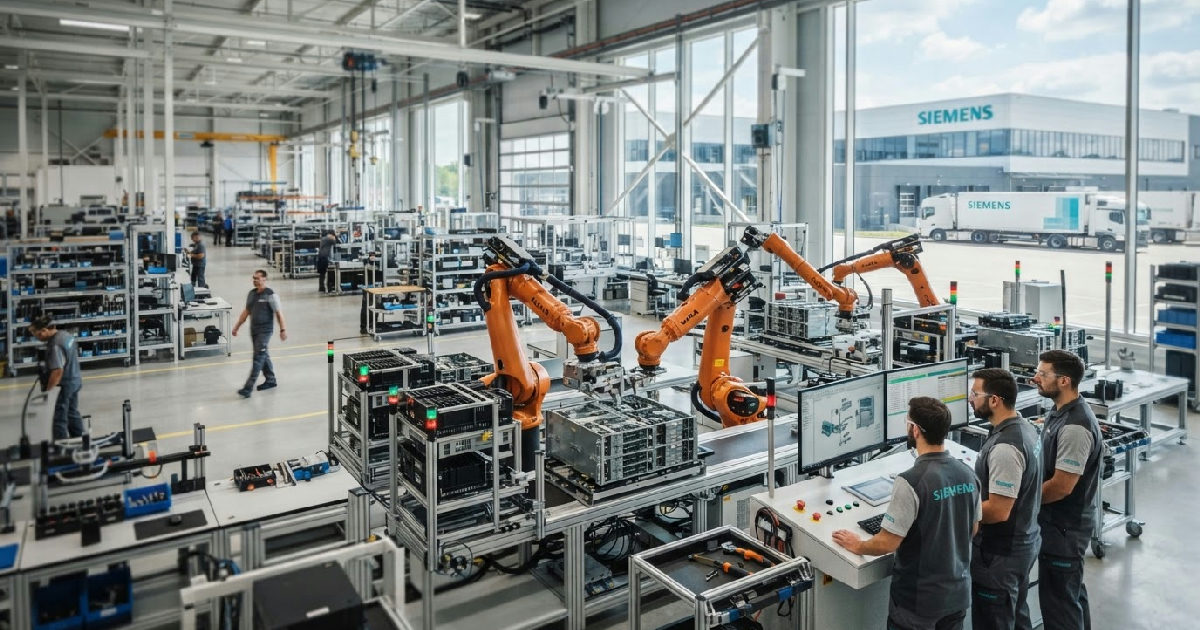
Siemens has committed over $200 million to establish two new manufacturing facilities in the United States.
This move is part of a broader push to strengthen Siemens’ footprint in the American manufacturing sector. The facilities will support not only AI infrastructure but also critical power needs across semiconductor, automotive, and healthcare industries. The company reports triple-digit order growth in its data centre business for the first nine months of its current fiscal year, with orders reaching approximately €6 billion.
Boosting electrical infrastructure for AI
The relentless growth of artificial intelligence, particularly in areas like large language models and complex computing, places immense pressure on existing electrical infrastructure. These new Siemens manufacturing facilities will address that demand. They will produce essential electrical equipment for efficient power distribution, monitoring, and control within modern data centres.
This includes systems that manage capacity expansion, enhance reliability, and optimise load management for more sustainable energy consumption.
As AI applications become more pervasive, the energy requirements of the data centres that house them have escalated dramatically.
Roland Busch, President and CEO of Siemens AG, highlighted the company’s deep involvement, stating, “We are present across the AI value chain – from chip design and data center infrastructure to the electrical systems and smart grids that power accelerated computing.” He added that these investments would further strengthen Siemens’ global leadership in providing the electrical backbone for AI, helping customers build efficient, resilient, AI-ready data centres.
The decision to expand follows a €300 million investment announced by Siemens in July 2026 for its factories in Germany. That move also aimed at supporting the burgeoning demand for AI and data centre infrastructure. This global strategy reflects a concerted effort to scale production capabilities in response to the technological shift driven by AI, ensuring power reliability remains a cornerstone of digital advancement.
Pendergrass, Georgia: a hub for low-voltage components
The larger of the two new sites, located at 580 Raco Parkway SE near Pendergrass, Jackson County, Georgia, represents an investment of at least $185 million. This substantial new facility, spanning approximately 550,000 square feet, will become a central production hub for low-voltage electrical components.
It will also produce critical electrical infrastructure products and distribution equipment tailored for the data centre market, specifically supporting the intensive power requirements of AI infrastructure and cloud computing operations.
Georgia was a deliberate choice for this significant expansion. Barry Powell, North America President of the Siemens Electrical Products business unit, noted that the state offers a strong business environment and access to a skilled workforce.
Its proximity to Siemens’ existing operations and supply chain networks, including an electrical manufacturing footprint in South Carolina, also proved to be a deciding factor.
Georgia Governor Brian P. Kemp welcomed the news, stating, “For 140 years, Siemens has been a valued part of Georgia’s business community, and this latest investment decision is another testament to the strong economic partnership between our state and Germany.”
The Pendergrass facility is projected to create more than 1,400 new jobs in Jackson County over the next three years. Roles will encompass engineering, fabrication, assembly, and testing. Buildout is scheduled to commence in November 2026, with hiring for these positions set to begin in 2027.
Furthermore, the facility underscores a commitment to sustainability, featuring electric paint lines and advanced energy management systems, aligning with Siemens’ goal to achieve net-zero carbon operations by 2030.
Grand Prairie, Texas: boosting switchgear capacity
Concurrently, Siemens is investing $19 million in a new 96,000 square foot facility in Grand Prairie, Texas. This site will serve a distinct but equally vital function: expanding the capacity of an existing Siemens flagship switchgear factory located nearby. The new facility will be dedicated to factory acceptance testing and warehousing for Siemens’ Electrical Products business, which supplies crucial components for various industrial applications.
The Grand Prairie expansion specifically targets markets such as semiconductor manufacturing, automotive production, and healthcare. All these sectors require reliable and critical power infrastructure. The additional capacity will help Siemens streamline its operations and improve service delivery to these industries.
Hiring for roles in fabrication, assembly, material handling, testing, and engineering is expected to commence in late 2026, contributing to the more than 1,500 new jobs across both locations.
A notable aspect of the Grand Prairie facility’s development involves Siemens’ own industrial technology. The company is using its Digital Industries Software portfolio, including Technomatix’s 3D models, to simulate production lines. This digital simulation allows for optimised layouts, logistics planning, and efficient workstation design before construction begins, ensuring a highly productive operational setup.
The application of such advanced techniques demonstrates how Siemens applies the industrial AI principles underpinning the data centres it helps power.
Strategic context: a broader US manufacturing push
These latest investments are not isolated incidents but rather part of a larger, concerted effort by Siemens to bolster its manufacturing capabilities within the United States. Over the past five years, the company has channelled more than $1 billion into its U.S. manufacturing operations. This reflects a broader strategy of strengthening domestic supply chains and production resilience.
This trend is visible across various industrial sectors, as companies respond to geopolitical shifts, economic incentives, and the need for closer proximity to key markets.
Ann Fairchild, Siemens USA President and CEO, emphasised this commitment, stating, “These investments underscore Siemens’ commitment to scaling American manufacturing capacity and creating American jobs.”
She also highlighted the “unprecedented demand for critical infrastructure here in the U.S.,” affirming the company’s intent to continue expanding its footprint to meet customer needs while simultaneously boosting local economies. The impact of such investments reaches beyond job creation, fostering skills development in advanced manufacturing and engineering roles that are increasingly in demand.
The rapid evolution of AI technology and its associated infrastructure requirements present both challenges and opportunities for global manufacturers. Companies like Siemens are positioning themselves at the forefront, not only as providers of software and automation but also as producers of the physical equipment that enables the AI revolution.
This dual role, spanning AI infrastructure and hardware production, illustrates a deep integration into the technological advancements shaping the modern industrial world.
Marty Clark, chairman of the Jackson County Board of Commissioners, acknowledged this, remarking that Siemens’ investment would create “high-quality jobs, expand our manufacturing base, strengthen workforce opportunities, and support the county’s long-term goals of sustainable economic growth and increased prosperity.”
Global implications and future outlook
The surge in demand for AI-ready data centres is a global phenomenon, not limited to the United States. As nations across Africa, for instance, accelerate their digital transformation efforts and seek to build out their own data infrastructure, the lessons and technologies deployed by Siemens in these new U.S. facilities could prove relevant.
Reliable electrical infrastructure is a foundational requirement for any substantial digital economy, and the efficiency gains achieved through advanced manufacturing and energy management systems deployed in Pendergrass and Grand Prairie offer a model for future projects..
This strategic focus on expanding local production capacity echoes broader trends in industrial development. Companies across various sectors are investing in domestic manufacturing, reflecting the same objectives as other significant projects like the Ohio manufacturing plant. Such initiatives are crucial for building resilient supply chains and fostering economic growth in regions with increasing industrial needs.
As AI capabilities continue their upward trajectory globally, firms capable of delivering both digital and physical infrastructure will become increasingly important.
The construction of these two new US facilities signals a clear strategic direction for Siemens: anchoring critical production closer to key markets while implementing advanced manufacturing techniques and sustainable practices. It is a testament to the ongoing industrial reorganisation, driven by technological advancements and the growing need for localised supply chains.
The coming years will undoubtedly see further investments of this nature, shaping the future of global manufacturing.
