


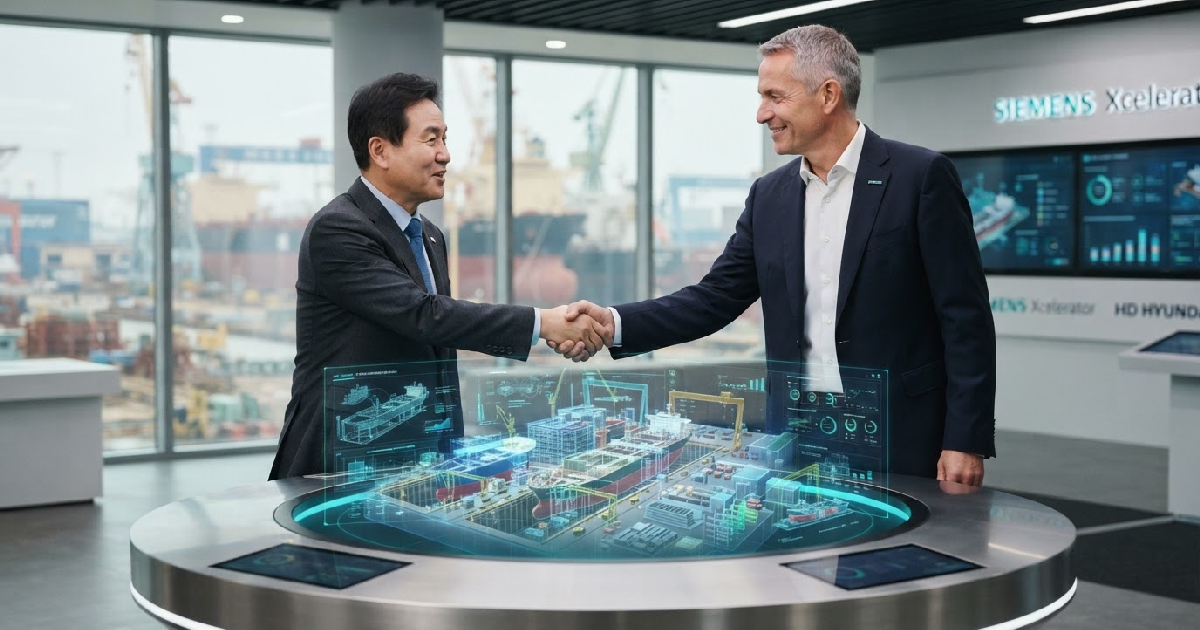
Siemens and HD Hyundai finalised a low triple-digit million USD agreement to develop a digital shipyard model for shipbuilding transformation.
The collaboration seeks to modernise global shipbuilding operations, significantly boosting productivity, enhancing quality, and notably supporting U.S. maritime manufacturing capabilities. This move builds on HD Hyundai’s existing use of the Siemens Xcelerator portfolio across its extensive shipbuilding activities. The expanded deal signals a concentrated effort to establish a new industry benchmark for efficiency and technological integration in a sector known for its complexity.
Forging the digital blueprint for shipbuilding
The core of this long-term agreement involves creating a comprehensive digital blueprint that connects every stage of the shipbuilding lifecycle. This extends from initial design and engineering through to manufacturing, production planning, simulation, and ultimately, shipyard execution and lifecycle management. The partnership aims to establish a common digital backbone that ensures seamless data flow and continuity.
Roland Busch, President and CEO of Siemens AG, underscored the sheer complexity inherent in modern shipbuilding. “To build the world’s most advanced vessels, shipbuilders must manage enormous complexity across millions of components,” he stated.
He added that the extended partnership with HD Hyundai provides a scalable blueprint for the digital shipyard of the future, with Siemens Xcelerator at its core. This, he explained, builds the operating system for industrial AI by connecting data, software, and automation.
Unifying design and production processes
A key objective is to create a scalable digital thread. This thread will unify disparate processes such as design, engineering, manufacturing, and production planning. Through this integration, the companies expect to achieve substantial improvements in production readiness, overall quality, and a significant reduction in rework.
H.K. Kim, President & CEO of HD Korea Shipbuilding & Offshore Engineering, highlighted the transformative potential of the initiative. He noted that integrating AI, digital twin, and automation technologies into a connected digital shipyard environment aims to establish a future-ready model for the entire industry. This approach promises to reshape how ships are designed, built, and operated.
U.S. maritime sector eyes modernisation
The collaboration holds particular significance for the U.S. maritime industry, a sector currently seeing considerable investment from both public and private organisations. HD Hyundai’s broader multi-million-dollar investment strategy in the U.S. aligns directly with this partnership, focusing on shipbuilding capacity, workforce readiness, and industrial resilience.
Tony Hemmelgarn, President and CEO of Siemens Digital Industries Software, stressed that this strategic collaboration goes beyond merely deploying technology. He described it as establishing a repeatable blueprint for modern shipbuilding. By combining Siemens’ digital capabilities with HD Hyundai’s operational excellence, the partners aim to help shipbuilders improve throughput, quality, and workforce productivity, ultimately strengthening global competitiveness.
A new cooperation centre
As part of this initiative, HD Hyundai and Siemens will support the launch of a U.S.-Korea Shipbuilding Technology Cooperation Center in Washington, D.C. This centre will serve as a critical platform. It aims to foster collaboration among government, industry, and technology organisations on the topic of digital shipbuilding.
The D.C. centre will facilitate the exploration of modernisation strategies and accelerate the adoption of digital shipyard technologies. It also plans to support workforce and industrial development initiatives, directly addressing the need for a skilled workforce in a rapidly evolving industrial landscape.
Sangmin Moon, Executive Vice President of Global Strategy Division at HD Hyundai, stated that maximising production efficiency through digital and automation technologies is key to reconstructing the U.S. shipbuilding industry.
Technology driving the transformation
The technical backbone of this digital shipyard model will rely heavily on the Siemens Xcelerator portfolio. This suite of tools covers a wide array of functions essential for modern industrial operations. The intention is to create a secure collaborative operating environment that allows for controlled data sharing, configuration management, and digital approvals.
The technology stack includes Designcenter for product engineering and ship design, and Teamcenter for product lifecycle management and configuration control. Opcenter will handle manufacturing operations management, while Plant Simulation will be used for production planning and optimisation. Simcenter will provide simulation and systems engineering capabilities, and Intelligence Center X will orchestrate industrial AI applications.
The Siemens Xcelerator ecosystem
These integrated tools are designed to connect engineering, manufacturing, suppliers, and shipyard operations through a shared digital foundation. This integrated approach aims to support production visibility and lifecycle traceability across multiple shipbuilding scenarios, all while maintaining design authority and execution responsibility.
Robert Jones, Chief Revenue Officer of Siemens Digital Industries Software, highlighted how this agreement brings together global shipbuilding excellence and Siemens’ proven digital transformation technologies.
The goal is to help U.S. shipyards build smarter, faster, and become more resilient. Jones noted that by combining Siemens’ digital backbone with HD Hyundai’s advanced engineering, they are enabling the revitalisation of American shipbuilding and supporting the creation of a sustainable, future-ready workforce.
Siemens believes its leadership in industrial AI, automation, and digital twin software uniquely positions it to help transform how shipyards design, build, and sustain the next generation of vessels.
Industry implications and future outlook
This partnership is not just about enhancing HD Hyundai’s operations; the companies intend to jointly develop and commercialise these digital shipyard solutions. This means the model will be available for shipbuilders at different stages of digital maturity, supporting both traditional shipyards looking to modernise and large naval or commercial programmes seeking greater scale and efficiency.
The agreement evolves from previous discussions, notably a Memorandum of Understanding (MoU) signed in November 2025 focusing on U.S. shipyard automation and workforce development. In February 2026, HD Hyundai selected Siemens Xcelerator as the digital backbone for its broader Future of Shipyard programme.
Phased implementation of this programme was set to begin in 2026, with a target for first operational vessels using the new system by 2028 and overall programme completion by 2030.
Phased implementation and reusability
The digital shipyard approach caters to both entirely new modernisation projects and phased transformation programmes. This flexibility allows shipbuilders to incrementally upgrade their operations without disrupting existing production activities. The underlying aim is to enable shipyards to operate with greater agility and efficiency.
Under the planned U.S. collaboration, Siemens and HD Hyundai will conduct shipyard modernisation assessments. They will also develop digital transformation roadmaps, identify pilot deployments, and engage with government and commercial stakeholders. This comprehensive strategy is geared towards creating reusable digital shipyard offerings that can be deployed across a wide range of maritime industrial bases.
Broader impact on global manufacturing
The partnership between Siemens and HD Hyundai represents a significant step in the broader trend of industrial digitalisation. The “low triple-digit million USD” investment in creating a comprehensive digital twin and AI-driven framework for shipbuilding demonstrates a commitment to advanced manufacturing principles. This kind of deep integration across the product lifecycle is increasingly critical for industries facing complex design and production challenges.
While the immediate focus includes the U.S. maritime sector, the underlying technologies and methodologies have wider implications. The development of a repeatable digital shipyard model could set a precedent for other heavy industries.
The initiative also highlights the growing importance of international cooperation in driving technological advancement, a factor that can become complex given geopolitical realities. For the manufacturing professional, this agreement underscores the imperative to embrace digital transformation, not just as an efficiency tool, but as a fundamental shift in operational philosophy.
