


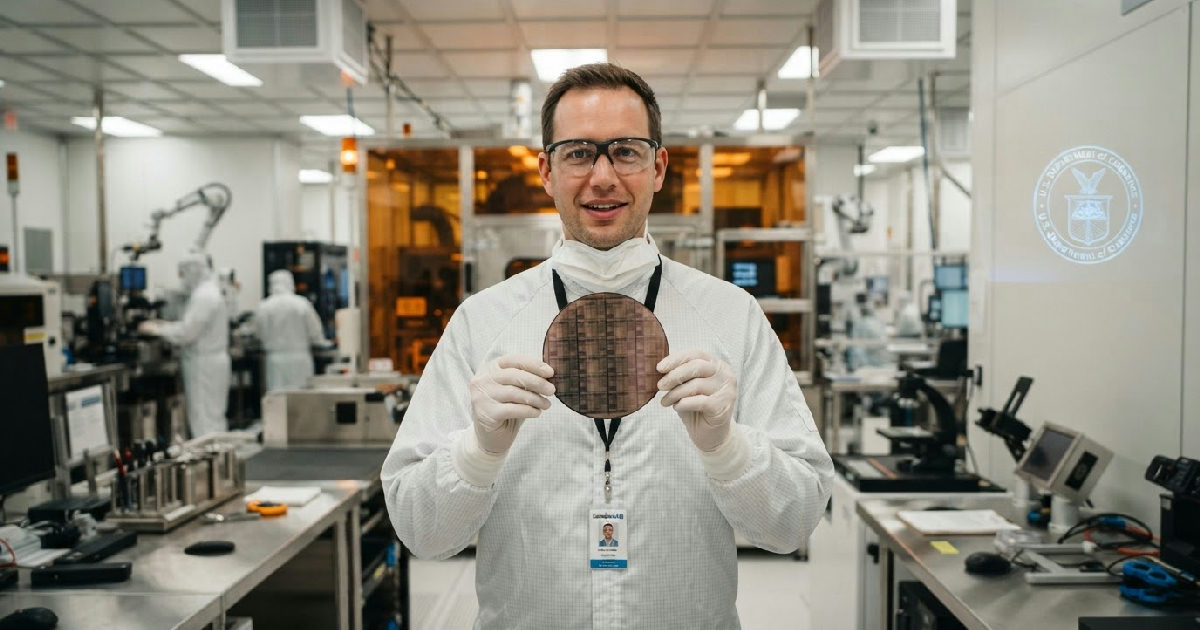
SandboxAQ received a $500 million U.S. CHIPS Act award for developing PFAS-free semiconductor alternatives.
Stefan Leichenauer, Vice President of Engineering at SandboxAQ, confirmed on August 20, 2026, that the company expects to identify viable alternative candidates within two to four years. This marks a critical step toward cleaner and more secure chip production. The strategic investment, channelled through the U.S. Department of Commerce’s CHIPS Research and Development Office in Washington, D.C., underscores a national imperative.
Addressing the PFAS-free semiconductor alternatives challenge
PFAS compounds, first discovered in 1934, comprise a class of approximately 15,000 synthetic chemicals. These “forever chemicals” are defined by an exceptionally strong carbon-fluorine bond, granting them unusual durability and chemical stability. They also resist heat, water, and oil, making them seemingly indispensable across diverse industrial applications.
The same characteristics that make PFAS effective also contribute to their notoriety. They resist natural degradation, leading to widespread environmental contamination in water, soil, and air. Scientific evidence links certain PFAS compounds to serious health concerns, including cancer, thyroid dysfunction, liver damage, and developmental issues. This has spurred a global push for their elimination and stringent regulatory actions.
Critical role in chip production
Semiconductor manufacturing, with its nanometric precision, relies heavily on PFAS at almost every stage. These chemicals are used in up to 1,000 different processes, ranging from photolithography and etching to cleaning, plasma processing, and heat-transfer fluids. Specific applications include formulations for photoresists, anti-reflective coatings, lubricants, insulating coatings, and surface-treatment chemicals that ensure wafers are heat-resistant and durable.
The pervasive use of PFAS in chipmaking means that any disruption to their supply or aggressive regulatory bans could severely impact production. Factories unable to transition to PFAS-free process chemicals risk significant regulatory exposure and potential production cutbacks. This dual threat of environmental hazard and supply chain fragility highlights the urgency behind SandboxAQ’s initiative.
SandboxAQ’s AI and quantum approach
SandboxAQ, a B2B company spun out of Alphabet in 2022, is spearheading the search for PFAS-free alternatives through advanced computational methods. Their approach fuses Artificial Intelligence (AI) with quantum techniques, a combination they term “AQ.” This strategy aims to drastically accelerate the discovery and development cycle for new materials.
Central to SandboxAQ’s methodology are Large Quantitative Models (LQMs). These proprietary models integrate physics-based simulations with machine learning through a sophisticated three-layer architecture. LQMs generate physics-grounded data, which then trains both proprietary AI and physics models. This combination facilitates automated workflows for Design-Make-Test-Learn (DMTL) loops, streamlining the R&D process.
Accelerating materials discovery
The company plans to deepen its investment in the ReAQT Software Platform. This AI simulation tool is specifically designed to accelerate the discovery of new materials. This platform underpins its AQCat workflows, which leverage an astonishing 13.5 million high-fidelity chemistry calculations developed in collaboration with NVIDIA.
These workflows enable the screening of catalyst candidates at near-quantum-chemistry accuracy, doing so 20,000 times faster than conventional methods. Such speed can cut development timelines from months to mere weeks. SandboxAQ’s advanced computational methods are also being applied to find alternatives for other critical materials.
This includes rare-earth-free magnets, catalysts, and battery systems for semiconductor facilities. Stefan Leichenauer noted that these methods extend to other sectors, including the development of alternative catalysts. The company is actively recruiting for this initiative, evidenced by a Staff Materials Research Scientist for PFAS Alternative Discovery listing on July 24, 2026.
National strategy for secure supply chains
The $500 million award to SandboxAQ is a direct outcome of the CHIPS and Science Act. This U.S. federal law aims to reinforce domestic semiconductor research, development, and production. The initiative reflects a broader national strategy to reduce America’s reliance on foreign supply chains, particularly for critical materials.
Howard Lutnick serves as Secretary of Commerce, a role central to these national economic strategies. This effort extends beyond PFAS-free alternatives, encompassing other programmatic areas funded by the Department of Commerce. These include catalysts, rare-earth-free magnets, and battery systems.
By fostering domestic innovation in these areas, the U.S. aims to insulate its manufacturing base from geopolitical risks and ensure a steady supply of essential components. Paladin Capital Group, an investor in SandboxAQ, invested in the company during its first fundraising round in 2022. Michael Steed is the Founder and Managing Partner of Paladin Capital Group.
Regulatory pressure and environmental imperative
The drive for PFAS-free alternatives is not solely an economic or strategic concern. It is also a response to increasing environmental regulations. The U.S. Environmental Protection Agency (EPA) unveiled its PFAS Strategic Roadmap in October 2021. The roadmap outlined a comprehensive plan to research, restrict, and remediate PFAS contamination.
In April 2024, the EPA established legally enforceable Maximum Contaminant Levels (MCLs) for six PFAS in drinking water. Public water systems must begin monitoring by 2027 and comply with the standards by 2029. While the EPA later announced its intention to delay compliance for some compounds until 2031, the trajectory towards stricter regulation is clear.
State lawmakers are also actively targeting PFAS for bans in various products. SandboxAQ’s work offers a proactive solution.
The path ahead for alternative materials
The ambition to find viable PFAS-free alternatives within two to four years, as outlined by Stefan Leichenauer, represents an aggressive but achievable timeline. SandboxAQ, valued at $5.75 billion in April 2025, possesses significant resources and expertise. Its ongoing investment in the ReAQT platform and continuous pursuit of scientific talent underscore a sustained commitment to this goal.
The search for alternatives is a multifaceted endeavour, requiring not just discovery but also validation, rigorous testing, scaling, and integration into existing manufacturing processes. Skadden, a prominent legal firm, advised SandboxAQ on its agreement with the U.S. Department of Commerce. This ensured the intricate legal and financial frameworks are robust for such a high-stakes national project.
Broader industrial implications
While the immediate focus remains on semiconductor manufacturing, the computational methods developed by SandboxAQ hold wider implications. These methods could impact industrial productivity across various sectors. The ability to rapidly screen and discover new materials, whether for quantum computing components, rare-earth-free magnets, or advanced catalysts, could transform materials science. This technology offers a significant advantage to industries globally by accelerating research and development.
This focus on more sustainable and efficient materials development processes can lower barriers to entry for new innovations. It could also reduce reliance on legacy, environmentally problematic substances across a broad range of manufacturing applications. The long-term impact extends to enhancing national security by securing critical supply chains.
