


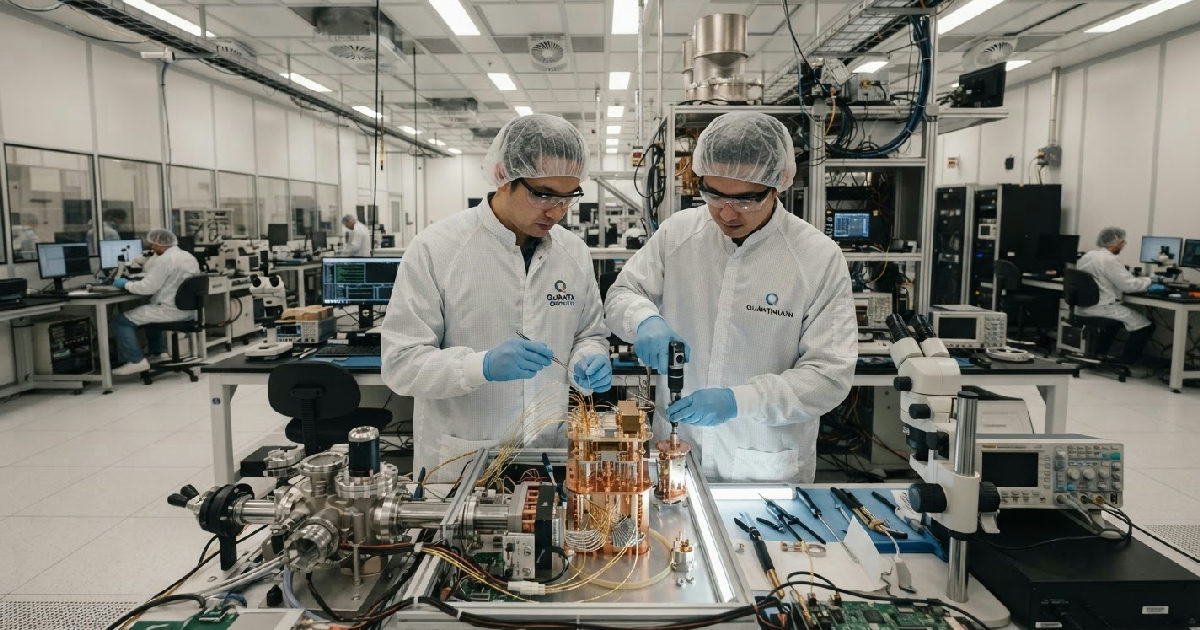
Quanta Computer and Quantinuum have announced a collaborative development agreement set to industrialise the next era of quantum computing, focusing on scaling quantum hardware production.
The core of the agreement focuses on jointly developing critical hardware infrastructure. This will support future generations of Quantinuum’s quantum systems, leveraging Quanta’s extensive experience in manufacturing sophisticated computing platforms.
Driving quantum hardware industrialisation
The collaboration specifically targets creating modular, manufacturable infrastructure for future scalable quantum systems. Joint engineering efforts are already underway, focusing on designs that will make upcoming quantum computers more adaptable, easier to produce, and capable of operating at significant scale.
Dr. Rajeeb Hazra, President and CEO of Quantinuum, underscored the shift required in the sector. He noted that it’s time for quantum computing to move past physics breakthroughs in the lab and towards breakthroughs in system manufacturing that allow for widespread deployment and operation.
Establishing a mass-manufacturing pathway
A key aspect of this agreement is the establishment of mass-manufacturing supply chains. The companies plan to co-engineer standardised, rack-mountable enclosures, environmental packaging, and high-density interface interconnects specifically for trapped-ion systems. This level of detail highlights a focus on practical, repeatable production.
This deep collaboration will stabilise the supply chain. It will achieve this by creating robust, high-volume component procurement pipelines for crucial elements like sub-system electronics, laser and optical assemblies, and radio-frequency control hardware. Such a structured approach is essential for any technology aiming for widespread industrial use.
Leveraging manufacturing expertise for quantum scale
Quanta Computer brings decades of manufacturing experience to this partnership. Founded in 1988, the Taiwanese firm is globally recognised for industrialising advanced computing technologies, including being the world’s largest manufacturer of notebook computers.
With a revenue of US$34.860 billion in 2023 and a workforce of 56,708, Quanta’s expertise extends to servers, storage, networking switches, mobile communication devices, and automotive electronics manufacturing. This background makes them a critical partner in scaling the complex hardware demands of quantum systems.
Quantinuum’s quantum technology leadership
Quantinuum, formed in 2021 from the merger of Honeywell Quantum Solutions and Cambridge Quantum Computing, is a leader in trapped-ion quantum computing. Their H-Series systems have repeatedly set records for quantum volume, demonstrating high performance and qubit fidelity.
The company, publicly traded on Nasdaq under the ticker QNT, brings its advanced trapped-ion Quantum Charge-Coupled Device (QCCD) architecture to the table. This technological foundation is pivotal for developing fault-tolerant, megaquop-class quantum systems, a major goal for the quantum computing industry.
The path to fault-tolerant quantum computing
The ultimate goal of this collaboration is to accelerate the development of commercially deployable, large-scale, fault-tolerant quantum systems. Fault tolerance is widely considered the holy grail in quantum computing, enabling computations with extremely low error rates, which is vital for solving complex, real-world problems.
Quantinuum has outlined an accelerated roadmap to achieve a universal, fully fault-tolerant quantum computer by 2030. Their forthcoming fifth-generation ion-trap processor, named “Apollo,” targets over 100 qubits. A prototype has already achieved a quantum volume exceeding 2,000,000, illustrating the rapid advancements in the field.
Overcoming technical and operational hurdles
Moving quantum computing from highly controlled lab environments to robust, mass-manufacturable products presents significant technical and operational challenges. This includes managing extreme environmental controls for trapped ions, ensuring the precision of optical and laser components, and integrating complex RF control hardware.
The partnership aims to de-risk these challenges by combining Quantinuum’s deep quantum physics knowledge with Quanta’s industrial design and production capabilities. This includes co-engineering hardware that can withstand the rigours of commercial deployment and operation.
The joint engineering teams are not just designing new hardware; they are addressing the entire lifecycle, from design to sourcing and assembly. Such a holistic approach is critical for any emerging technology to cross the chasm from research curiosity to industrial utility.
Broader implications for industrial technology
This collaboration represents a significant step for the entire industrial technology sector, particularly for those working in advanced computing. The industrialisation of quantum hardware could eventually impact industries far beyond initial scientific research. Its success could lead to breakthroughs in materials science, drug discovery, and complex logistical optimisation across enterprises.
The current partnership between Quanta and Quantinuum provides a clear example of how traditional manufacturing prowess can accelerate the development of next-generation computing.
Expanding access to quantum capabilities
One of the long-term benefits of this industrialisation effort is the potential to make quantum computing more accessible. By creating manufacturable and modular systems, the barrier to entry for enterprises and researchers could lower significantly. This could foster wider experimentation and application development across various sectors.
The ability to reliably produce quantum computers at scale means more institutions can acquire and operate them. This shift would accelerate the discovery of practical applications and move the field closer to its transformative potential. It’s a pragmatic step towards demystifying and democratising a highly complex technology.
Global impact and future outlook
The partnership between a Taiwanese manufacturing giant and a US-headquartered quantum computing pioneer reflects a global effort to push technological boundaries. It underscores the international collaboration needed to bring such advanced capabilities to fruition, drawing on diverse strengths from different regions.
For industrial players globally, the availability of more robust quantum hardware could unlock unprecedented computational power for complex problem-solving and innovation in the years to come.
Securing a robust supply chain for quantum components
Establishing dependable supply chains for quantum components is paramount for scaling the technology. The precision required for trapped-ion systems means that every optical, electronic, and RF control component must meet exceptionally high standards. Quanta’s experience in managing vast and complex electronics supply chains will be instrumental here.
This focus on component procurement is a crucial, often overlooked, aspect of developing advanced technology. Without a stable and scalable supply, even the most innovative designs remain confined to the laboratory. The partnership addresses this directly, ensuring future quantum systems can be built with consistent quality and volume.
The economic ripple effect of quantum industrialisation
The successful industrialisation of quantum hardware could generate substantial economic benefits. It would not only create new manufacturing jobs and supply chain opportunities but also stimulate innovation in adjacent industries that could leverage quantum capabilities. This includes everything from advanced materials production to cybersecurity.
The investment in this foundational hardware development signals a maturation of the quantum computing market. It shows a commitment to moving beyond theoretical promise towards tangible, scalable products that can integrate into existing industrial and technological frameworks, promising a new wave of industrial productivity and scientific advancement worldwide.
