


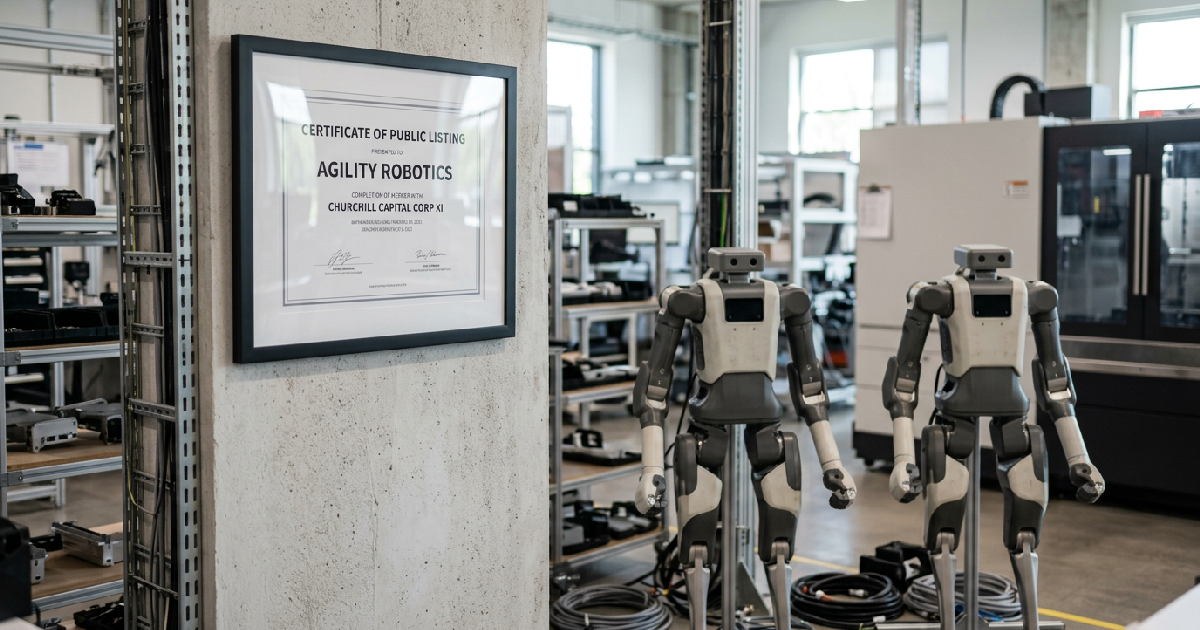
Agility Robotics will go public via a merger with Michael Klein’s Churchill Capital Corp XI, a move that values the Salem-based humanoid robotics firm at approximately $2.5 billion.
The capital injection is intended to scale operations at the company’s 70,000-square-foot manufacturing facility in Oregon, where the flagship bipedal robot, Digit, is produced.
Agility Robotics enters public markets to scale Digit production
While competitors in the humanoid space have recently sought eye-watering valuations in private rounds, Agility’s choice of a Special Purpose Acquisition Company (SPAC) merger offers a transparent, if technically demanding, path to liquidity.
By choosing the public markets, the company is effectively betting that its decade of operational data and safety certifications will outweigh the recent volatility associated with the SPAC structure.
The decision to list publicly comes at a time when the humanoid robotics sector is experiencing an unprecedented influx of venture capital. Just last week, Shenzhen-based AI2 Robotics secured $735 million at a $3 billion valuation, while Austin’s Apptronik recently closed a $935 million round.
Most notably, Figure AI reported a Series C funding round that valued the San Jose startup at $39 billion. Against this backdrop of soaring private valuations, Peggy Johnson’s move to lead Agility through a $2.5 billion SPAC merger represents a strategic play for “first-mover advantage” in the public sphere.
For industrial observers, this isn’t just a financial transaction; it is a test case for whether the market is ready for a standalone robotics entity. Unlike the diversified giants or the secretive, VC-backed startups, Agility is offering a direct look at its order books.
Digit’s design and operational advantage
Digit itself is a deliberately unfussy piece of hardware. Standing about 5’9″ and weighing around 160 pounds, it is specifically engineered to move heavy objects within human-designed industrial environments. One distinguishing feature is its reverse-bend knees, often referred to as “bird legs.”
This design allows Digit to access items from floor level to overhead shelving without its knees obstructing warehouse racking. Agility’s founders consciously avoided biomimicry solely for aesthetic reasons, prioritising functional movement in its design. The robot’s hands, equipped with two thumbs and two fingers, are similarly optimised for gripping tasks, specifically handling heavy plastic totes even as their contents shift during transit, critical for warehouse operations.
Agility also maintains what it calls an “LLM-agnostic” approach. It draws on various large language models, including Claude and Gemini, to manage the semantic layer of its robots. This allows Digit to translate high-level instructions into concrete robot behaviours, as demonstrated in a recent test where the robot successfully sorted and binned various types of scattered trash after being told simply to “clean up this mess.”
Key details of the SPAC merger
Entering the public markets via a SPAC is a bold choice, given the poor performance of many companies that used the same vehicle in 2021. However, Johnson, a veteran executive who helped lead Microsoft’s $26 billion acquisition of LinkedIn, appears unfazed by the potential for volatility.
Her strategy is to ignore market noise and focus on “robot by robot” execution. For retail investors, this provides a rare opportunity to gain exposure to the sector, but it also means Agility must now answer to the quarterly scrutiny of public shareholders.
As industrial firms continue to seek ways to increase output, the role of bipedal robots is becoming more concrete. Companies are no longer just looking for software; they are looking for industrial connectivity and IoT expansion that includes a physical labour component.
Agility’s customer list already includes heavyweights like Amazon, Toyota Motor Manufacturing Canada, and GXO Logistics, suggesting that the transition from pilot programmes to full-scale deployment is already underway.
Tempering expectations for the consumer home robot
Despite the excitement surrounding the public listing, Johnson is remarkably candid about the limitations of current technology. She estimates that a truly useful consumer humanoid for the home is at least 10 years away.
The reasoning is rooted in environmental complexity: while warehouses have fixed aisles and predictable workflows, homes are chaotic environments filled with unpredictable variables like pets, stairs, and children. In Johnson’s view, even public roads—the domain of autonomous vehicles—have more discipline than the average living room.
The priority of physical AI and safety compliance
Johnson stressed that the core proprietary advantage lies in the physical layer of the robot—its mechanics of balance, locomotion, and manipulation. She argues that while LLMs had the entire internet for training, the “physical AI” required for humanoids in unstructured environments is still largely undeveloped across the industry. Agility, with its decade-plus of real-world deployment data, believes it has built the largest data lake of actual operating robotics data in real-world environments.
Moreover, safety compliance sets Agility apart. Unlike rivals whose robots are often showcased in lab demos or choreographed videos, Agility’s Digit has met stringent industrial safety certification requirements for operation in customer facilities. Johnson highlighted that safety must be integrated from the outset, encompassing the electrical system, all parts, and supporting software, rather than being an afterthought.
This is a critical distinction, especially considering past allegations involving other companies, such as Figure AI, where a former head of product safety reportedly sued over concerns of robots being powerful enough to fracture a human skull.
This honesty might frustrate some investors seeking a “Star Wars” future, but it serves to insulate the company from the hype cycles that have plagued the robotics industry in the past. By managing expectations today, Agility aims to build a sustainable business that can survive the long road to general-purpose utility.
The immediate focus: industrial labour gaps
The home market remains a future goal, but current efforts are concentrated where the demand is most acute and the environment is most manageable. Johnson points to over a million unfilled jobs in the US manufacturing and logistics sectors, roles that are physically demanding and increasingly difficult to staff. Manufacturing Execution Systems are becoming important strategic levers for companies looking to address these labour gaps.
Industrial scaling in Salem and beyond
The proceeds from the merger with Churchill Capital Corp XI are primarily earmarked for the “RoboFab” manufacturing site. Scaling production of a complex bipedal robot is a different challenge than building a prototype; it requires a robust supply chain and rigorous quality control. The 70,000-square-foot facility in Salem, Oregon, is central to these plans. For Agility, the focus is now on manufacturing throughput.
The ability to produce 1,000 units to meet the current backlog will be the true test of whether bipedal robots are ready for the mainstream industrial economy. This scaling effort includes fulfilling multi-year revenue contracts worth over $300 million for its “robots-as-a-service” model. Expanding production capabilities locally means Agility Robotics hopes to address the growing demand in warehouses and factories more effectively.
Ultimately, Agility’s transition to a public company marks a turning point for the industry. It signals that humanoid robotics has moved past the “science project” phase and into a commercial era defined by booked revenue, safety compliance, and manufacturing scale. Whether Digit becomes a common sight in global warehouses depends on how well Agility can execute on its production targets in the coming months.
