


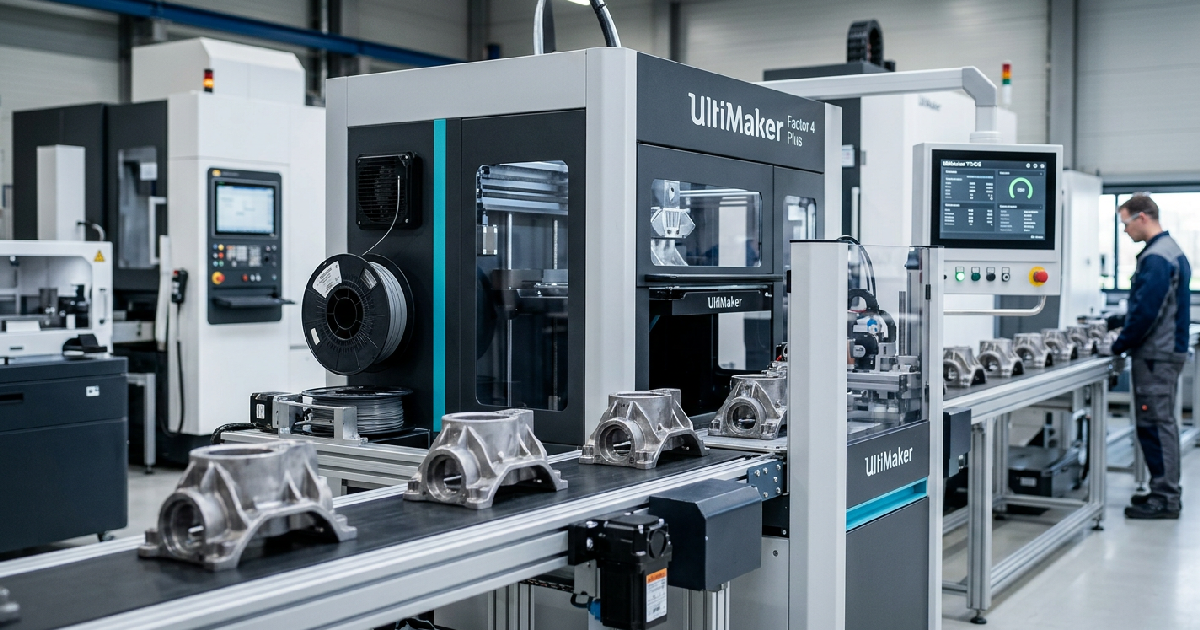
UltiMaker launched the UltiMaker Factor 4 Plus on May 21, 2026, a new industrial 3D printing platform designed to shift additive manufacturing from prototyping to continuous factory production. Announced from New York and Zaltbommel, Netherlands, the Dutch-American company’s latest hardware targets the manufacturing and defence sectors, offering up to twice the print speed of the standard Factor 4 launched in 2024.
The system integrates the Technical Reporting And Certification Engine (TRACE), a quality assurance tool that automatically validates prints by recording extrusion behavior and chamber temperatures. This creates a CAD-validation report that can be reviewed immediately, supporting the deployment of mission-ready components in demanding environments. “Proving the quality of the part is the real challenge,” says UltiMaker CTO Arjen Dirks, noting that TRACE provides the traceability required for true production.
For industrial operators, the platform offers a ruggedised design and an improved gantry system engineered specifically to absorb vibration at high print speeds. This mechanical stability works alongside the Cheetah motion planner, which removes abrupt changes that cause vibrations. This combination enables higher production rates with superior dimensional accuracy, allowing companies to respond quickly to supply chain gaps through industrial connectivity and automation.
High-temperature capabilities for engineering-grade materials
The hardware is built to handle complex materials with a dual-extrusion direct drive print head and an actively controlled build volume that reaches 70°C. Using the HT print core, the system can achieve temperatures up to 340°C, making it compatible with high-performance composites like PPS-CF. This specific material is chemical-resistant, flame-retardant, and carries a heat deflection temperature greater than 230°C, suitable for functional engineering prototypes.
Precision remains a focal point for the platform, which maintains a positional accuracy of ± 0.2 mm or ± 0.2% of the feature’s nominal length when using UltiMaker Verified Materials. The build volume of 330 x 240 x 300 mm is supported by a heated bed that reaches 120°C, ensuring thermal stability for larger parts. Such precision is vital as engineering initiatives increasingly move toward local production of durable spare parts.
Environmental control is managed through an automated material handling system that keeps the internal chamber at less than 15% relative humidity. This system features six bays with NFC recognition for 1 kg spools. UltiMaker reports a tested print completion success rate of over 95% using materials such as PET CF, Tough PLA, and PPS CF, ensuring that high-speed production does not come at the cost of wasted material.
Strategic deployment in global defence operations
UltiMaker expects defence to account for approximately 30% of its total revenue by the end of 2026. The Factor 4 Plus is designed for rapid use in forward operations or temporary field sites, featuring a self-contained setup that requires minimal training. The Royal Netherlands Navy and the Dutch Air Force already deploy the company’s hardware for on-demand tools and spare parts, a trend mirrored as industrial and engineering stocks show increased focus on resilient manufacturing.
The platform is compatible with the company’s Secure Line portfolio, which includes the S6 and S8 Secure models. These machines are built for high-security environments, utilizing air-gapped, USB-only workflows and hardware-sealed components to protect sensitive design data. Integrated HEPA filters and low-emission monitoring also make the Factor 4 Plus a low-maintenance solution for diverse operating environments.
The UltiMaker Factor 4 Plus will sell for upwards of $15,000, while the standard Factor 4 has been adjusted to a price of $16,500.00. This pricing positions the new platform as a competitive option for manufacturers seeking to scale additive manufacturing. Andy Middleton, SVP EMEA at UltiMaker, stated that the release is about delivering the “speed, traceability, and resilience” needed to solve real-world production challenges in demanding environments.
