


A startup operating near MIT has unveiled a compact desktop fusion device, revealing its quiet development on October 13, 2026.
Co-founder and CEO Yun Kai gave TechCrunch an exclusive look at the technology, which recently secured $6.2 million in seed funding. This investment, led by Azolla Ventures with participation from Overlay, Neta Foundation, P3A, MassCEC, and the Rothrock family, underscores growing confidence in novel approaches to fusion energy.
Desktop fusion device engineering
Unlike the gargantuan infrastructure often associated with fusion research, Cambridge Heavy Industries has engineered a system small enough to fit on a tabletop. This compact design allows the company to conduct between 50 and 80 experiments daily, rapidly accelerating research and development cycles. Data from these frequent experiments feed into AI simulations, optimising the design and pushing advancements faster than traditional, larger setups.
The device leverages laser fusion, a method similar to inertial confinement fusion (ICF), but with a critical distinction: it minimises the number of lasers required for ignition. Dr. Kai emphasised that the small, modular nature of their reactor simplifies the entire process, enabling faster iteration and data collection.
This approach also reduces the need for large power-conversion hardware, allowing the device to operate in standard warehouse spaces.
Overcoming Scale with Novel Optics
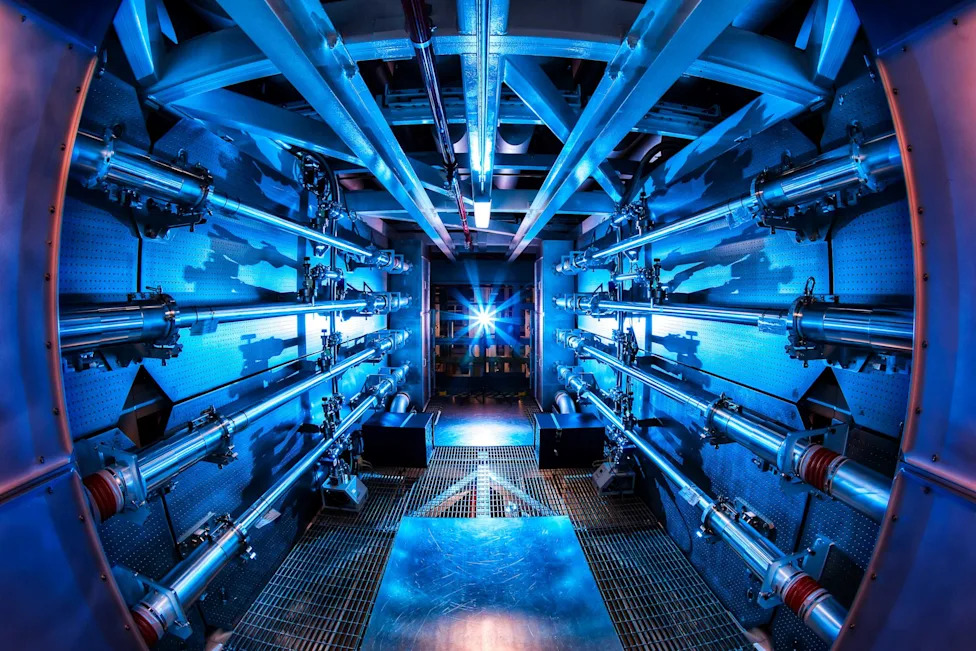
Cambridge Heavy’s reactor employs two primary lasers to initiate fusion. One laser splits into multiple beam lines, delivering light in concentric rings that strike a flat, round fuel target in timed succession. This sequential impact creates a compression wave that travels inwards, boosted by subsequent laser rings, intensifying the compression.
As this shock wave converges at the target’s core, another laser fires, generating intense heat and a magnetic field. This precise orchestration of pressure and heat makes fusion possible. The concept originated in Professor Keith Nelson’s lab at MIT, where researchers, including Dr. Kai, explored materials under extreme conditions using laser pulses, leading to the development of novel optical device manufacturing techniques.
The team realised they were approaching fusion-ready conditions as they intensified pressures. Their design generates pressures at the terapascal (TPa) level, a significant feat achieved with relatively low laser power. This method contrasts sharply with the National Ignition Facility (NIF), which required 192 laser beams for its breakthrough.
Addressing the Tritium Shortage
Cambridge Heavy Industries isn’t solely focused on long-term energy generation; its immediate goal is to address a critical bottleneck in the fusion industry: the scarcity of tritium. Tritium, a radioactive isotope of hydrogen, is the primary fuel for nearly all contemporary fusion reactor designs, yet it is exceedingly rare.
Estimates suggest only about 40 kilograms of tritium exist globally. With current prices around $30,000 per gram, or $30 million per kilogram, this scarcity poses a significant challenge. One study predicts a shortage of approximately 28 kilograms by 2054, valued at roughly $840 million, if new production sources aren’t established.
By producing tritium with its desktop fusion device, Cambridge Heavy Industries plans to create a vital revenue stream. This strategy enables the company to fund its ongoing research and development without waiting a decade or more for large-scale power plant deployment. Many fusion startups anticipate needing external tritium supplies for up to ten years until their reactors can become largely self-sufficient in fuel breeding.
From Benchtop Research to Future Power Plants
While tritium production offers an immediate commercial pathway, Cambridge Heavy Industries retains an ambitious long-term vision: generating sustainable electricity. The company aims to develop a full-scale power plant from its modular concept within a decade.
This future facility, though larger than the current benchtop prototype, is projected to be about the size of two basketball courts, a far cry from the sprawling complexes typically envisioned for fusion power.
The company’s mission statement, “Produce tritium today. Sustainable energy tomorrow,” encapsulates this two-pronged strategy. Their laser fusion machine is specifically designed to enhance density, temperature, and confinement time—the three components of the Lawson triple product, which collectively measure a fusion reactor’s efficiency. By improving all three, they seek to make fusion energy economically viable.
The Broader Fusion Landscape and Technological Edge
The fusion energy sector has seen significant developments, most notably the “scientific breakeven” achieved at the Lawrence Livermore National Laboratory’s (LLNL) National Ignition Facility (NIF) on December 5, 2022. NIF demonstrated that laser fusion could produce more energy than delivered to the fuel target, a major milestone. However, NIF’s 192 laser beams and massive scale highlight the engineering challenge of bringing fusion to commercial viability.
Cambridge Heavy Industries differentiates itself by focusing on compact, modular design and leveraging readily available components. Their system relies on off-the-shelf equipment, tapping into the mature laser and optics industry for its supply chain. This approach allows for scalability through parallelization, meaning multiple desktop units could operate concurrently to meet demand, akin to advanced physical AI robotics applications.
Founded in 2025 and based at 750 Main Street, Cambridge, Massachusetts, the company operates under a US regulatory framework that, since 2023, regulates fusion separately from nuclear fission. This streamlined regulatory path offers a clearer route for commercialization, supporting innovations like Cambridge Heavy’s desktop fusion device as it seeks to transform industrial power generation.
